

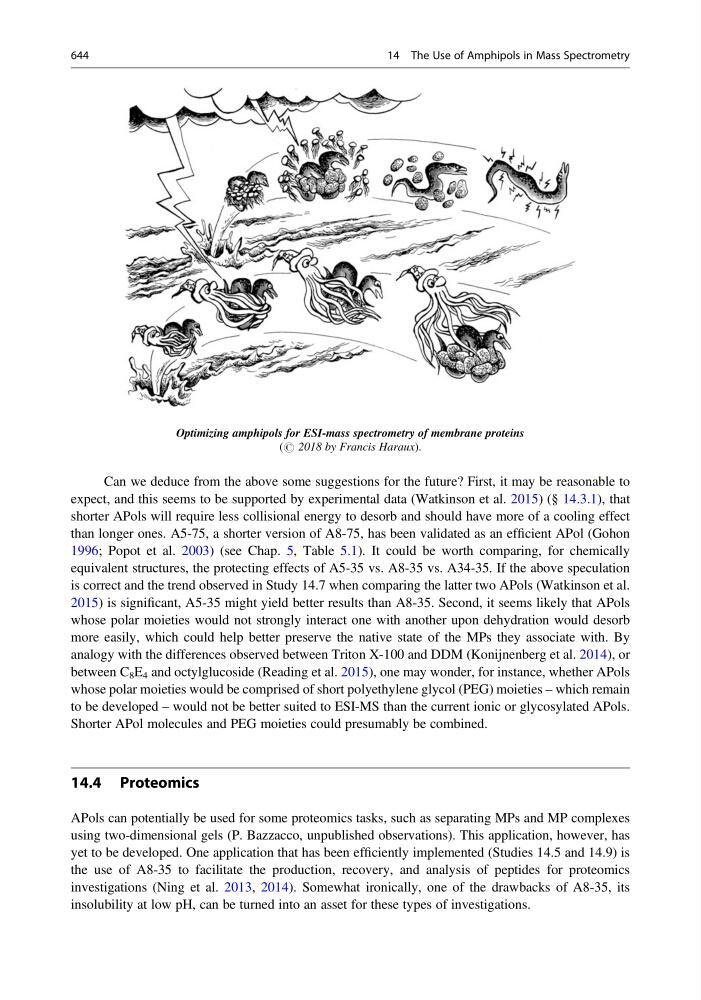
Optimizing amphipols for ESI-mass spectrometry of membrane proteins
(# 2018 by Francis Haraux).
Can we deduce from the above some suggestions for the future? First, it may be reasonable to
expect, and this seems to be supported by experimental data (Watkinson et al. 2015) (§ 14.3.1), that
shorter APols will require less collisional energy to desorb and should have more of a cooling effect
than longer ones. A5-75, a shorter version of A8-75, has been validated as an efficient APol (Gohon
1996; Popot et al. 2003) (see Chap. 5, Table 5.1). It could be worth comparing, for chemically
equivalent structures, the protecting effects of A5-35 vs. A8-35 vs. A34-35. If the above speculation
is correct and the trend observed in Study 14.7 when comparing the latter two APols (Watkinson et al.
2015) is significant, A5-35 might yield better results than A8-35. Second, it seems likely that APols
whose polar moieties would not strongly interact one with another upon dehydration would desorb
more easily, which could help better preserve the native state of the MPs they associate with. By
analogy with the differences observed between Triton X-100 and DDM (Konijnenberg et al. 2014), or
between C 8 E 4 and octylglucoside (Reading et al. 2015), one may wonder, for instance, whether APols
whose polar moieties would be comprised of short polyethylene glycol (PEG) moieties – which remain
to be developed – would not be better suited to ESI-MS than the current ionic or glycosylated APols.
Shorter APol molecules and PEG moieties could presumably be combined.
14.4 Proteomics
APols can potentially be used for some proteomics tasks, such as separating MPs and MP complexes
using two-dimensional gels (P. Bazzacco, unpublished observations). This application, however, has
yet to be developed. One application that has been efficiently implemented (Studies 14.5 and 14.9) is
the use of A8-35 to facilitate the production, recovery, and analysis of peptides for proteomics
investigations (Ning et al. 2013, 2014). Somewhat ironically, one of the drawbacks of A8-35, its
insolubility at low pH, can be turned into an asset for these types of investigations.
644
14 The Use of Amphipols in Mass Spectrometry