

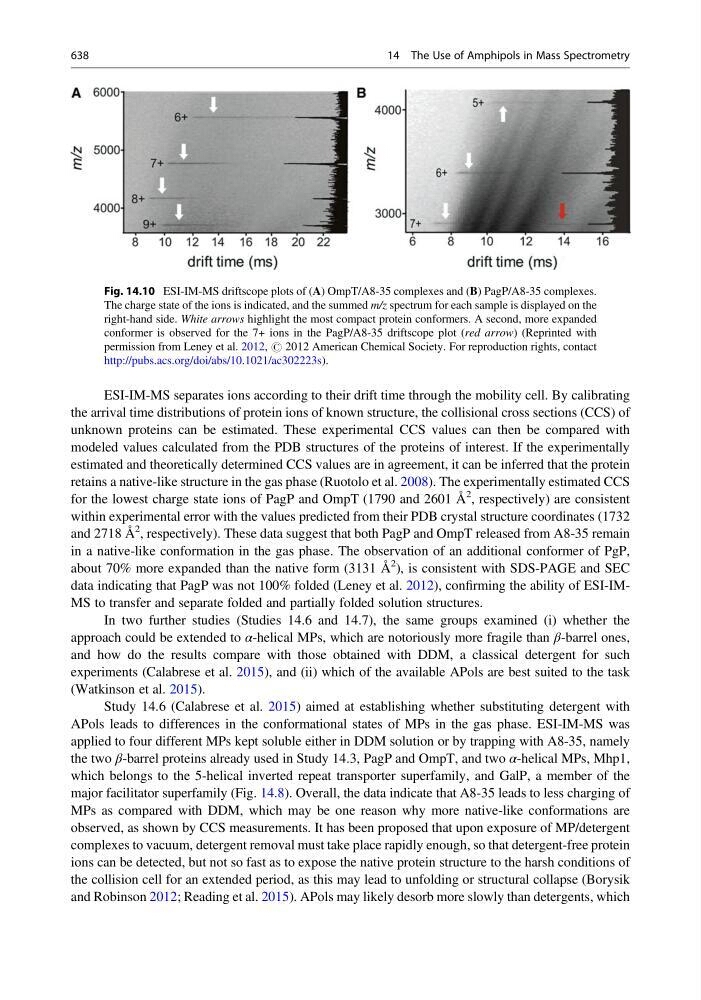
ESI-IM-MS separates ions according to their drift time through the mobility cell. By calibrating
the arrival time distributions of protein ions of known structure, the collisional cross sections (CCS) of
unknown proteins can be estimated. These experimental CCS values can then be compared with
modeled values calculated from the PDB structures of the proteins of interest. If the experimentally
estimated and theoretically determined CCS values are in agreement, it can be inferred that the protein
retains a native-like structure in the gas phase (Ruotolo et al. 2008). The experimentally estimated CCS
for the lowest charge state ions of PagP and OmpT (1790 and 2601 Å
2 , respectively) are consistent
within experimental error with the values predicted from their PDB crystal structure coordinates (1732
and 2718 Å
2 , respectively). These data suggest that both PagP and OmpT released from A8-35 remain
in a native-like conformation in the gas phase. The observation of an additional conformer of PgP,
about 70% more expanded than the native form (3131 Å
2 ), is consistent with SDS-PAGE and SEC
data indicating that PagP was not 100% folded (Leney et al. 2012), confirming the ability of ESI-IMMS to transfer and separate folded and partially folded solution structures.
In two further studies (Studies 14.6 and 14.7), the same groups examined (i) whether the
approach could be extended to α-helical MPs, which are notoriously more fragile than β-barrel ones,
and how do the results compare with those obtained with DDM, a classical detergent for such
experiments (Calabrese et al. 2015), and (ii) which of the available APols are best suited to the task
(Watkinson et al. 2015).
Study 14.6 (Calabrese et al. 2015) aimed at establishing whether substituting detergent with
APols leads to differences in the conformational states of MPs in the gas phase. ESI-IM-MS was
applied to four different MPs kept soluble either in DDM solution or by trapping with A8-35, namely
the two β-barrel proteins already used in Study 14.3, PagP and OmpT, and two α-helical MPs, Mhp1,
which belongs to the 5-helical inverted repeat transporter superfamily, and GalP, a member of the
major facilitator superfamily (Fig. 14.8). Overall, the data indicate that A8-35 leads to less charging of
MPs as compared with DDM, which may be one reason why more native-like conformations are
observed, as shown by CCS measurements. It has been proposed that upon exposure of MP/detergent
complexes to vacuum, detergent removal must take place rapidly enough, so that detergent-free protein
ions can be detected, but not so fast as to expose the native protein structure to the harsh conditions of
the collision cell for an extended period, as this may lead to unfolding or structural collapse (Borysik
and Robinson 2012; Reading et al. 2015). APols may likely desorb more slowly than detergents, which
Fig. 14.10 ESI-IM-MS driftscope plots of (A) OmpT/A8-35 complexes and (B) PagP/A8-35 complexes.
The charge state of the ions is indicated, and the summed m/z spectrum for each sample is displayed on the
right-hand side. White arrows highlight the most compact protein conformers. A second, more expanded
conformer is observed for the 7+ ions in the PagP/A8-35 driftscope plot (red arrow) (Reprinted with
permission from Leney et al. 2012, # 2012 American Chemical Society. For reproduction rights, contact
http://pubs.acs.org/doi/abs/10.1021/ac302223s).
638
14 The Use of Amphipols in Mass Spectrometry