

In a first study (Study 14.3), the acyl transferase PagP and the proteinase OmpT were trapped in
A8-35, and their functionality demonstrated by enzymatic measurements (Leney et al. 2012). Prior to
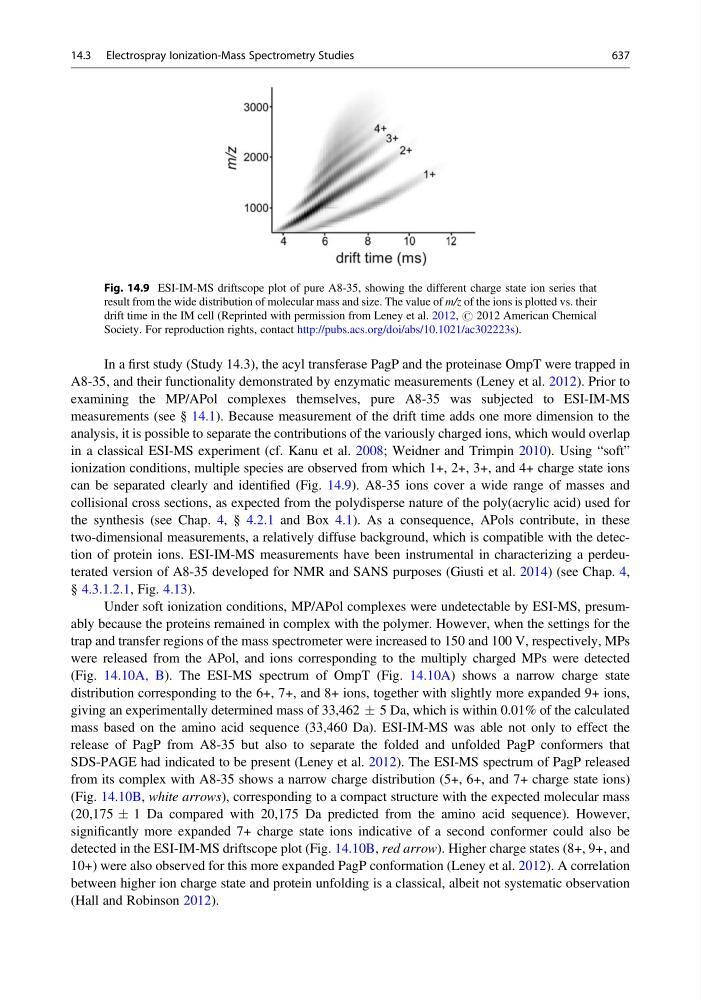
examining the MP/APol complexes themselves, pure A8-35 was subjected to ESI-IM-MS
measurements (see § 14.1). Because measurement of the drift time adds one more dimension to the
analysis, it is possible to separate the contributions of the variously charged ions, which would overlap
in a classical ESI-MS experiment (cf. Kanu et al. 2008; Weidner and Trimpin 2010). Using “soft”
ionization conditions, multiple species are observed from which 1+, 2+, 3+, and 4+ charge state ions
can be separated clearly and identified (Fig. 14.9). A8-35 ions cover a wide range of masses and
collisional cross sections, as expected from the polydisperse nature of the poly(acrylic acid) used for
the synthesis (see Chap. 4, § 4.2.1 and Box 4.1). As a consequence, APols contribute, in these
two-dimensional measurements, a relatively diffuse background, which is compatible with the detection of protein ions. ESI-IM-MS measurements have been instrumental in characterizing a perdeuterated version of A8-35 developed for NMR and SANS purposes (Giusti et al. 2014) (see Chap. 4,
§ 4.3.1.2.1, Fig. 4.13).
Under soft ionization conditions, MP/APol complexes were undetectable by ESI-MS, presumably because the proteins remained in complex with the polymer. However, when the settings for the
trap and transfer regions of the mass spectrometer were increased to 150 and 100 V, respectively, MPs
were released from the APol, and ions corresponding to the multiply charged MPs were detected
(Fig. 14.10A, B). The ESI-MS spectrum of OmpT (Fig. 14.10A) shows a narrow charge state
distribution corresponding to the 6+, 7+, and 8+ ions, together with slightly more expanded 9+ ions,
giving an experimentally determined mass of 33,462 Æ 5 Da, which is within 0.01% of the calculated
mass based on the amino acid sequence (33,460 Da). ESI-IM-MS was able not only to effect the
release of PagP from A8-35 but also to separate the folded and unfolded PagP conformers that
SDS-PAGE had indicated to be present (Leney et al. 2012). The ESI-MS spectrum of PagP released
from its complex with A8-35 shows a narrow charge distribution (5+, 6+, and 7+ charge state ions)
(Fig. 14.10B, white arrows), corresponding to a compact structure with the expected molecular mass
(20,175 Æ 1 Da compared with 20,175 Da predicted from the amino acid sequence). However,
significantly more expanded 7+ charge state ions indicative of a second conformer could also be
detected in the ESI-IM-MS driftscope plot (Fig. 14.10B, red arrow). Higher charge states (8+, 9+, and
10+) were also observed for this more expanded PagP conformation (Leney et al. 2012). A correlation
between higher ion charge state and protein unfolding is a classical, albeit not systematic observation
(Hall and Robinson 2012).
Fig. 14.9 ESI-IM-MS driftscope plot of pure A8-35, showing the different charge state ion series that
result from the wide distribution of molecular mass and size. The value of m/z of the ions is plotted vs. their
drift time in the IM cell (Reprinted with permission from Leney et al. 2012, # 2012 American Chemical
Society. For reproduction rights, contact http://pubs.acs.org/doi/abs/10.1021/ac302223s).
14.3 Electrospray Ionization-Mass Spectrometry Studies
637