

Robinson 2011; Whitelegge 2013; Konijnenberg et al. 2015; Mehmood et al. 2015; Rajabi et al. 2015;
Marty et al. 2016b). MS practitioners distinguish “top-down” experiments, in which the protein or
complex under study is first transferred intact (or as intact as possible) to vacuum, and can subsequently be more or less drastically fragmented, and “bottom-up” experiments, in which the target,
which can be a whole proteome, is first proteolytically or chemically cut into peptides, which can be
further fragmented inside the spectrometer in tandem (MS/MS) experiments and whose identification
leads to that of the proteins they derive from, as well as to an examination of their posttranslational
modifications (see e.g. Mann and Jensen 2003). The use of MP/amphipol (APol) complexes has been
validated in both configurations.
MS relies on measuring the mass of positively or negatively charged ions derived from the
molecules or fragments under study. A critical step is to transfer the targets from their original
environment, typically an aqueous solution supplemented or not with surfactants, to a gas phase,
under the form of molecular ions carrying one or several charges. The ions are then accelerated in a
vacuum chamber, and the ratio of their mass m to their charge z is measured.
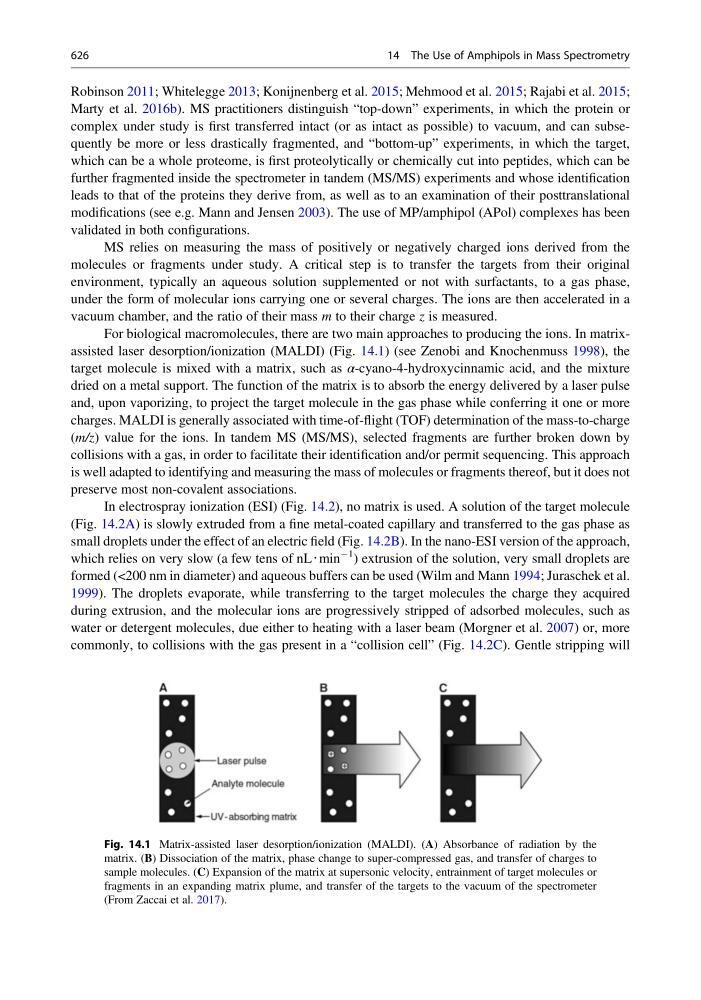
For biological macromolecules, there are two main approaches to producing the ions. In matrixassisted laser desorption/ionization (MALDI) (Fig. 14.1) (see Zenobi and Knochenmuss 1998), the
target molecule is mixed with a matrix, such as α-cyano-4-hydroxycinnamic acid, and the mixture
dried on a metal support. The function of the matrix is to absorb the energy delivered by a laser pulse
and, upon vaporizing, to project the target molecule in the gas phase while conferring it one or more
charges. MALDI is generally associated with time-of-flight (TOF) determination of the mass-to-charge
(m/z) value for the ions. In tandem MS (MS/MS), selected fragments are further broken down by
collisions with a gas, in order to facilitate their identification and/or permit sequencing. This approach
is well adapted to identifying and measuring the mass of molecules or fragments thereof, but it does not
preserve most non-covalent associations.
In electrospray ionization (ESI) (Fig. 14.2), no matrix is used. A solution of the target molecule
(Fig. 14.2A) is slowly extruded from a fine metal-coated capillary and transferred to the gas phase as
small droplets under the effect of an electric field (Fig. 14.2B). In the nano-ESI version of the approach,
which relies on very slow (a few tens of nL‧min
À1 ) extrusion of the solution, very small droplets are
formed (<200 nm in diameter) and aqueous buffers can be used (Wilm and Mann 1994; Juraschek et al.
1999). The droplets evaporate, while transferring to the target molecules the charge they acquired
during extrusion, and the molecular ions are progressively stripped of adsorbed molecules, such as
water or detergent molecules, due either to heating with a laser beam (Morgner et al. 2007) or, more
commonly, to collisions with the gas present in a “collision cell” (Fig. 14.2C). Gentle stripping will
Fig. 14.1 Matrix-assisted laser desorption/ionization (MALDI). (A) Absorbance of radiation by the
matrix. (B) Dissociation of the matrix, phase change to super-compressed gas, and transfer of charges to
sample molecules. (C) Expansion of the matrix at supersonic velocity, entrainment of target molecules or
fragments in an expanding matrix plume, and transfer of the targets to the vacuum of the spectrometer
(From Zaccai et al. 2017).
626
14 The Use of Amphipols in Mass Spectrometry