

A8-35 in good yield turned out to be a difficult and frustrating endeavor. Sulfides, which are
chemically much easier to handle and also adsorb onto gold or silver surfaces, albeit with a lower
affinity (see e.g. Troughton et al. 1988; Lenk et al. 1993; Beulen et al. 1996; Jung et al. 1998; Lim et al.
2006), offer an interesting alternative.
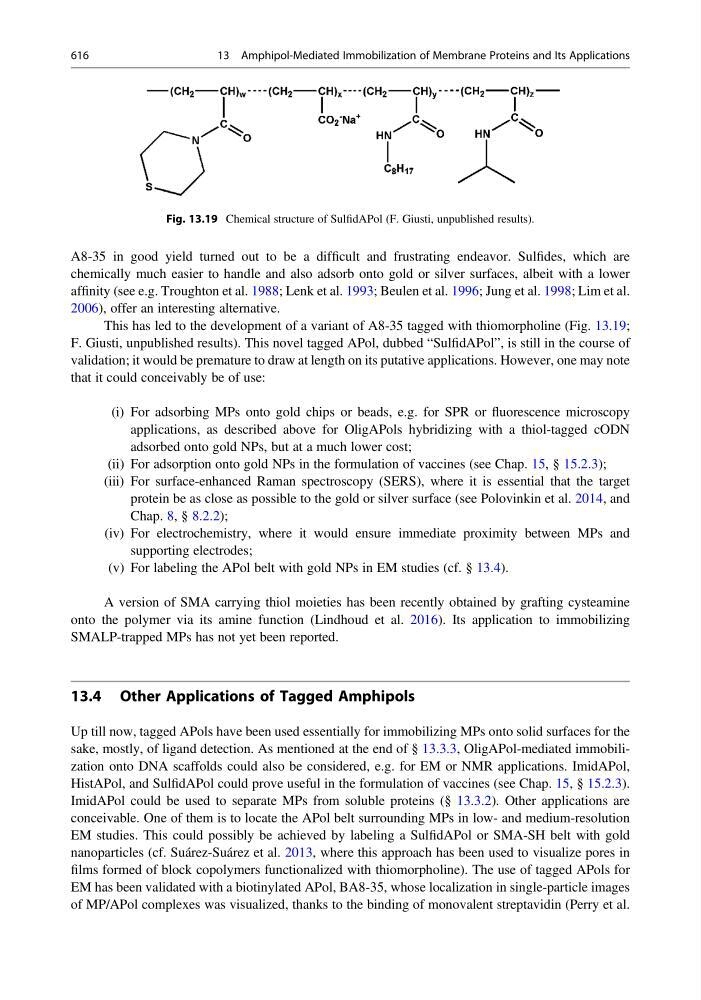
This has led to the development of a variant of A8-35 tagged with thiomorpholine (Fig. 13.19;
F. Giusti, unpublished results). This novel tagged APol, dubbed “SulfidAPol”, is still in the course of
validation; it would be premature to draw at length on its putative applications. However, one may note
that it could conceivably be of use:
(i) For adsorbing MPs onto gold chips or beads, e.g. for SPR or fluorescence microscopy
applications, as described above for OligAPols hybridizing with a thiol-tagged cODN
adsorbed onto gold NPs, but at a much lower cost;
(ii) For adsorption onto gold NPs in the formulation of vaccines (see Chap. 15, § 15.2.3);
(iii) For surface-enhanced Raman spectroscopy (SERS), where it is essential that the target
protein be as close as possible to the gold or silver surface (see Polovinkin et al. 2014, and
Chap. 8, § 8.2.2);
(iv) For electrochemistry, where it would ensure immediate proximity between MPs and
supporting electrodes;
(v) For labeling the APol belt with gold NPs in EM studies (cf. § 13.4).
A version of SMA carrying thiol moieties has been recently obtained by grafting cysteamine
onto the polymer via its amine function (Lindhoud et al. 2016). Its application to immobilizing
SMALP-trapped MPs has not yet been reported.
13.4 Other Applications of Tagged Amphipols
Up till now, tagged APols have been used essentially for immobilizing MPs onto solid surfaces for the
sake, mostly, of ligand detection. As mentioned at the end of § 13.3.3, OligAPol-mediated immobilization onto DNA scaffolds could also be considered, e.g. for EM or NMR applications. ImidAPol,
HistAPol, and SulfidAPol could prove useful in the formulation of vaccines (see Chap. 15, § 15.2.3).
ImidAPol could be used to separate MPs from soluble proteins (§ 13.3.2). Other applications are
conceivable. One of them is to locate the APol belt surrounding MPs in low- and medium-resolution
EM studies. This could possibly be achieved by labeling a SulfidAPol or SMA-SH belt with gold
nanoparticles (cf. Suárez-Suárez et al. 2013, where this approach has been used to visualize pores in
films formed of block copolymers functionalized with thiomorpholine). The use of tagged APols for
EM has been validated with a biotinylated APol, BA8-35, whose localization in single-particle images
of MP/APol complexes was visualized, thanks to the binding of monovalent streptavidin (Perry et al.
Fig. 13.19 Chemical structure of SulfidAPol (F. Giusti, unpublished results).
616
13 Amphipol-Mediated Immobilization of Membrane Proteins and Its Applications