

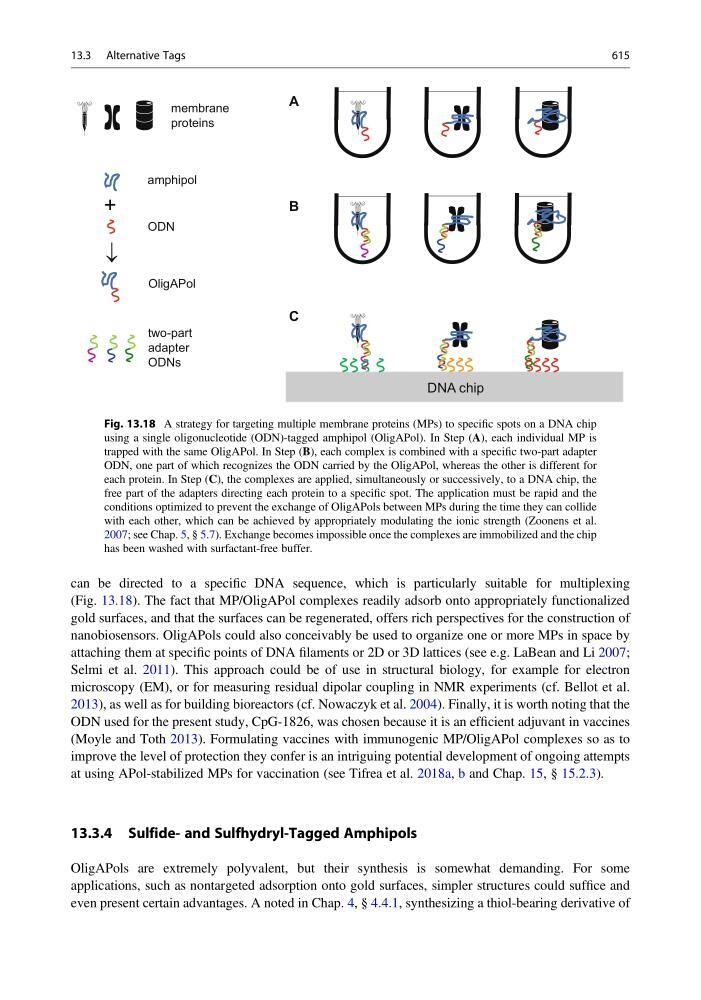
can be directed to a specific DNA sequence, which is particularly suitable for multiplexing
(Fig. 13.18). The fact that MP/OligAPol complexes readily adsorb onto appropriately functionalized
gold surfaces, and that the surfaces can be regenerated, offers rich perspectives for the construction of
nanobiosensors. OligAPols could also conceivably be used to organize one or more MPs in space by
attaching them at specific points of DNA filaments or 2D or 3D lattices (see e.g. LaBean and Li 2007;
Selmi et al. 2011). This approach could be of use in structural biology, for example for electron
microscopy (EM), or for measuring residual dipolar coupling in NMR experiments (cf. Bellot et al.
2013), as well as for building bioreactors (cf. Nowaczyk et al. 2004). Finally, it is worth noting that the
ODN used for the present study, CpG-1826, was chosen because it is an efficient adjuvant in vaccines
(Moyle and Toth 2013). Formulating vaccines with immunogenic MP/OligAPol complexes so as to
improve the level of protection they confer is an intriguing potential development of ongoing attempts
at using APol-stabilized MPs for vaccination (see Tifrea et al. 2018a, b and Chap. 15, § 15.2.3).
13.3.4 Sulfide- and Sulfhydryl-Tagged Amphipols
OligAPols are extremely polyvalent, but their synthesis is somewhat demanding. For some
applications, such as nontargeted adsorption onto gold surfaces, simpler structures could suffice and
even present certain advantages. A noted in Chap. 4, § 4.4.1, synthesizing a thiol-bearing derivative of
A
B
C
membrane
proteins
amphipol
ODN
OligAPol
two-part
adapter
ODNs
DNA chip
+
↓
Fig. 13.18 A strategy for targeting multiple membrane proteins (MPs) to specific spots on a DNA chip
using a single oligonucleotide (ODN)-tagged amphipol (OligAPol). In Step (A), each individual MP is
trapped with the same OligAPol. In Step (B), each complex is combined with a specific two-part adapter
ODN, one part of which recognizes the ODN carried by the OligAPol, whereas the other is different for
each protein. In Step (C), the complexes are applied, simultaneously or successively, to a DNA chip, the
free part of the adapters directing each protein to a specific spot. The application must be rapid and the
conditions optimized to prevent the exchange of OligAPols between MPs during the time they can collide
with each other, which can be achieved by appropriately modulating the ionic strength (Zoonens et al.
2007; see Chap. 5, § 5.7). Exchange becomes impossible once the complexes are immobilized and the chip
has been washed with surfactant-free buffer.
13.3 Alternative Tags
615