

Some interesting additional observations were made in the course of Study 13.1. In particular:
(i) Removing free BA8-35 from the trapped preparations, which suppresses the competition
between MP/BA8-35 complexes and free BA8-35 particles for binding to SA, results, as
expected, in increasing the protein fraction in the material adsorbed and, thereby, the signalto-noise ratio observed upon challenging the chip with antibodies.
(ii) Despite a lower signal-to-noise ratio, specific recognition of antibodies can also be observed
with crude sera.
(iii) The fact that A8-35 is insoluble in acidic solutions (Chap. 4, § 4.3) does not prevent
regenerating chips carrying BA8-35-immobilized PMs by washing away PM-bound
antibodies at pH 2.2 (Charvolin et al. 2009).
The functionality of immobilized MPs was tested on BR and the nAChR. The photocycle of
A8-35-trapped BR was examined using BR trapped with BA8-35 and adsorbed onto SA-coated beads.
Its kinetics were found to be undistinguishable from those of BR trapped in untagged A8-35 and kept
free in solution. Comparison of the amplitude of the photo-induced signals measured before and after
separation of free from immobilized BR showed the immobilization yield to be 70–75% (Charvolin
et al. 2009).
The nAChR was solubilized with CHAPS from postsynaptic membranes of T. marmorata
electric organs, purified, and trapped with a mixture of BA8-35 and A8-35 as described for
non-functionalized A8-35 (Martinez et al. 2002), conditions under which the nAChR is known to
remain functional (see Chap. 5, § 5.4). Free APols were removed by size exclusion chromatography
(SEC), and the nAChR/APol complexes immobilized onto SA-coated beads. The binding kinetics of
α-bungarotoxin (α-Bgt) fluorescently labeled with Alexa Fluor 647 (α-Bgt-647) was monitored by
confocal fluorescence microscopy. In the absence of nAChR, or in the presence of an excess of
nonfluorescent α-Bgt, no fluorescence signal was detected at the bead surface (Fig.13.4A, lower
panels), whereas an intense signal appeared when α-Bgt-647 was added to beads preincubated with
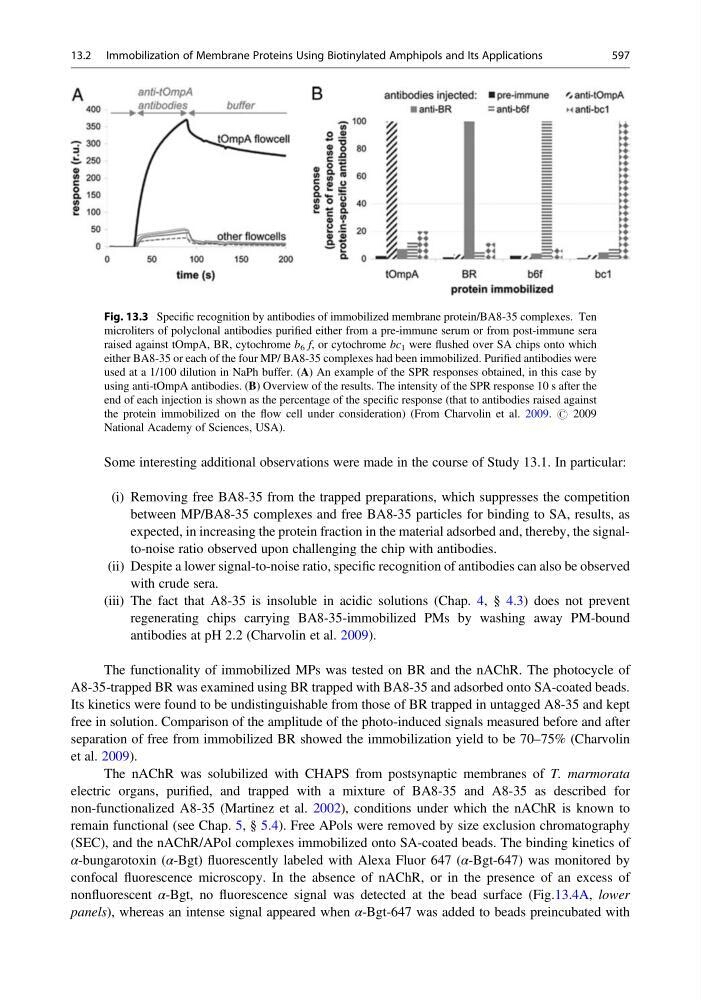
Fig. 13.3 Specific recognition by antibodies of immobilized membrane protein/BA8-35 complexes. Ten
microliters of polyclonal antibodies purified either from a pre-immune serum or from post-immune sera
raised against tOmpA, BR, cytochrome b 6 f, or cytochrome bc 1 were flushed over SA chips onto which
either BA8-35 or each of the four MP/ BA8-35 complexes had been immobilized. Purified antibodies were
used at a 1/100 dilution in NaPh buffer. (A) An example of the SPR responses obtained, in this case by
using anti-tOmpA antibodies. (B) Overview of the results. The intensity of the SPR response 10 s after the
end of each injection is shown as the percentage of the specific response (that to antibodies raised against
the protein immobilized on the flow cell under consideration) (From Charvolin et al. 2009. # 2009
National Academy of Sciences, USA).
13.2 Immobilization of Membrane Proteins Using Biotinylated Amphipols and Its Applications
597