

13.2 Immobilization of Membrane Proteins Using Biotinylated Amphipols
and Its Applications
13.2.1 Validation of the Approach Using Biotinylated A8-35
Biotinylated A8-35 (hereafter, BAPol or BA8-35) was synthesized as described in Chap. 4, § 4.4.1
(Charvolin et al. 2009). The feasibility of using it for immobilizing MPs onto solid supports was
established in Study 13.1 (Table 13.1), using five model MPs, namely bacteriorhodopsin (BR) from
Halobacterium salinarum (described in Chap. 1, § 1.6.1), the nicotinic acetylcholine receptor
(nAChR) from Torpedo marmorata (Chap. 1, § 1.6.2), the cytochrome b 6 f complex from
Chlamydomonas reinhardtii (Pierre et al. 1995; Stroebel et al. 2003), beef heart cytochrome bc 1
complex (Berry et al. 2000), and the transmembrane (TM) domain of Escherichia coli outer membrane
protein A (tOmpA) (Pautsch and Schulz 2000; Pervushin et al. 2000; Arora et al. 2001). Each of these
proteins is known to remain functional (or, in the case of tOmpA, to retain its native conformation)
following trapping with A8-35 (see Chap. 5, § 5.4, and Chap. 10, § 10.3.1).
Each protein was trapped with an excess of BA8-35. The resulting preparations therefore
comprised a mixture of MP/BA8-35 complexes and free BA8-35 particles. Upon flushing SA-coated
chips either with BA8-35 alone (Fig. 13.2A) or with any of the MP/BA8-35 preparations (Fig. 13.2B,
C), an SPR signal developed, a large fraction of which resisted washing with buffer. As observed with
pure APols (Fig. 13.2A), SPR signals were much higher for MP/BA8-35 complexes than observed for
the same MP trapped with underivatized A8-35, indicative of biotin-mediated immobilization
(Fig. 13.2B, C). For comparative purposes, injections of the four proteins were carried out at constant
overall APol concentration. For the two small MPs (tOmpA and BR), where the overall protein/
polymer mass ratio in the preparation is relatively low (0.2:1 and 0.25:1, respectively), the SPR signal
was comparable (Fig. 13.2C) and close to that observed with pure BA8-35; for larger complexes
(b 6 f and bc 1 , PM/BA8-35 % 1:3 and 1:1.5 w/w, respectively), it was significantly higher (Fig. 13.2C),
strongly suggesting that the protein contributed to the signal.
The presence of the four MPs on the chips and their ability to recognize specific ligands were
demonstrated using protein-specific antibodies. Antisera were raised in rabbits against each target
protein and the IgG fraction purified by affinity chromatography. After saturating non-specific binding
sites with pre-immune antibodies, each flow cell was flushed with either pre-immune or proteinspecific antibodies at several dilutions. Strong, specific responses were obtained at 1/100 dilution
membrane
protein
detergent
complementary
surface
ligand
1
2
3
4
antibody
functionalized
amphipol
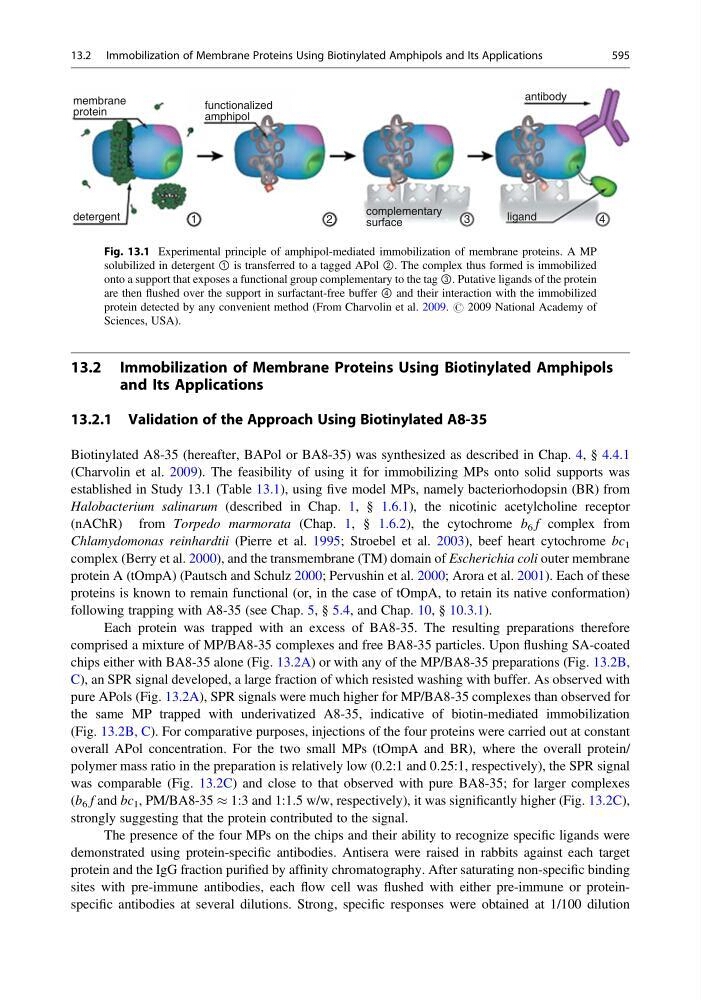
Fig. 13.1 Experimental principle of amphipol-mediated immobilization of membrane proteins. A MP
solubilized in detergent ① is transferred to a tagged APol ②. The complex thus formed is immobilized
onto a support that exposes a functional group complementary to the tag ③. Putative ligands of the protein
are then flushed over the support in surfactant-free buffer ④ and their interaction with the immobilized
protein detected by any convenient method (From Charvolin et al. 2009. # 2009 National Academy of
Sciences, USA).
13.2 Immobilization of Membrane Proteins Using Biotinylated Amphipols and Its Applications
595