

11.3.3 Challenges and Prospects
The general impression one derives from the data analyzed in this chapter is that, whereas APols to
date have not permitted to solve any new crystallographic MP structure, they may hold an interesting
potential that is only starting to be investigated:
1. Experiments with cytochrome bc 1 /A8-35 complexes have led to the conclusion that A8-35
itself is unlikely to lead to the formation of crystals of binary MP/APol complexes, but that it
can be used in ternary MP/APol/detergent complexes, in which the APol may represent as
much as half the mass of the protein-bound surfactant, and that these complexes can
crystallize. It is much to be regretted that circumstances made it impossible to establish up
to which resolution such crystals can be made to diffract. Current results, however, suggest
that APols, because they can be stabilizing even when used in mixtures with detergents, could
be tentatively used as additives to stabilize MPs that are too unstable in solutions of pure
detergent to yield good-quality crystals.
2. The same experiments strongly suggest that traces of APols, even of charged APols such as
A8-35, can be tolerated in solutions used for crystallization of MP/detergent complexes. This
implies that preparations of APol-trapped MPs can be transferred to detergent solutions for
the purpose of crystallization without the need for an extensive removal of traces of APols.
BR/lipids/APol
complexes
+
Pn3m lipid
mesophase
Crystallization
in meso
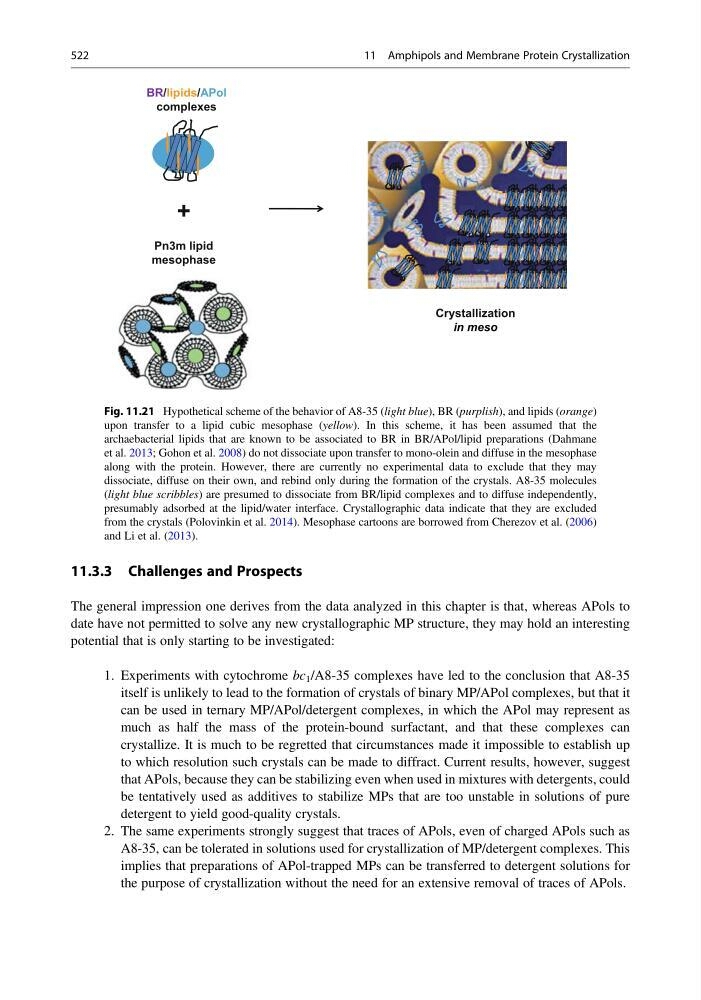
Fig. 11.21 Hypothetical scheme of the behavior of A8-35 (light blue), BR (purplish), and lipids (orange)
upon transfer to a lipid cubic mesophase (yellow). In this scheme, it has been assumed that the
archaebacterial lipids that are known to be associated to BR in BR/APol/lipid preparations (Dahmane
et al. 2013; Gohon et al. 2008) do not dissociate upon transfer to mono-olein and diffuse in the mesophase
along with the protein. However, there are currently no experimental data to exclude that they may
dissociate, diffuse on their own, and rebind only during the formation of the crystals. A8-35 molecules
(light blue scribbles) are presumed to dissociate from BR/lipid complexes and to diffuse independently,
presumably adsorbed at the lipid/water interface. Crystallographic data indicate that they are excluded
from the crystals (Polovinkin et al. 2014). Mesophase cartoons are borrowed from Cherezov et al. (2006)
and Li et al. (2013).
522
11 Amphipols and Membrane Protein Crystallization
The general impression one derives from the data analyzed in this chapter is that, whereas APols to
date have not permitted to solve any new crystallographic MP structure, they may hold an interesting
potential that is only starting to be investigated:
1. Experiments with cytochrome bc 1 /A8-35 complexes have led to the conclusion that A8-35
itself is unlikely to lead to the formation of crystals of binary MP/APol complexes, but that it
can be used in ternary MP/APol/detergent complexes, in which the APol may represent as
much as half the mass of the protein-bound surfactant, and that these complexes can
crystallize. It is much to be regretted that circumstances made it impossible to establish up
to which resolution such crystals can be made to diffract. Current results, however, suggest
that APols, because they can be stabilizing even when used in mixtures with detergents, could
be tentatively used as additives to stabilize MPs that are too unstable in solutions of pure
detergent to yield good-quality crystals.
2. The same experiments strongly suggest that traces of APols, even of charged APols such as
A8-35, can be tolerated in solutions used for crystallization of MP/detergent complexes. This
implies that preparations of APol-trapped MPs can be transferred to detergent solutions for
the purpose of crystallization without the need for an extensive removal of traces of APols.
BR/lipids/APol
complexes
+
Pn3m lipid
mesophase
Crystallization
in meso
Fig. 11.21 Hypothetical scheme of the behavior of A8-35 (light blue), BR (purplish), and lipids (orange)
upon transfer to a lipid cubic mesophase (yellow). In this scheme, it has been assumed that the
archaebacterial lipids that are known to be associated to BR in BR/APol/lipid preparations (Dahmane
et al. 2013; Gohon et al. 2008) do not dissociate upon transfer to mono-olein and diffuse in the mesophase
along with the protein. However, there are currently no experimental data to exclude that they may
dissociate, diffuse on their own, and rebind only during the formation of the crystals. A8-35 molecules
(light blue scribbles) are presumed to dissociate from BR/lipid complexes and to diffuse independently,
presumably adsorbed at the lipid/water interface. Crystallographic data indicate that they are excluded
from the crystals (Polovinkin et al. 2014). Mesophase cartoons are borrowed from Cherezov et al. (2006)
and Li et al. (2013).
522
11 Amphipols and Membrane Protein Crystallization