

• As described above (Chap. 6; for reviews, see Kleinschmidt and Popot 2014; Popot 2014;
Zoonens and Popot 2014), APol-assisted folding has been extended to many other MPs,
among which the pharmacologically important class of GPCRs.
• BR is a classical model for MP studies and has been instrumental in the development of MP
crystallization in detergent solution (Michel and Oesterhelt 1980; Michel 1982), in lipidic
mesophases (Landau and Rosenbusch 1996; Takeda et al. 1998), or from bicelles (Faham and
Bowie 2002; see Chap. 3, § 3.2.2).
In Study 11.4, the laboratory of Valentin Gordeliy used BR/A8-35 complexes to develop an
approach for crystallizing APol-trapped MPs by direct transfer to a lipidic mesophase.
Following solubilization of H. salinarum purple membrane with OG, BR was trapped in A8-35,
along with archaebacterial lipids, using a ~2.5Â excess of APol over the amount that actually binds to
the protein (Gohon et al. 2008). Crystallization attempts were carried out at 20
C either in the presence
or after removal of the excess APol. Experiments in which the crude sample, containing free APol, was
mixed directly with mono-olein (MO) did not yield any high-quality crystals. On the contrary, after
1. Transfer to
detergent
MP/APol
complex
MP/detergent
complex
MP/APol/
detergent
ternary
complex
Crystallize in
detergent
solution
Crystallize in
APol/detergent
solution
2. Supplement
with detergent
3. Transfer to
lipidic
mesophase
Crystallize
in meso
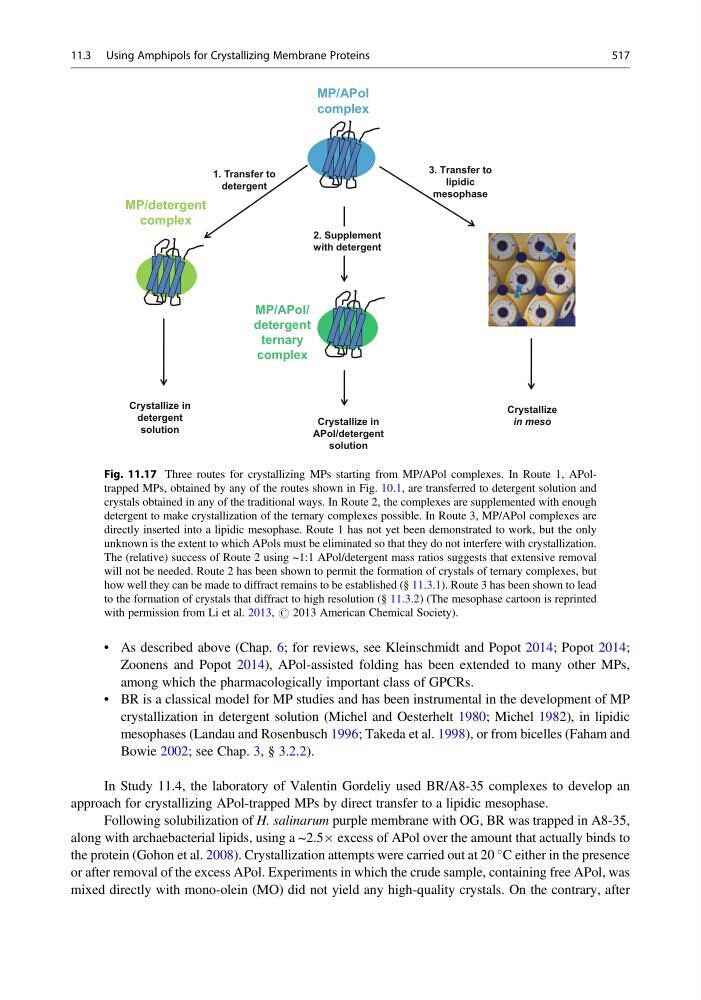
Fig. 11.17 Three routes for crystallizing MPs starting from MP/APol complexes. In Route 1, APoltrapped MPs, obtained by any of the routes shown in Fig. 10.1, are transferred to detergent solution and
crystals obtained in any of the traditional ways. In Route 2, the complexes are supplemented with enough
detergent to make crystallization of the ternary complexes possible. In Route 3, MP/APol complexes are
directly inserted into a lipidic mesophase. Route 1 has not yet been demonstrated to work, but the only
unknown is the extent to which APols must be eliminated so that they do not interfere with crystallization.
The (relative) success of Route 2 using ~1:1 APol/detergent mass ratios suggests that extensive removal
will not be needed. Route 2 has been shown to permit the formation of crystals of ternary complexes, but
how well they can be made to diffract remains to be established (§ 11.3.1). Route 3 has been shown to lead
to the formation of crystals that diffract to high resolution (§ 11.3.2) (The mesophase cartoon is reprinted
with permission from Li et al. 2013, # 2013 American Chemical Society).
11.3 Using Amphipols for Crystallizing Membrane Proteins
517
Zoonens and Popot 2014), APol-assisted folding has been extended to many other MPs,
among which the pharmacologically important class of GPCRs.
• BR is a classical model for MP studies and has been instrumental in the development of MP
crystallization in detergent solution (Michel and Oesterhelt 1980; Michel 1982), in lipidic
mesophases (Landau and Rosenbusch 1996; Takeda et al. 1998), or from bicelles (Faham and
Bowie 2002; see Chap. 3, § 3.2.2).
In Study 11.4, the laboratory of Valentin Gordeliy used BR/A8-35 complexes to develop an
approach for crystallizing APol-trapped MPs by direct transfer to a lipidic mesophase.
Following solubilization of H. salinarum purple membrane with OG, BR was trapped in A8-35,
along with archaebacterial lipids, using a ~2.5Â excess of APol over the amount that actually binds to
the protein (Gohon et al. 2008). Crystallization attempts were carried out at 20
C either in the presence
or after removal of the excess APol. Experiments in which the crude sample, containing free APol, was
mixed directly with mono-olein (MO) did not yield any high-quality crystals. On the contrary, after
1. Transfer to
detergent
MP/APol
complex
MP/detergent
complex
MP/APol/
detergent
ternary
complex
Crystallize in
detergent
solution
Crystallize in
APol/detergent
solution
2. Supplement
with detergent
3. Transfer to
lipidic
mesophase
Crystallize
in meso
Fig. 11.17 Three routes for crystallizing MPs starting from MP/APol complexes. In Route 1, APoltrapped MPs, obtained by any of the routes shown in Fig. 10.1, are transferred to detergent solution and
crystals obtained in any of the traditional ways. In Route 2, the complexes are supplemented with enough
detergent to make crystallization of the ternary complexes possible. In Route 3, MP/APol complexes are
directly inserted into a lipidic mesophase. Route 1 has not yet been demonstrated to work, but the only
unknown is the extent to which APols must be eliminated so that they do not interfere with crystallization.
The (relative) success of Route 2 using ~1:1 APol/detergent mass ratios suggests that extensive removal
will not be needed. Route 2 has been shown to permit the formation of crystals of ternary complexes, but
how well they can be made to diffract remains to be established (§ 11.3.1). Route 3 has been shown to lead
to the formation of crystals that diffract to high resolution (§ 11.3.2) (The mesophase cartoon is reprinted
with permission from Li et al. 2013, # 2013 American Chemical Society).
11.3 Using Amphipols for Crystallizing Membrane Proteins
517