

e.g. Page et al. 2006; Poget and Girvin 2007; Kim et al. 2009; Raschle et al. 2010; Kang and Li 2011;
Nietlispach and Gautier 2011; Qureshi and Goto 2011; Tapaneeyakorn et al. 2011; Warschawski et al.
2011; Catoire et al. 2014; Mineev and Nadezhdin 2017; Opella and Marassi 2017). Only a brief
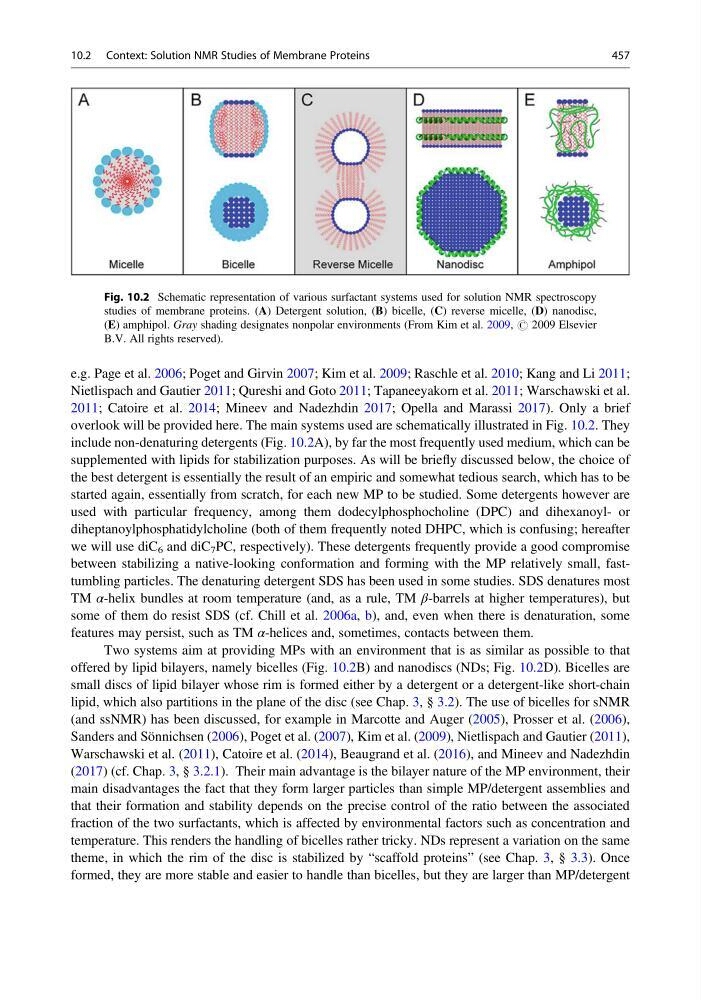
overlook will be provided here. The main systems used are schematically illustrated in Fig. 10.2. They
include non-denaturing detergents (Fig. 10.2A), by far the most frequently used medium, which can be
supplemented with lipids for stabilization purposes. As will be briefly discussed below, the choice of
the best detergent is essentially the result of an empiric and somewhat tedious search, which has to be
started again, essentially from scratch, for each new MP to be studied. Some detergents however are
used with particular frequency, among them dodecylphosphocholine (DPC) and dihexanoyl- or
diheptanoylphosphatidylcholine (both of them frequently noted DHPC, which is confusing; hereafter
we will use diC 6 and diC 7 PC, respectively). These detergents frequently provide a good compromise
between stabilizing a native-looking conformation and forming with the MP relatively small, fasttumbling particles. The denaturing detergent SDS has been used in some studies. SDS denatures most
TM α-helix bundles at room temperature (and, as a rule, TM β-barrels at higher temperatures), but
some of them do resist SDS (cf. Chill et al. 2006a, b), and, even when there is denaturation, some
features may persist, such as TM α-helices and, sometimes, contacts between them.
Two systems aim at providing MPs with an environment that is as similar as possible to that
offered by lipid bilayers, namely bicelles (Fig. 10.2B) and nanodiscs (NDs; Fig. 10.2D). Bicelles are
small discs of lipid bilayer whose rim is formed either by a detergent or a detergent-like short-chain
lipid, which also partitions in the plane of the disc (see Chap. 3, § 3.2). The use of bicelles for sNMR
(and ssNMR) has been discussed, for example in Marcotte and Auger (2005), Prosser et al. (2006),
Sanders and Sönnichsen (2006), Poget et al. (2007), Kim et al. (2009), Nietlispach and Gautier (2011),
Warschawski et al. (2011), Catoire et al. (2014), Beaugrand et al. (2016), and Mineev and Nadezhdin
(2017) (cf. Chap. 3, § 3.2.1). Their main advantage is the bilayer nature of the MP environment, their
main disadvantages the fact that they form larger particles than simple MP/detergent assemblies and
that their formation and stability depends on the precise control of the ratio between the associated
fraction of the two surfactants, which is affected by environmental factors such as concentration and
temperature. This renders the handling of bicelles rather tricky. NDs represent a variation on the same
theme, in which the rim of the disc is stabilized by “scaffold proteins” (see Chap. 3, § 3.3). Once
formed, they are more stable and easier to handle than bicelles, but they are larger than MP/detergent
Fig. 10.2 Schematic representation of various surfactant systems used for solution NMR spectroscopy
studies of membrane proteins. (A) Detergent solution, (B) bicelle, (C) reverse micelle, (D) nanodisc,
(E) amphipol. Gray shading designates nonpolar environments (From Kim et al. 2009, # 2009 Elsevier
B.V. All rights reserved).
10.2 Context: Solution NMR Studies of Membrane Proteins
457
Nietlispach and Gautier 2011; Qureshi and Goto 2011; Tapaneeyakorn et al. 2011; Warschawski et al.
2011; Catoire et al. 2014; Mineev and Nadezhdin 2017; Opella and Marassi 2017). Only a brief
overlook will be provided here. The main systems used are schematically illustrated in Fig. 10.2. They
include non-denaturing detergents (Fig. 10.2A), by far the most frequently used medium, which can be
supplemented with lipids for stabilization purposes. As will be briefly discussed below, the choice of
the best detergent is essentially the result of an empiric and somewhat tedious search, which has to be
started again, essentially from scratch, for each new MP to be studied. Some detergents however are
used with particular frequency, among them dodecylphosphocholine (DPC) and dihexanoyl- or
diheptanoylphosphatidylcholine (both of them frequently noted DHPC, which is confusing; hereafter
we will use diC 6 and diC 7 PC, respectively). These detergents frequently provide a good compromise
between stabilizing a native-looking conformation and forming with the MP relatively small, fasttumbling particles. The denaturing detergent SDS has been used in some studies. SDS denatures most
TM α-helix bundles at room temperature (and, as a rule, TM β-barrels at higher temperatures), but
some of them do resist SDS (cf. Chill et al. 2006a, b), and, even when there is denaturation, some
features may persist, such as TM α-helices and, sometimes, contacts between them.
Two systems aim at providing MPs with an environment that is as similar as possible to that
offered by lipid bilayers, namely bicelles (Fig. 10.2B) and nanodiscs (NDs; Fig. 10.2D). Bicelles are
small discs of lipid bilayer whose rim is formed either by a detergent or a detergent-like short-chain
lipid, which also partitions in the plane of the disc (see Chap. 3, § 3.2). The use of bicelles for sNMR
(and ssNMR) has been discussed, for example in Marcotte and Auger (2005), Prosser et al. (2006),
Sanders and Sönnichsen (2006), Poget et al. (2007), Kim et al. (2009), Nietlispach and Gautier (2011),
Warschawski et al. (2011), Catoire et al. (2014), Beaugrand et al. (2016), and Mineev and Nadezhdin
(2017) (cf. Chap. 3, § 3.2.1). Their main advantage is the bilayer nature of the MP environment, their
main disadvantages the fact that they form larger particles than simple MP/detergent assemblies and
that their formation and stability depends on the precise control of the ratio between the associated
fraction of the two surfactants, which is affected by environmental factors such as concentration and
temperature. This renders the handling of bicelles rather tricky. NDs represent a variation on the same
theme, in which the rim of the disc is stabilized by “scaffold proteins” (see Chap. 3, § 3.3). Once
formed, they are more stable and easier to handle than bicelles, but they are larger than MP/detergent
Fig. 10.2 Schematic representation of various surfactant systems used for solution NMR spectroscopy
studies of membrane proteins. (A) Detergent solution, (B) bicelle, (C) reverse micelle, (D) nanodisc,
(E) amphipol. Gray shading designates nonpolar environments (From Kim et al. 2009, # 2009 Elsevier
B.V. All rights reserved).
10.2 Context: Solution NMR Studies of Membrane Proteins
457