

10.2.2 Membrane Protein/Surfactant Complexes Suitable for Solution NMR
The second major difficulty, once a conveniently labeled and properly folded MP is available in
sufficient quantity, is to identify a surfactant system that will keep it in solution under an appropriate
form. For sNMR studies, the protein must be (i) in a conformation as close as possible to that (or one of
those) it adopts in its native membrane, (ii) stable for extended periods (several hours, if not days) at or
above room temperature, and (iii) tumbling rapidly. These requirements are to some extent antagonistic, because as a rule the surfactants that yield particularly small particles are not those in which the MP
is best folded and most stable. The experimenter therefore has to navigate an uncomfortable route
between the Charybdis of structure perturbation and instability and the Scylla of peak broadening and
unusable spectra (for discussions about arbitrating between these constraints, see e.g. Poget and
Girvin 2007; Qureshi and Goto 2011).
Because of these difficulties, a great deal of imagination and exploration has been invested into
trying to identify systems that offer the best compromise between these requirements, and many
reviews have devoted important sections to discussing their relative advantages and constraints (see
SDS
In vitro
synthesis
In vivo
synthesis
Extract in
detergent
Fold or
extract in
detergent
Dissolve
in SDS
(or urea)
Transfer
to APol
Transfer
to APol
Synthesize
in APol
Transfer to
other media
Fold
in APol
NMR study
in APol
NMR study
in bicelle,
ND, etc.
1
2
3
4
5
6
7
8
9
10
Non-denaturing
detergent
APol
Dissolve
in SDS
(or urea)
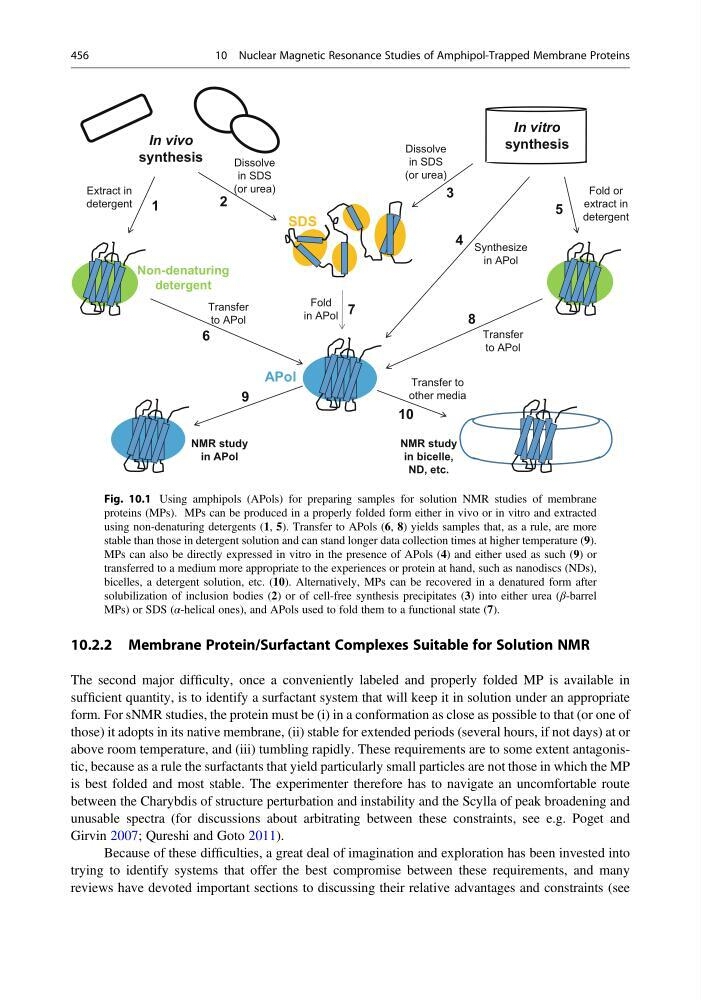
Fig. 10.1 Using amphipols (APols) for preparing samples for solution NMR studies of membrane
proteins (MPs). MPs can be produced in a properly folded form either in vivo or in vitro and extracted
using non-denaturing detergents (1, 5). Transfer to APols (6, 8) yields samples that, as a rule, are more
stable than those in detergent solution and can stand longer data collection times at higher temperature (9).
MPs can also be directly expressed in vitro in the presence of APols (4) and either used as such (9) or
transferred to a medium more appropriate to the experiences or protein at hand, such as nanodiscs (NDs),
bicelles, a detergent solution, etc. (10). Alternatively, MPs can be recovered in a denatured form after
solubilization of inclusion bodies (2) or of cell-free synthesis precipitates (3) into either urea (β-barrel
MPs) or SDS (α-helical ones), and APols used to fold them to a functional state (7).
456
10 Nuclear Magnetic Resonance Studies of Amphipol-Trapped Membrane Proteins
The second major difficulty, once a conveniently labeled and properly folded MP is available in
sufficient quantity, is to identify a surfactant system that will keep it in solution under an appropriate
form. For sNMR studies, the protein must be (i) in a conformation as close as possible to that (or one of
those) it adopts in its native membrane, (ii) stable for extended periods (several hours, if not days) at or
above room temperature, and (iii) tumbling rapidly. These requirements are to some extent antagonistic, because as a rule the surfactants that yield particularly small particles are not those in which the MP
is best folded and most stable. The experimenter therefore has to navigate an uncomfortable route
between the Charybdis of structure perturbation and instability and the Scylla of peak broadening and
unusable spectra (for discussions about arbitrating between these constraints, see e.g. Poget and
Girvin 2007; Qureshi and Goto 2011).
Because of these difficulties, a great deal of imagination and exploration has been invested into
trying to identify systems that offer the best compromise between these requirements, and many
reviews have devoted important sections to discussing their relative advantages and constraints (see
SDS
In vitro
synthesis
In vivo
synthesis
Extract in
detergent
Fold or
extract in
detergent
Dissolve
in SDS
(or urea)
Transfer
to APol
Transfer
to APol
Synthesize
in APol
Transfer to
other media
Fold
in APol
NMR study
in APol
NMR study
in bicelle,
ND, etc.
1
2
3
4
5
6
7
8
9
10
Non-denaturing
detergent
APol
Dissolve
in SDS
(or urea)
Fig. 10.1 Using amphipols (APols) for preparing samples for solution NMR studies of membrane
proteins (MPs). MPs can be produced in a properly folded form either in vivo or in vitro and extracted
using non-denaturing detergents (1, 5). Transfer to APols (6, 8) yields samples that, as a rule, are more
stable than those in detergent solution and can stand longer data collection times at higher temperature (9).
MPs can also be directly expressed in vitro in the presence of APols (4) and either used as such (9) or
transferred to a medium more appropriate to the experiences or protein at hand, such as nanodiscs (NDs),
bicelles, a detergent solution, etc. (10). Alternatively, MPs can be recovered in a denatured form after
solubilization of inclusion bodies (2) or of cell-free synthesis precipitates (3) into either urea (β-barrel
MPs) or SDS (α-helical ones), and APols used to fold them to a functional state (7).
456
10 Nuclear Magnetic Resonance Studies of Amphipol-Trapped Membrane Proteins