

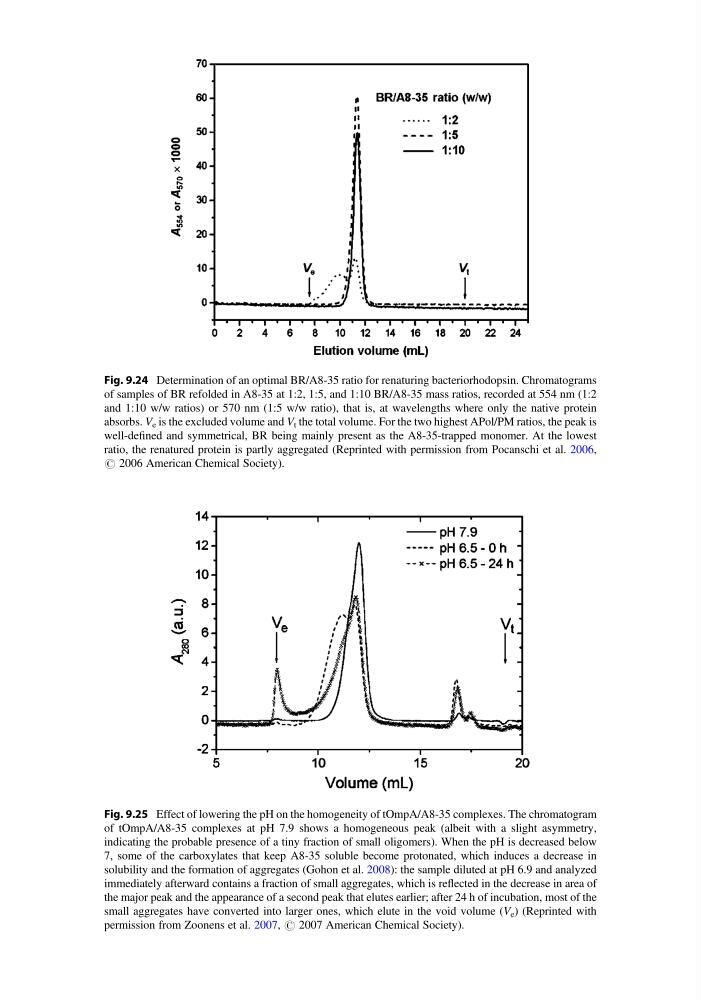
Fig. 9.25 Effect of lowering the pH on the homogeneity of tOmpA/A8-35 complexes. The chromatogram
of tOmpA/A8-35 complexes at pH 7.9 shows a homogeneous peak (albeit with a slight asymmetry,
indicating the probable presence of a tiny fraction of small oligomers). When the pH is decreased below
7, some of the carboxylates that keep A8-35 soluble become protonated, which induces a decrease in
solubility and the formation of aggregates (Gohon et al. 2008): the sample diluted at pH 6.9 and analyzed
immediately afterward contains a fraction of small aggregates, which is reflected in the decrease in area of
the major peak and the appearance of a second peak that elutes earlier; after 24 h of incubation, most of the
small aggregates have converted into larger ones, which elute in the void volume (V e ) (Reprinted with
permission from Zoonens et al. 2007, # 2007 American Chemical Society).
Fig. 9.24 Determination of an optimal BR/A8-35 ratio for renaturing bacteriorhodopsin. Chromatograms
of samples of BR refolded in A8-35 at 1:2, 1:5, and 1:10 BR/A8-35 mass ratios, recorded at 554 nm (1:2
and 1:10 w/w ratios) or 570 nm (1:5 w/w ratio), that is, at wavelengths where only the native protein
absorbs. V e is the excluded volume and V t the total volume. For the two highest APol/PM ratios, the peak is
well-defined and symmetrical, BR being mainly present as the A8-35-trapped monomer. At the lowest
ratio, the renatured protein is partly aggregated (Reprinted with permission from Pocanschi et al. 2006,
# 2006 American Chemical Society).
of tOmpA/A8-35 complexes at pH 7.9 shows a homogeneous peak (albeit with a slight asymmetry,
indicating the probable presence of a tiny fraction of small oligomers). When the pH is decreased below
7, some of the carboxylates that keep A8-35 soluble become protonated, which induces a decrease in
solubility and the formation of aggregates (Gohon et al. 2008): the sample diluted at pH 6.9 and analyzed
immediately afterward contains a fraction of small aggregates, which is reflected in the decrease in area of
the major peak and the appearance of a second peak that elutes earlier; after 24 h of incubation, most of the
small aggregates have converted into larger ones, which elute in the void volume (V e ) (Reprinted with
permission from Zoonens et al. 2007, # 2007 American Chemical Society).
Fig. 9.24 Determination of an optimal BR/A8-35 ratio for renaturing bacteriorhodopsin. Chromatograms
of samples of BR refolded in A8-35 at 1:2, 1:5, and 1:10 BR/A8-35 mass ratios, recorded at 554 nm (1:2
and 1:10 w/w ratios) or 570 nm (1:5 w/w ratio), that is, at wavelengths where only the native protein
absorbs. V e is the excluded volume and V t the total volume. For the two highest APol/PM ratios, the peak is
well-defined and symmetrical, BR being mainly present as the A8-35-trapped monomer. At the lowest
ratio, the renatured protein is partly aggregated (Reprinted with permission from Pocanschi et al. 2006,
# 2006 American Chemical Society).