

9.3.8.3 Small-Angle X-ray Scattering
The principle of X-ray scattering is the same as that of neutron scattering, with the following main
differences:
(i) In SAXS, the contrast is due to differences in electron density between the solution and the
particles, not to different interactions with the nuclei (see Box 9.2).
(ii) Because the X-ray beams delivered by synchrotrons are much brighter than neutron beams
from nuclear reactors or spallation sources, measuring times are shorter, making it possible
to investigate many more conditions.
(iii) On the downside, isotopic labeling cannot be used for contrast-matching, which is a serious
disadvantage when studying MP/surfactant complexes.
SAXS has been used in two studies of MP/APol complexes (Studies 9.7 and 9.41) and one study
of complexes formed between various APols and non-membrane, hydrophobic proteins extracted from
seeds (Study 9.20).
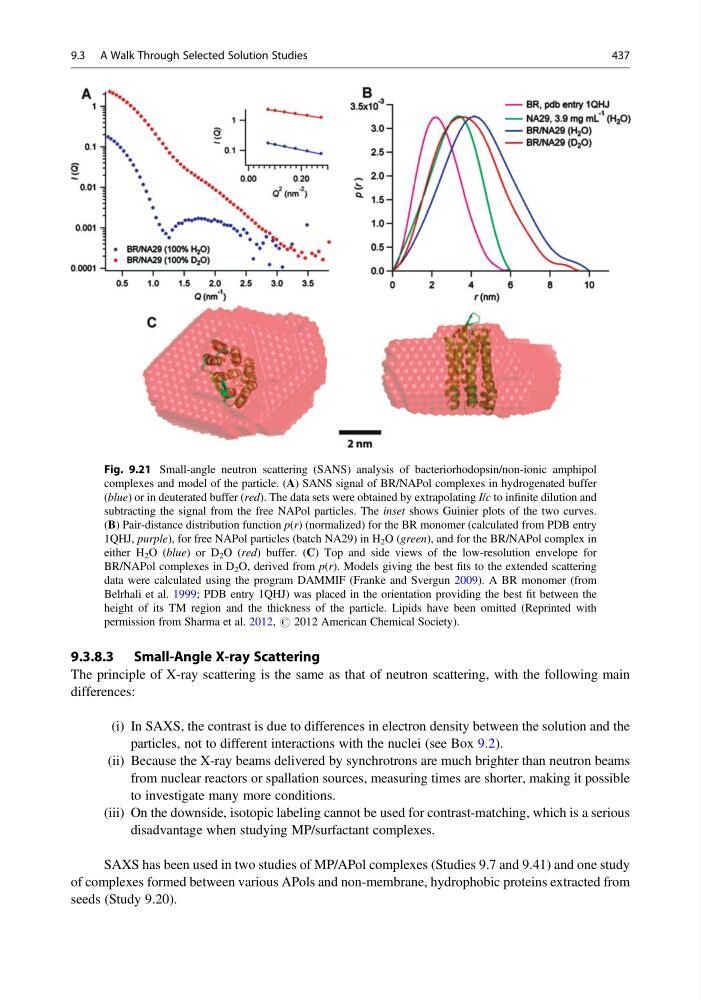
Fig. 9.21 Small-angle neutron scattering (SANS) analysis of bacteriorhodopsin/non-ionic amphipol
complexes and model of the particle. (A) SANS signal of BR/NAPol complexes in hydrogenated buffer
(blue) or in deuterated buffer (red). The data sets were obtained by extrapolating I/c to infinite dilution and
subtracting the signal from the free NAPol particles. The inset shows Guinier plots of the two curves.
(B) Pair-distance distribution function p(r) (normalized) for the BR monomer (calculated from PDB entry
1QHJ, purple), for free NAPol particles (batch NA29) in H 2 O (green), and for the BR/NAPol complex in
either H 2 O (blue) or D 2 O (red) buffer. (C) Top and side views of the low-resolution envelope for
BR/NAPol complexes in D 2 O, derived from p(r). Models giving the best fits to the extended scattering
data were calculated using the program DAMMIF (Franke and Svergun 2009). A BR monomer (from
Belrhali et al. 1999; PDB entry 1QHJ) was placed in the orientation providing the best fit between the
height of its TM region and the thickness of the particle. Lipids have been omitted (Reprinted with
permission from Sharma et al. 2012, # 2012 American Chemical Society).
9.3 A Walk Through Selected Solution Studies
437
The principle of X-ray scattering is the same as that of neutron scattering, with the following main
differences:
(i) In SAXS, the contrast is due to differences in electron density between the solution and the
particles, not to different interactions with the nuclei (see Box 9.2).
(ii) Because the X-ray beams delivered by synchrotrons are much brighter than neutron beams
from nuclear reactors or spallation sources, measuring times are shorter, making it possible
to investigate many more conditions.
(iii) On the downside, isotopic labeling cannot be used for contrast-matching, which is a serious
disadvantage when studying MP/surfactant complexes.
SAXS has been used in two studies of MP/APol complexes (Studies 9.7 and 9.41) and one study
of complexes formed between various APols and non-membrane, hydrophobic proteins extracted from
seeds (Study 9.20).
Fig. 9.21 Small-angle neutron scattering (SANS) analysis of bacteriorhodopsin/non-ionic amphipol
complexes and model of the particle. (A) SANS signal of BR/NAPol complexes in hydrogenated buffer
(blue) or in deuterated buffer (red). The data sets were obtained by extrapolating I/c to infinite dilution and
subtracting the signal from the free NAPol particles. The inset shows Guinier plots of the two curves.
(B) Pair-distance distribution function p(r) (normalized) for the BR monomer (calculated from PDB entry
1QHJ, purple), for free NAPol particles (batch NA29) in H 2 O (green), and for the BR/NAPol complex in
either H 2 O (blue) or D 2 O (red) buffer. (C) Top and side views of the low-resolution envelope for
BR/NAPol complexes in D 2 O, derived from p(r). Models giving the best fits to the extended scattering
data were calculated using the program DAMMIF (Franke and Svergun 2009). A BR monomer (from
Belrhali et al. 1999; PDB entry 1QHJ) was placed in the orientation providing the best fit between the
height of its TM region and the thickness of the particle. Lipids have been omitted (Reprinted with
permission from Sharma et al. 2012, # 2012 American Chemical Society).
9.3 A Walk Through Selected Solution Studies
437