

presented in § 9.3.9, the solution properties of MP/APol complexes have been studied mostly by either
small-angle neutron scattering (SANS; four studies) or small-angle X-ray scattering (SAXS; three
studies) (Table 9.1). The principle and the principal characteristics and constraints of these two
approaches are presented in Box 9.2.
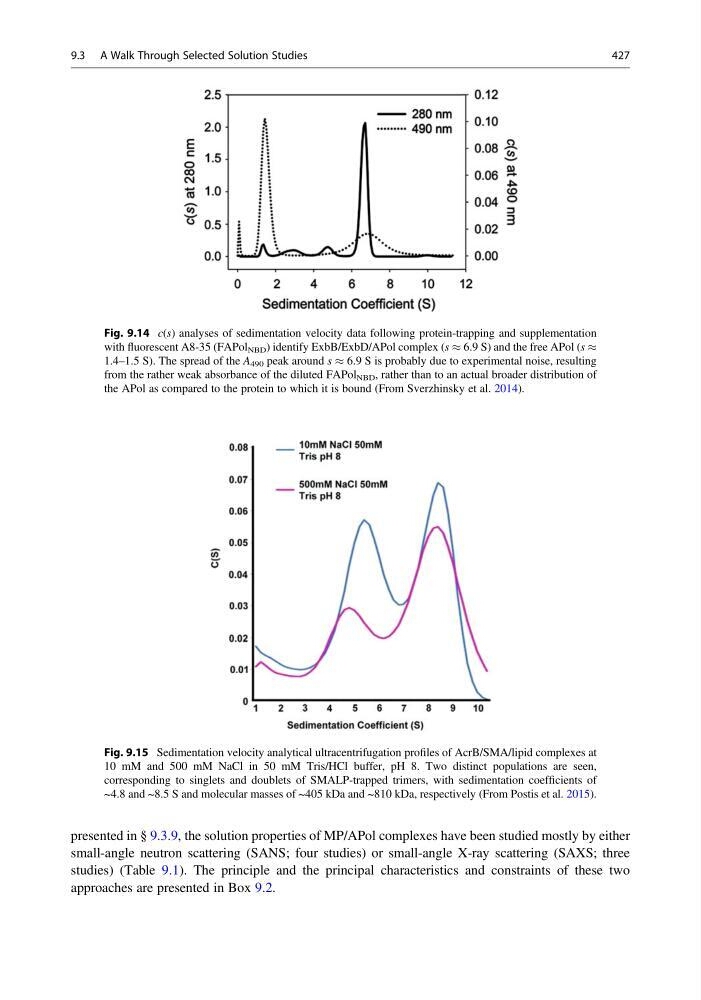
Fig. 9.15 Sedimentation velocity analytical ultracentrifugation profiles of AcrB/SMA/lipid complexes at
10 mM and 500 mM NaCl in 50 mM Tris/HCl buffer, pH 8. Two distinct populations are seen,
corresponding to singlets and doublets of SMALP-trapped trimers, with sedimentation coefficients of
~4.8 and ~8.5 S and molecular masses of ~405 kDa and ~810 kDa, respectively (From Postis et al. 2015).
Fig. 9.14 c(s) analyses of sedimentation velocity data following protein-trapping and supplementation
with fluorescent A8-35 (FAPol NBD ) identify ExbB/ExbD/APol complex (s % 6.9 S) and the free APol (s %
1.4–1.5 S). The spread of the A 490 peak around s % 6.9 S is probably due to experimental noise, resulting
from the rather weak absorbance of the diluted FAPol NBD , rather than to an actual broader distribution of
the APol as compared to the protein to which it is bound (From Sverzhinsky et al. 2014).
9.3 A Walk Through Selected Solution Studies
427
small-angle neutron scattering (SANS; four studies) or small-angle X-ray scattering (SAXS; three
studies) (Table 9.1). The principle and the principal characteristics and constraints of these two
approaches are presented in Box 9.2.
Fig. 9.15 Sedimentation velocity analytical ultracentrifugation profiles of AcrB/SMA/lipid complexes at
10 mM and 500 mM NaCl in 50 mM Tris/HCl buffer, pH 8. Two distinct populations are seen,
corresponding to singlets and doublets of SMALP-trapped trimers, with sedimentation coefficients of
~4.8 and ~8.5 S and molecular masses of ~405 kDa and ~810 kDa, respectively (From Postis et al. 2015).
Fig. 9.14 c(s) analyses of sedimentation velocity data following protein-trapping and supplementation
with fluorescent A8-35 (FAPol NBD ) identify ExbB/ExbD/APol complex (s % 6.9 S) and the free APol (s %
1.4–1.5 S). The spread of the A 490 peak around s % 6.9 S is probably due to experimental noise, resulting
from the rather weak absorbance of the diluted FAPol NBD , rather than to an actual broader distribution of
the APol as compared to the protein to which it is bound (From Sverzhinsky et al. 2014).
9.3 A Walk Through Selected Solution Studies
427