

Separating free from MP-bound APol by SGSV is much more difficult when the protein is small,
as is the case of BR. This is illustrated in Fig. 9.4, taken from Study 9.5, in which a sample of BR
trapped in [
3 H]A8-35 was subjected to two successive rounds of SGSV fractionation. In the first
gradient (Panel A), a majority of the free [
3 H]A8-35 (short dashes) is separated from BR/APol
complexes, but enough of it comigrates with them to strongly affect the determination of the MP/APol
mass ratio (A
0 ). When the least contaminated BR fractions were pooled and applied to a second
gradient (B), enough BR/APol fractions were reasonably uncontaminated (roughly from fraction 12
to 15) for an estimate of the BR/A8-35 mass ratio in the complexes to be obtained (B
0 ). In the process,
however, two new problems arose: (i) some of BR aggregated (compare the late fractions and the pellet
in the first and second gradient); and (ii) AUC and SANS data (see §§ 9.3.7 and 9.3.8.2) showed that
the mass of bound A8-35 measured by this procedure is underestimated by a factor close to two, very
likely because aggregated BR had released part of the APol originally associated with it. Sucrose
gradient fractionation obviously is not adapted to determining the mass ratio of APols associated to
small MPs, unless the gradient contains enough free APols to prevent aggregation, which was not the
case in these experiments.
As can be expected, the migration of a given protein in sucrose gradients is affected by the APol
used to trap it: the hydrodynamic radius of the particle depends on the thickness of the APol belt, and
its mass and density on the protein/APol mass ratio and the density of the APol. This is illustrated in
Fig. 9.5 (taken from Study 9.37), where the migration of a light-harvesting complex (LHC) is
compared in n-dodecyl-α-D-maltopyranoside (α-DDM) or after trapping with either A8-35 or a
glycosylated, non-ionic APol, whose density is higher.
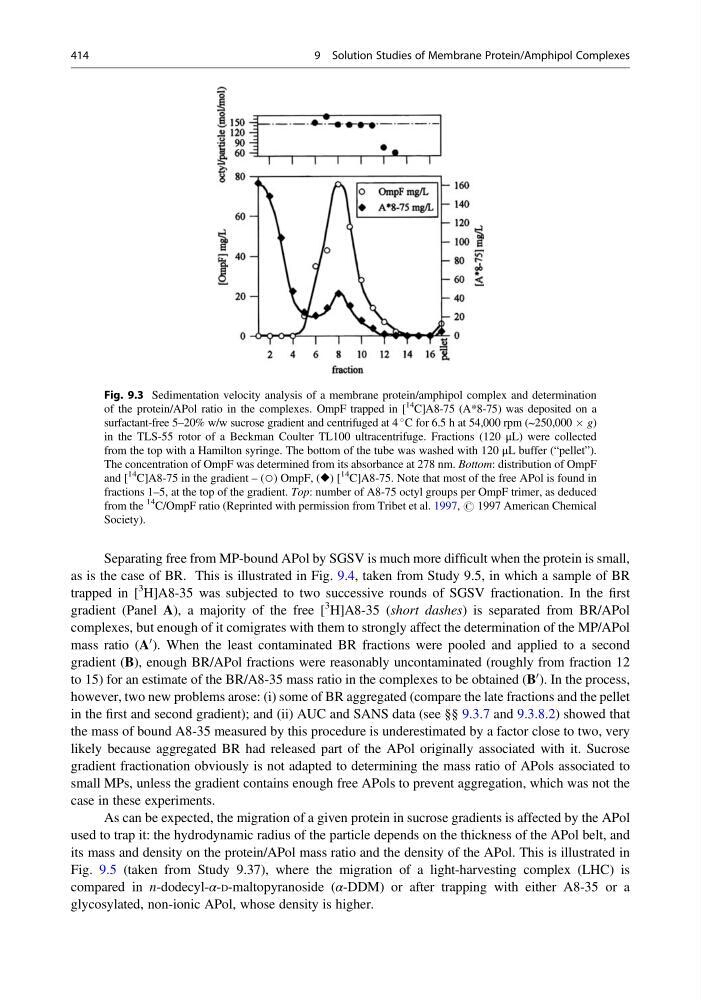
Fig. 9.3 Sedimentation velocity analysis of a membrane protein/amphipol complex and determination
of the protein/APol ratio in the complexes. OmpF trapped in [
14
C]A8-75 (A*8-75) was deposited on a
surfactant-free 5–20% w/w sucrose gradient and centrifuged at 4
C for 6.5 h at 54,000 rpm (~250,000 Â g)
in the TLS-55 rotor of a Beckman Coulter TL100 ultracentrifuge. Fractions (120 μL) were collected
from the top with a Hamilton syringe. The bottom of the tube was washed with 120 μL buffer (“pellet”).
The concentration of OmpF was determined from its absorbance at 278 nm. Bottom: distribution of OmpF
and [
14
C]A8-75 in the gradient – (○) OmpF, (r) [
14
C]A8-75. Note that most of the free APol is found in
fractions 1–5, at the top of the gradient. Top: number of A8-75 octyl groups per OmpF trimer, as deduced
from the
14
C/OmpF ratio (Reprinted with permission from Tribet et al. 1997, # 1997 American Chemical
Society).
414
9 Solution Studies of Membrane Protein/Amphipol Complexes
as is the case of BR. This is illustrated in Fig. 9.4, taken from Study 9.5, in which a sample of BR
trapped in [
3 H]A8-35 was subjected to two successive rounds of SGSV fractionation. In the first
gradient (Panel A), a majority of the free [
3 H]A8-35 (short dashes) is separated from BR/APol
complexes, but enough of it comigrates with them to strongly affect the determination of the MP/APol
mass ratio (A
0 ). When the least contaminated BR fractions were pooled and applied to a second
gradient (B), enough BR/APol fractions were reasonably uncontaminated (roughly from fraction 12
to 15) for an estimate of the BR/A8-35 mass ratio in the complexes to be obtained (B
0 ). In the process,
however, two new problems arose: (i) some of BR aggregated (compare the late fractions and the pellet
in the first and second gradient); and (ii) AUC and SANS data (see §§ 9.3.7 and 9.3.8.2) showed that
the mass of bound A8-35 measured by this procedure is underestimated by a factor close to two, very
likely because aggregated BR had released part of the APol originally associated with it. Sucrose
gradient fractionation obviously is not adapted to determining the mass ratio of APols associated to
small MPs, unless the gradient contains enough free APols to prevent aggregation, which was not the
case in these experiments.
As can be expected, the migration of a given protein in sucrose gradients is affected by the APol
used to trap it: the hydrodynamic radius of the particle depends on the thickness of the APol belt, and
its mass and density on the protein/APol mass ratio and the density of the APol. This is illustrated in
Fig. 9.5 (taken from Study 9.37), where the migration of a light-harvesting complex (LHC) is
compared in n-dodecyl-α-D-maltopyranoside (α-DDM) or after trapping with either A8-35 or a
glycosylated, non-ionic APol, whose density is higher.
Fig. 9.3 Sedimentation velocity analysis of a membrane protein/amphipol complex and determination
of the protein/APol ratio in the complexes. OmpF trapped in [
14
C]A8-75 (A*8-75) was deposited on a
surfactant-free 5–20% w/w sucrose gradient and centrifuged at 4
C for 6.5 h at 54,000 rpm (~250,000 Â g)
in the TLS-55 rotor of a Beckman Coulter TL100 ultracentrifuge. Fractions (120 μL) were collected
from the top with a Hamilton syringe. The bottom of the tube was washed with 120 μL buffer (“pellet”).
The concentration of OmpF was determined from its absorbance at 278 nm. Bottom: distribution of OmpF
and [
14
C]A8-75 in the gradient – (○) OmpF, (r) [
14
C]A8-75. Note that most of the free APol is found in
fractions 1–5, at the top of the gradient. Top: number of A8-75 octyl groups per OmpF trimer, as deduced
from the
14
C/OmpF ratio (Reprinted with permission from Tribet et al. 1997, # 1997 American Chemical
Society).
414
9 Solution Studies of Membrane Protein/Amphipol Complexes