

Box 9.1 (continued)
For equilibrium sedimentation measurements, the hardware and procedure are similar to the
previous case, except for the use of shorter buffer columns, lower gravity fields, and longer running
times. The particles are left to reach their equilibrium distribution in the field, which depends only
on their mass and
v and not on their shape. Repeating the experiments at different solvent density,
e.g. by replacing H 2 O with D 2 O or D 2
18
O, yields a system of equations from which the buoyant
molecular mass and
v of the particles can be experimentally determined (cf. Fig. 9.13). This
approach is particularly useful for homogeneous samples, or when studying equilibria, e.g. those
due to oligomerization.
SGSV fractionation is a convenient way to separate MP/APol complexes from free APol,
provided the protein is not too small. This is illustrated in Fig. 9.3, taken from Study 9.1, in which
SGSV was used to estimate the amount of tritiated A8-75 bound per trimer of the porin OmpF
(~111 kDa). Note that, in this experiment, the complexes between OmpF trimers and A8-75 appear
essentially monodisperse, showing very little aggregation. A different distribution would probably
have been observed if fractions 6–10, which contain most of the protein, had been collected, washed
free of sucrose by dialysis or SEC, and centrifuged again under the same conditions: indeed, in the
absence of free APol, OmpF would have aggregated (cf. Arunmanee et al. 2014; see Chap. 12,
Fig. 12.13). Under the conditions of the experiment shown in Fig. 9.3, however, aggregation had no
time to develop to a significant extent, even though some degree of it is suggested by the trailing of the
peak toward the bottom of the gradient.
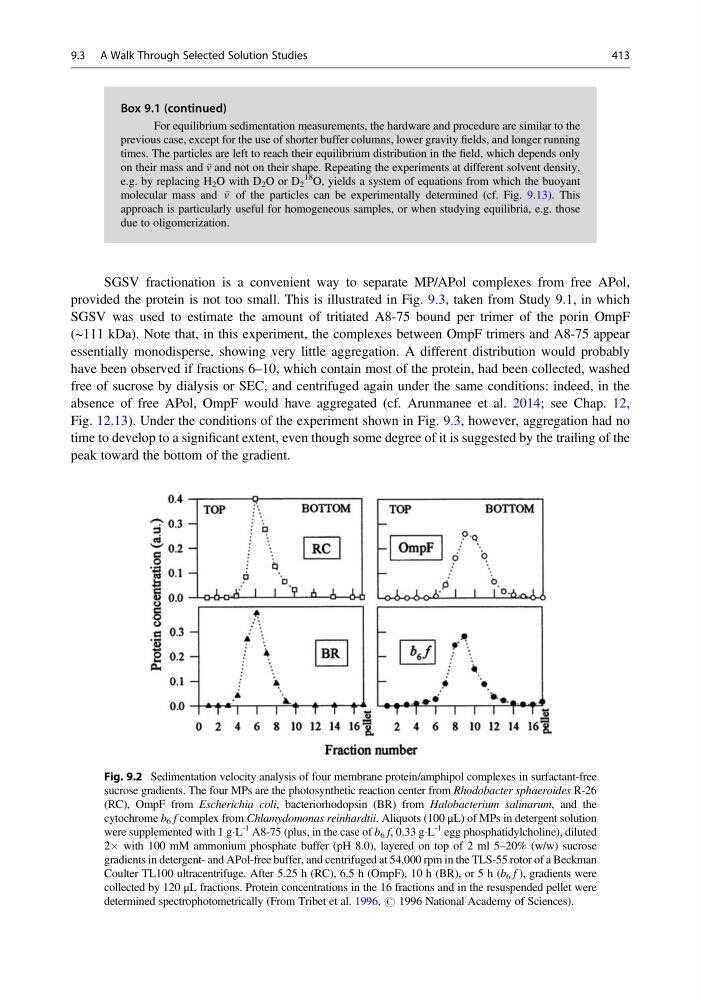
Fig. 9.2 Sedimentation velocity analysis of four membrane protein/amphipol complexes in surfactant-free
sucrose gradients. The four MPs are the photosynthetic reaction center from Rhodobacter sphaeroides R-26
(RC), OmpF from Escherichia coli, bacteriorhodopsin (BR) from Halobacterium salinarum, and the
cytochrome b 6 f complex from Chlamydomonas reinhardtii. Aliquots (100 μL) of MPs in detergent solution
were supplemented with 1 gÁL
-1 A8-75 (plus, in the case of b 6 f, 0.33 gÁL
-1 egg phosphatidylcholine), diluted
2Â with 100 mM ammonium phosphate buffer (pH 8.0), layered on top of 2 ml 5–20% (w/w) sucrose
gradients in detergent- and APol-free buffer, and centrifuged at 54,000 rpm in the TLS-55 rotor of a Beckman
Coulter TL100 ultracentrifuge. After 5.25 h (RC), 6.5 h (OmpF), 10 h (BR), or 5 h (b 6 f ), gradients were
collected by 120 μL fractions. Protein concentrations in the 16 fractions and in the resuspended pellet were
determined spectrophotometrically (From Tribet et al. 1996, # 1996 National Academy of Sciences).
9.3 A Walk Through Selected Solution Studies
413
For equilibrium sedimentation measurements, the hardware and procedure are similar to the
previous case, except for the use of shorter buffer columns, lower gravity fields, and longer running
times. The particles are left to reach their equilibrium distribution in the field, which depends only
on their mass and
v and not on their shape. Repeating the experiments at different solvent density,
e.g. by replacing H 2 O with D 2 O or D 2
18
O, yields a system of equations from which the buoyant
molecular mass and
v of the particles can be experimentally determined (cf. Fig. 9.13). This
approach is particularly useful for homogeneous samples, or when studying equilibria, e.g. those
due to oligomerization.
SGSV fractionation is a convenient way to separate MP/APol complexes from free APol,
provided the protein is not too small. This is illustrated in Fig. 9.3, taken from Study 9.1, in which
SGSV was used to estimate the amount of tritiated A8-75 bound per trimer of the porin OmpF
(~111 kDa). Note that, in this experiment, the complexes between OmpF trimers and A8-75 appear
essentially monodisperse, showing very little aggregation. A different distribution would probably
have been observed if fractions 6–10, which contain most of the protein, had been collected, washed
free of sucrose by dialysis or SEC, and centrifuged again under the same conditions: indeed, in the
absence of free APol, OmpF would have aggregated (cf. Arunmanee et al. 2014; see Chap. 12,
Fig. 12.13). Under the conditions of the experiment shown in Fig. 9.3, however, aggregation had no
time to develop to a significant extent, even though some degree of it is suggested by the trailing of the
peak toward the bottom of the gradient.
Fig. 9.2 Sedimentation velocity analysis of four membrane protein/amphipol complexes in surfactant-free
sucrose gradients. The four MPs are the photosynthetic reaction center from Rhodobacter sphaeroides R-26
(RC), OmpF from Escherichia coli, bacteriorhodopsin (BR) from Halobacterium salinarum, and the
cytochrome b 6 f complex from Chlamydomonas reinhardtii. Aliquots (100 μL) of MPs in detergent solution
were supplemented with 1 gÁL
-1 A8-75 (plus, in the case of b 6 f, 0.33 gÁL
-1 egg phosphatidylcholine), diluted
2Â with 100 mM ammonium phosphate buffer (pH 8.0), layered on top of 2 ml 5–20% (w/w) sucrose
gradients in detergent- and APol-free buffer, and centrifuged at 54,000 rpm in the TLS-55 rotor of a Beckman
Coulter TL100 ultracentrifuge. After 5.25 h (RC), 6.5 h (OmpF), 10 h (BR), or 5 h (b 6 f ), gradients were
collected by 120 μL fractions. Protein concentrations in the 16 fractions and in the resuspended pellet were
determined spectrophotometrically (From Tribet et al. 1996, # 1996 National Academy of Sciences).
9.3 A Walk Through Selected Solution Studies
413