

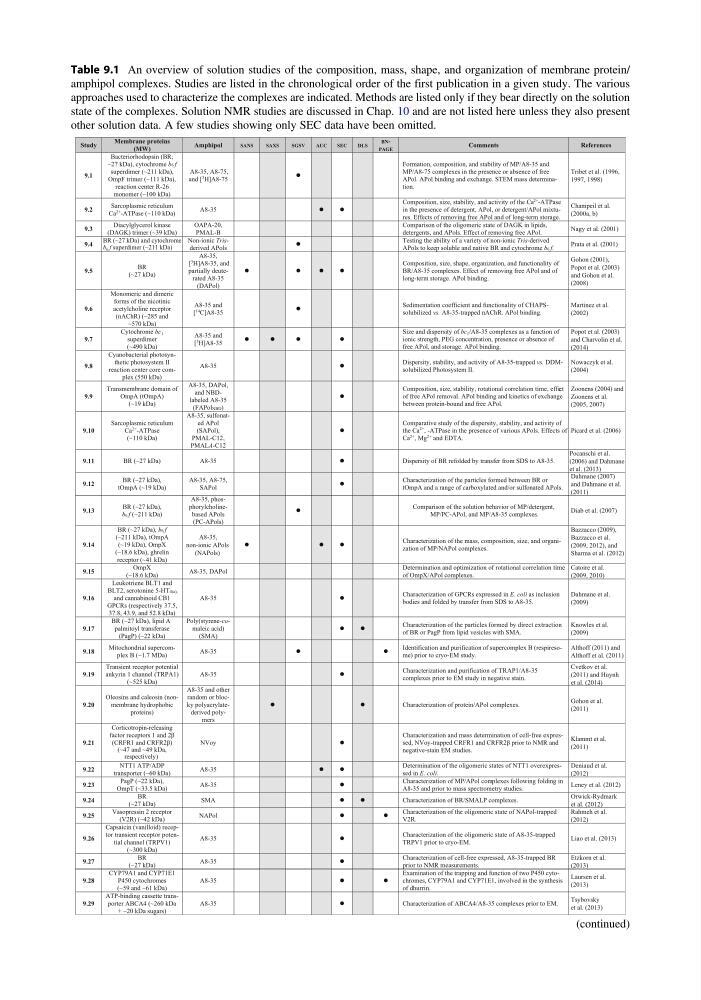
Table 9.1 An overview of solution studies of the composition, mass, shape, and organization of membrane protein/
amphipol complexes. Studies are listed in the chronological order of the first publication in a given study. The various
approaches used to characterize the complexes are indicated. Methods are listed only if they bear directly on the solution
state of the complexes. Solution NMR studies are discussed in Chap. 10 and are not listed here unless they also present
other solution data. A few studies showing only SEC data have been omitted.
Study
Membrane proteins
(MW)
Amphipol
SANS
SAXS
SGSV
AUC
SEC
DLS
BNPAGE
Comments
References
9.1
Bacteriorhodopsin (BR;
~27 kDa), cytochrome b6 f
superdimer (~211 kDa),
OmpF trimer (~111 kDa),
reaction center R-26
monomer (~100 kDa)
A8-35, A8-75,
and [ 3 H]A8-75
Formation, composition, and stability of MP/A8-35 and
MP/A8-75 complexes in the presence or absence of free
APol. APol binding and exchange. STEM mass determination.
Tribet et al. (1996,
1997, 1998)
9.2
Sarcoplasmic reticulum
Ca 2+ -ATPase (~110 kDa)
A8-35
Composition, size, stability, and activity of the Ca 2+ -ATPase
in the presence of detergent, APol, or detergent/APol mixtures. Effects of removing free APol and of long-term storage.
Champeil et al.
(2000a, b)
9.3
Diacylglycerol kinase
(DAGK) trimer (~39 kDa)
OAPA-20,
PMAL-B
Comparison of the oligomeric state of DAGK in lipids,
detergents, and APols. Effect of removing free APol.
Nagy et al. (2001)
9.4
BR (~27 kDa) and cytochrome
b6 f superdimer (~211 kDa)
Non-ionic Trisderived APols
Testing the ability of a variety of non-ionic Tris-derived
APols to keep soluble and native BR and cytochrome b6 f.
Prata et al. (2001)
9.5
BR
(~27 kDa)
A8-35,
[ 3 H]A8-35, and
partially deuterated A8-35
(DAPol)
Composition, size, shape, organization, and functionality of
BR/A8-35 complexes. Effect of removing free APol and of
long-term storage. APol binding.
Gohon (2001),
Popot et al. (2003)
and Gohon et al.
(2008)
9.6
Monomeric and dimeric
forms of the nicotinic
acetylcholine receptor
(nAChR) (~285 and
~570 kDa)
A8-35 and
[ 14 C]A8-35
Sedimentation coefficient and functionality of CHAPSsolubilized vs. A8-35-trapped nAChR. APol binding.
Martinez et al.
(2002)
9.7
Cytochrome bc1
superdimer
(~490 kDa)
A8-35 and
[ 3 H]A8-35
Size and dispersity of bc1/A8-35 complexes as a function of
ionic strength, PEG concentration, presence or absence of
free APol, and storage. APol binding.
Popot et al. (2003)
and Charvolin et al.
(2014)
9.8
Cyanobacterial photosynthetic photosystem II
reaction center core complex (550 kDa)
A8-35
Dispersity, stability, and activity of A8-35-trapped vs. DDMsolubilized Photosystem II.
Nowaczyk et al.
(2004)
9.9
Transmembrane domain of
OmpA (tOmpA)
(~19 kDa)
A8-35, DAPol,
and NBDlabeled A8-35
(FAPolNBD)
Composition, size, stability, rotational correlation time, effect
of free APol removal. APol binding and kinetics of exchange
between protein-bound and free APol.
Zoonens (2004) and
Zoonens et al.
(2005, 2007)
9.10
Sarcoplasmic reticulum
Ca 2+ -ATPase
(~110 kDa)
A8-35, sulfonated APol
(SAPol),
PMAL-C12,
PMALA-C12
Comparative study of the dispersity, stability, and activity of
the Ca 2+ , -ATPase in the presence of various APols. Effects of
Ca 2+ , Mg 2+ and EDTA.
Picard et al. (2006)
9.11
BR (~27 kDa)
A8-35
Dispersity of BR refolded by transfer from SDS to A8-35.
Pocanschi et al.
(2006) and Dahmane
et al. (2013)
9.12
BR (~27 kDa),
tOmpA (~19 kDa)
A8-35, A8-75,
SAPol
Characterization of the particles formed between BR or
tOmpA and a range of carboxylated and/or sulfonated APols.
Dahmane (2007)
and Dahmane et al.
(2011)
9.13
BR (~27 kDa),
b6 f (~211 kDa)
phorylcholinebased APols
(PC-APols)
Comparison of the solution behavior of MP/detergent,
MP/PC-APol, and MP/A8-35 complexes.
Diab et al. (2007)
9.14
BR (~27 kDa), b6 f
(~211 kDa), tOmpA
(~19 kDa), OmpX
(~18.6 kDa), ghrelin
receptor (~41 kDa)
A8-35,
non-ionic APols
(NAPols)
Characterization of the mass, composition, size, and organization of MP/NAPol complexes.
Bazzacco (2009),
Bazzacco et al.
(2009, 2012), and
Sharma et al. (2012)
9.15
OmpX
(~18.6 kDa)
A8-35, DAPol
Determination and optimization of rotational correlation time
of OmpX/APol complexes.
Catoire et al.
(2009, 2010)
9.16
Leukotriene BLT1 and
BLT2, serotonine 5-HT4(a),
and cannabinoid CB1
GPCRs (respectively 37.5,
37.8, 43.9, and 52.8 kDa)
A8-35
Characterization of GPCRs expressed in E. coli as inclusion
bodies and folded by transfer from SDS to A8-35.
Dahmane et al.
(2009)
9.17
BR (~27 kDa), lipid A
palmitoyl transferase
(PagP) (~22 kDa)
Poly(styrene-comaleic acid)
(SMA)
Characterization of the particles formed by direct extraction
of BR or PagP from lipid vesicles with SMA.
Knowles et al.
(2009)
9.18
Mitochondrial supercomplex B (~1.7 MDa)
A8-35
Identification and purification of supercomplex B (respiresome) prior to cryo-EM study.
Althoff (2011) and
Althoff et al. (2011)
9.19
Transient receptor potential
ankyrin 1 channel (TRPA1)
(~525 kDa)
A8-35
Characterization and purification of TRAP1/A8-35
complexes prior to EM study in negative stain.
Cvetkov et al.
(2011) and Huynh
et al. (2014)
9.20
Oleosins and caleosin (nonmembrane hydrophobic
proteins)
A8-35 and other
random or blocky polyacrylatederived polymers
Characterization of protein/APol complexes.
Gohon et al.
(2011)
9.21
Corticotropin-releasing
factor receptors 1 and 2β
(CRFR1 and CRFR2β)
(~47 and ~49 kDa,
respectively)
NVoy
Characterization and mass determination of cell-free expressed, NVoy-trapped CRFR1 and CRFR2β prior to NMR and
negative-stain EM studies.
Klammt et al.
(2011)
9.22
NTT1 ATP/ADP
transporter (~60 kDa)
A8-35
Determination of the oligomeric states of NTT1 overexpressed in E. coli.
Deniaud et al.
(2012)
9.23
PagP (~22 kDa),
OmpT (~33.5 kDa)
A8-35
Characterization of MP/APol complexes following folding in
A8-35 and prior to mass spectrometry studies.
Leney et al. (2012)
9.24
BR
(~27 kDa)
SMA
Characterization of BR/SMALP complexes.
Orwick-Rydmark
et al. (2012)
9.25
Vasopressin 2 receptor
(V2R) (~42 kDa)
NAPol
Characterization of the oligomeric state of NAPol-trapped
V2R.
Rahmeh et al.
(2012)
9.26
Capsaicin (vanilloid) receptor transient receptor potential channel (TRPV1)
(~300 kDa)
A8-35
Characterization of the oligomeric state of A8-35-trapped
TRPV1 prior to cryo-EM.
Liao et al. (2013)
9.27
BR
(~27 kDa)
A8-35
Characterization of cell-free expressed, A8-35-trapped BR
prior to NMR measurements.
Etzkorn et al.
(2013)
9.28
CYP79A1 and CYP71E1
P450 cytochromes
(~59 and ~61 kDa)
A8-35
Examination of the trapping and function of two P450 cytochromes, CYP79A1 and CYP71E1, involved in the synthesis
of dhurrin.
Laursen et al.
(2013)
9.29
ATP-binding cassette transporter ABCA4 (~260 kDa
+ ~20 kDa sugars)
A8-35
Characterization of ABCA4/A8-35 complexes prior to EM.
Tsybovsky
et al. (2013)
(continued)
amphipol complexes. Studies are listed in the chronological order of the first publication in a given study. The various
approaches used to characterize the complexes are indicated. Methods are listed only if they bear directly on the solution
state of the complexes. Solution NMR studies are discussed in Chap. 10 and are not listed here unless they also present
other solution data. A few studies showing only SEC data have been omitted.
Study
Membrane proteins
(MW)
Amphipol
SANS
SAXS
SGSV
AUC
SEC
DLS
BNPAGE
Comments
References
9.1
Bacteriorhodopsin (BR;
~27 kDa), cytochrome b6 f
superdimer (~211 kDa),
OmpF trimer (~111 kDa),
reaction center R-26
monomer (~100 kDa)
A8-35, A8-75,
and [ 3 H]A8-75
Formation, composition, and stability of MP/A8-35 and
MP/A8-75 complexes in the presence or absence of free
APol. APol binding and exchange. STEM mass determination.
Tribet et al. (1996,
1997, 1998)
9.2
Sarcoplasmic reticulum
Ca 2+ -ATPase (~110 kDa)
A8-35
Composition, size, stability, and activity of the Ca 2+ -ATPase
in the presence of detergent, APol, or detergent/APol mixtures. Effects of removing free APol and of long-term storage.
Champeil et al.
(2000a, b)
9.3
Diacylglycerol kinase
(DAGK) trimer (~39 kDa)
OAPA-20,
PMAL-B
Comparison of the oligomeric state of DAGK in lipids,
detergents, and APols. Effect of removing free APol.
Nagy et al. (2001)
9.4
BR (~27 kDa) and cytochrome
b6 f superdimer (~211 kDa)
Non-ionic Trisderived APols
Testing the ability of a variety of non-ionic Tris-derived
APols to keep soluble and native BR and cytochrome b6 f.
Prata et al. (2001)
9.5
BR
(~27 kDa)
A8-35,
[ 3 H]A8-35, and
partially deuterated A8-35
(DAPol)
Composition, size, shape, organization, and functionality of
BR/A8-35 complexes. Effect of removing free APol and of
long-term storage. APol binding.
Gohon (2001),
Popot et al. (2003)
and Gohon et al.
(2008)
9.6
Monomeric and dimeric
forms of the nicotinic
acetylcholine receptor
(nAChR) (~285 and
~570 kDa)
A8-35 and
[ 14 C]A8-35
Sedimentation coefficient and functionality of CHAPSsolubilized vs. A8-35-trapped nAChR. APol binding.
Martinez et al.
(2002)
9.7
Cytochrome bc1
superdimer
(~490 kDa)
A8-35 and
[ 3 H]A8-35
Size and dispersity of bc1/A8-35 complexes as a function of
ionic strength, PEG concentration, presence or absence of
free APol, and storage. APol binding.
Popot et al. (2003)
and Charvolin et al.
(2014)
9.8
Cyanobacterial photosynthetic photosystem II
reaction center core complex (550 kDa)
A8-35
Dispersity, stability, and activity of A8-35-trapped vs. DDMsolubilized Photosystem II.
Nowaczyk et al.
(2004)
9.9
Transmembrane domain of
OmpA (tOmpA)
(~19 kDa)
A8-35, DAPol,
and NBDlabeled A8-35
(FAPolNBD)
Composition, size, stability, rotational correlation time, effect
of free APol removal. APol binding and kinetics of exchange
between protein-bound and free APol.
Zoonens (2004) and
Zoonens et al.
(2005, 2007)
9.10
Sarcoplasmic reticulum
Ca 2+ -ATPase
(~110 kDa)
A8-35, sulfonated APol
(SAPol),
PMAL-C12,
PMALA-C12
Comparative study of the dispersity, stability, and activity of
the Ca 2+ , -ATPase in the presence of various APols. Effects of
Ca 2+ , Mg 2+ and EDTA.
Picard et al. (2006)
9.11
BR (~27 kDa)
A8-35
Dispersity of BR refolded by transfer from SDS to A8-35.
Pocanschi et al.
(2006) and Dahmane
et al. (2013)
9.12
BR (~27 kDa),
tOmpA (~19 kDa)
A8-35, A8-75,
SAPol
Characterization of the particles formed between BR or
tOmpA and a range of carboxylated and/or sulfonated APols.
Dahmane (2007)
and Dahmane et al.
(2011)
9.13
BR (~27 kDa),
b6 f (~211 kDa)
phorylcholinebased APols
(PC-APols)
Comparison of the solution behavior of MP/detergent,
MP/PC-APol, and MP/A8-35 complexes.
Diab et al. (2007)
9.14
BR (~27 kDa), b6 f
(~211 kDa), tOmpA
(~19 kDa), OmpX
(~18.6 kDa), ghrelin
receptor (~41 kDa)
A8-35,
non-ionic APols
(NAPols)
Characterization of the mass, composition, size, and organization of MP/NAPol complexes.
Bazzacco (2009),
Bazzacco et al.
(2009, 2012), and
Sharma et al. (2012)
9.15
OmpX
(~18.6 kDa)
A8-35, DAPol
Determination and optimization of rotational correlation time
of OmpX/APol complexes.
Catoire et al.
(2009, 2010)
9.16
Leukotriene BLT1 and
BLT2, serotonine 5-HT4(a),
and cannabinoid CB1
GPCRs (respectively 37.5,
37.8, 43.9, and 52.8 kDa)
A8-35
Characterization of GPCRs expressed in E. coli as inclusion
bodies and folded by transfer from SDS to A8-35.
Dahmane et al.
(2009)
9.17
BR (~27 kDa), lipid A
palmitoyl transferase
(PagP) (~22 kDa)
Poly(styrene-comaleic acid)
(SMA)
Characterization of the particles formed by direct extraction
of BR or PagP from lipid vesicles with SMA.
Knowles et al.
(2009)
9.18
Mitochondrial supercomplex B (~1.7 MDa)
A8-35
Identification and purification of supercomplex B (respiresome) prior to cryo-EM study.
Althoff (2011) and
Althoff et al. (2011)
9.19
Transient receptor potential
ankyrin 1 channel (TRPA1)
(~525 kDa)
A8-35
Characterization and purification of TRAP1/A8-35
complexes prior to EM study in negative stain.
Cvetkov et al.
(2011) and Huynh
et al. (2014)
9.20
Oleosins and caleosin (nonmembrane hydrophobic
proteins)
A8-35 and other
random or blocky polyacrylatederived polymers
Characterization of protein/APol complexes.
Gohon et al.
(2011)
9.21
Corticotropin-releasing
factor receptors 1 and 2β
(CRFR1 and CRFR2β)
(~47 and ~49 kDa,
respectively)
NVoy
Characterization and mass determination of cell-free expressed, NVoy-trapped CRFR1 and CRFR2β prior to NMR and
negative-stain EM studies.
Klammt et al.
(2011)
9.22
NTT1 ATP/ADP
transporter (~60 kDa)
A8-35
Determination of the oligomeric states of NTT1 overexpressed in E. coli.
Deniaud et al.
(2012)
9.23
PagP (~22 kDa),
OmpT (~33.5 kDa)
A8-35
Characterization of MP/APol complexes following folding in
A8-35 and prior to mass spectrometry studies.
Leney et al. (2012)
9.24
BR
(~27 kDa)
SMA
Characterization of BR/SMALP complexes.
Orwick-Rydmark
et al. (2012)
9.25
Vasopressin 2 receptor
(V2R) (~42 kDa)
NAPol
Characterization of the oligomeric state of NAPol-trapped
V2R.
Rahmeh et al.
(2012)
9.26
Capsaicin (vanilloid) receptor transient receptor potential channel (TRPV1)
(~300 kDa)
A8-35
Characterization of the oligomeric state of A8-35-trapped
TRPV1 prior to cryo-EM.
Liao et al. (2013)
9.27
BR
(~27 kDa)
A8-35
Characterization of cell-free expressed, A8-35-trapped BR
prior to NMR measurements.
Etzkorn et al.
(2013)
9.28
CYP79A1 and CYP71E1
P450 cytochromes
(~59 and ~61 kDa)
A8-35
Examination of the trapping and function of two P450 cytochromes, CYP79A1 and CYP71E1, involved in the synthesis
of dhurrin.
Laursen et al.
(2013)
9.29
ATP-binding cassette transporter ABCA4 (~260 kDa
+ ~20 kDa sugars)
A8-35
Characterization of ABCA4/A8-35 complexes prior to EM.
Tsybovsky
et al. (2013)
(continued)