

Box 6.2 (continued)
monomer (Dahmane et al. 2009). Dimerization can be expected to stabilize the folded
state of the receptor, because unfolding implies breaking up intermolecular interactions
in addition to intramolecular ones. As the volume of the APol “phase” is increased, any
monomer ⇄ dimer equilibrium will be shifted toward the monomer, resulting in destabilization. This could account for the lower yields observed at the 1:10 and 1:20 w/w
BLT1/A8-35 ratios as compared with the 1:5 one.
• Alternatively, one could hypothesize that an unfolded receptor binds more APol than a
properly folded one, in which case increasing the APol concentration may favor
denaturation.
6.3.1.1.3 Folding of α-Helical Membrane Proteins in Non-ionic Amphipols
Non-ionic amphipols (NAPols; see Chap. 4, Fig. 4.8) have been used successfully to fold both BR and
the ghrelin GHSR-1a GPCR to their native state (Bazzacco et al. 2012). Because of their non-ionic
character, NAPols may provide an even milder environment than polyanionic A8-35 (Bazzacco et al.
2012), and they present the advantage of being soluble over a broader pH range (Sharma et al. 2012),
covering the mildly acidic regime favorable for NMR work (see Chap. 10). Folding of BR in
homopolymeric NAPols was achieved using the same strategy as previously used for folding BR
(Pocanschi et al. 2006) and GPCRs (Dahmane et al. 2009) in A8-35, i.e. by supplementing the
SDS-solubilized PM with NAPols, followed by PDS precipitation and removal of residual DS by
extensive dialysis (Fig. 6.5A). Quantitative analysis by UV-visible absorbance spectroscopy indicated
a yield !90%. NAPol-refolded BR was homogeneous, as shown by SEC (Bazzacco et al. 2012).
Following the proof of principle achieved with BR as a model, NAPols were used for folding the
GHSR-1a GPCR. The key advantage of NAPols over A8-35 for these experiments is their absence of
charges. Indeed, ghrelin, the positively charged and amphipathic ligand of GHSR-1a, binds
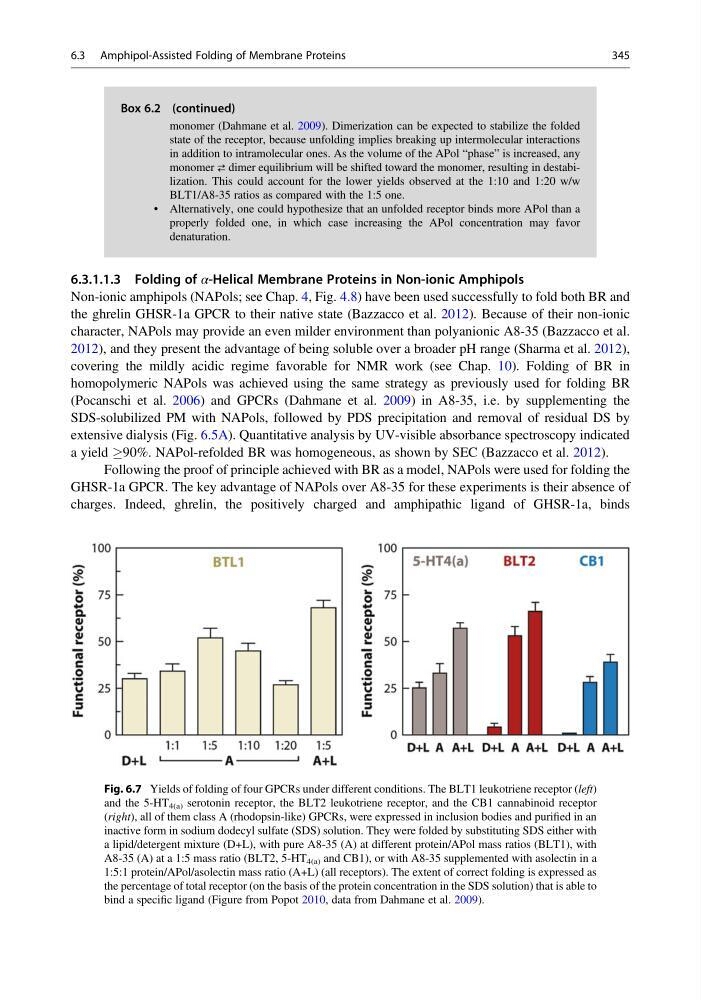
Fig. 6.7 Yields of folding of four GPCRs under different conditions. The BLT1 leukotriene receptor (left)
and the 5-HT 4(a) serotonin receptor, the BLT2 leukotriene receptor, and the CB1 cannabinoid receptor
(right), all of them class A (rhodopsin-like) GPCRs, were expressed in inclusion bodies and purified in an
inactive form in sodium dodecyl sulfate (SDS) solution. They were folded by substituting SDS either with
a lipid/detergent mixture (D+L), with pure A8-35 (A) at different protein/APol mass ratios (BLT1), with
A8-35 (A) at a 1:5 mass ratio (BLT2, 5-HT 4(a) and CB1), or with A8-35 supplemented with asolectin in a
1:5:1 protein/APol/asolectin mass ratio (A+L) (all receptors). The extent of correct folding is expressed as
the percentage of total receptor (on the basis of the protein concentration in the SDS solution) that is able to
bind a specific ligand (Figure from Popot 2010, data from Dahmane et al. 2009).
6.3 Amphipol-Assisted Folding of Membrane Proteins
345
monomer (Dahmane et al. 2009). Dimerization can be expected to stabilize the folded
state of the receptor, because unfolding implies breaking up intermolecular interactions
in addition to intramolecular ones. As the volume of the APol “phase” is increased, any
monomer ⇄ dimer equilibrium will be shifted toward the monomer, resulting in destabilization. This could account for the lower yields observed at the 1:10 and 1:20 w/w
BLT1/A8-35 ratios as compared with the 1:5 one.
• Alternatively, one could hypothesize that an unfolded receptor binds more APol than a
properly folded one, in which case increasing the APol concentration may favor
denaturation.
6.3.1.1.3 Folding of α-Helical Membrane Proteins in Non-ionic Amphipols
Non-ionic amphipols (NAPols; see Chap. 4, Fig. 4.8) have been used successfully to fold both BR and
the ghrelin GHSR-1a GPCR to their native state (Bazzacco et al. 2012). Because of their non-ionic
character, NAPols may provide an even milder environment than polyanionic A8-35 (Bazzacco et al.
2012), and they present the advantage of being soluble over a broader pH range (Sharma et al. 2012),
covering the mildly acidic regime favorable for NMR work (see Chap. 10). Folding of BR in
homopolymeric NAPols was achieved using the same strategy as previously used for folding BR
(Pocanschi et al. 2006) and GPCRs (Dahmane et al. 2009) in A8-35, i.e. by supplementing the
SDS-solubilized PM with NAPols, followed by PDS precipitation and removal of residual DS by
extensive dialysis (Fig. 6.5A). Quantitative analysis by UV-visible absorbance spectroscopy indicated
a yield !90%. NAPol-refolded BR was homogeneous, as shown by SEC (Bazzacco et al. 2012).
Following the proof of principle achieved with BR as a model, NAPols were used for folding the
GHSR-1a GPCR. The key advantage of NAPols over A8-35 for these experiments is their absence of
charges. Indeed, ghrelin, the positively charged and amphipathic ligand of GHSR-1a, binds
Fig. 6.7 Yields of folding of four GPCRs under different conditions. The BLT1 leukotriene receptor (left)
and the 5-HT 4(a) serotonin receptor, the BLT2 leukotriene receptor, and the CB1 cannabinoid receptor
(right), all of them class A (rhodopsin-like) GPCRs, were expressed in inclusion bodies and purified in an
inactive form in sodium dodecyl sulfate (SDS) solution. They were folded by substituting SDS either with
a lipid/detergent mixture (D+L), with pure A8-35 (A) at different protein/APol mass ratios (BLT1), with
A8-35 (A) at a 1:5 mass ratio (BLT2, 5-HT 4(a) and CB1), or with A8-35 supplemented with asolectin in a
1:5:1 protein/APol/asolectin mass ratio (A+L) (all receptors). The extent of correct folding is expressed as
the percentage of total receptor (on the basis of the protein concentration in the SDS solution) that is able to
bind a specific ligand (Figure from Popot 2010, data from Dahmane et al. 2009).
6.3 Amphipol-Assisted Folding of Membrane Proteins
345