

1.4
Membrane Protein Structure
1.4.1
Modes of Association with the Membrane
For reasons that will be briefly discussed below, and treated more at length in other chapters of the
book, knowledge of the structure of MPs has long lagged behind that of soluble proteins, and it still
does. The first electron-density map whose resolution was sufficient to show the secondary structure
elements of a TM protein region, that of BR, was obtained in 1975 by Richard Henderson and Nigel
Unwin using electron cryomicroscopy (cryo-EM) (Henderson and Unwin 1975). It showed the TM
region to be comprised of a bundle of seven α-helices oriented more or less normal to the plane of the
membrane. It took 15 more years to bring the structure of BR, still by cryo-EM, to a resolution
permitting an atomic model to be fitted into it (Henderson et al. 1990). The first X-ray structure of a
MP, that of a bacterial photosynthetic reaction center comprising three MPs and many cofactors, was
established in 1985 by Hartmut Michel and Johann Deisenhofer (Deisenhofer et al. 1985). Again, the
dominant theme of the TM region was bundles of α-helices. The first medium-resolution X-ray
structure of a bacterial outer MP, a trimeric porin, was established in 1989. It showed that each
monomer is comprised of a TM β-barrel (Weiss et al. 1989, 1991a, b). The first MP structures obtained
by solution NMR, those of the α-helix dimer of glycophorin A (MacKenzie et al. 1997) and of two
small β-barrel outer membrane proteins (Arora et al. 2001; Fernández et al. 2002), date back to the turn
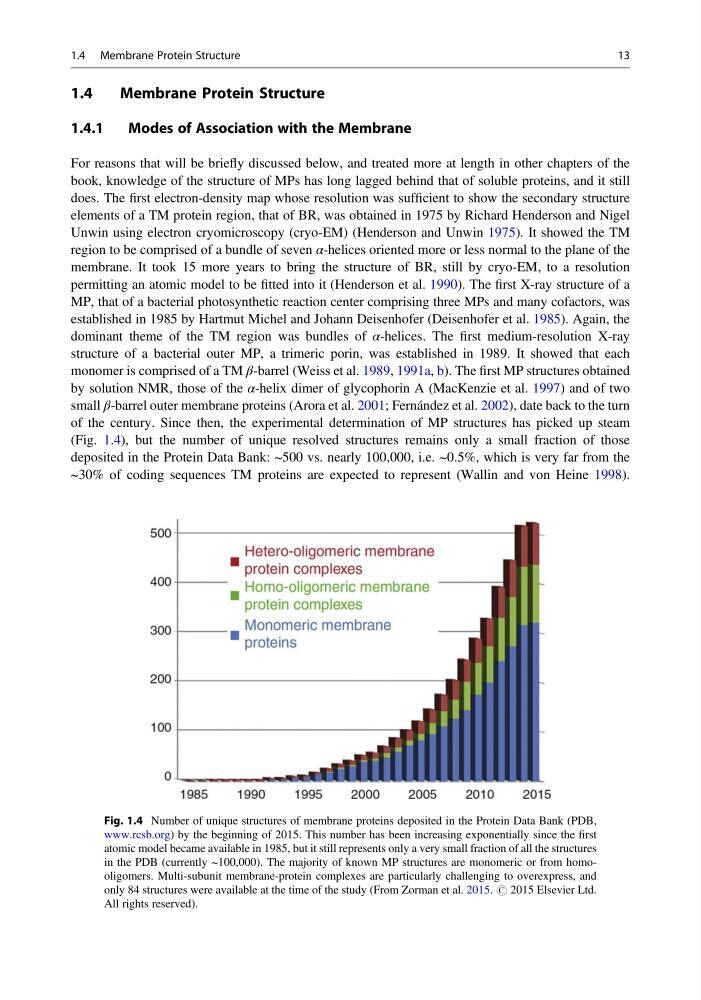
of the century. Since then, the experimental determination of MP structures has picked up steam
(Fig. 1.4), but the number of unique resolved structures remains only a small fraction of those
deposited in the Protein Data Bank: ~500 vs. nearly 100,000, i.e. ~0.5%, which is very far from the
~30% of coding sequences TM proteins are expected to represent (Wallin and von Heine 1998).
Fig. 1.4 Number of unique structures of membrane proteins deposited in the Protein Data Bank (PDB,
www.rcsb.org) by the beginning of 2015. This number has been increasing exponentially since the first
atomic model became available in 1985, but it still represents only a very small fraction of all the structures
in the PDB (currently ~100,000). The majority of known MP structures are monomeric or from homooligomers. Multi-subunit membrane-protein complexes are particularly challenging to overexpress, and
only 84 structures were available at the time of the study (From Zorman et al. 2015. # 2015 Elsevier Ltd.
All rights reserved).
1.4 Membrane Protein Structure
13
Membrane Protein Structure
1.4.1
Modes of Association with the Membrane
For reasons that will be briefly discussed below, and treated more at length in other chapters of the
book, knowledge of the structure of MPs has long lagged behind that of soluble proteins, and it still
does. The first electron-density map whose resolution was sufficient to show the secondary structure
elements of a TM protein region, that of BR, was obtained in 1975 by Richard Henderson and Nigel
Unwin using electron cryomicroscopy (cryo-EM) (Henderson and Unwin 1975). It showed the TM
region to be comprised of a bundle of seven α-helices oriented more or less normal to the plane of the
membrane. It took 15 more years to bring the structure of BR, still by cryo-EM, to a resolution
permitting an atomic model to be fitted into it (Henderson et al. 1990). The first X-ray structure of a
MP, that of a bacterial photosynthetic reaction center comprising three MPs and many cofactors, was
established in 1985 by Hartmut Michel and Johann Deisenhofer (Deisenhofer et al. 1985). Again, the
dominant theme of the TM region was bundles of α-helices. The first medium-resolution X-ray
structure of a bacterial outer MP, a trimeric porin, was established in 1989. It showed that each
monomer is comprised of a TM β-barrel (Weiss et al. 1989, 1991a, b). The first MP structures obtained
by solution NMR, those of the α-helix dimer of glycophorin A (MacKenzie et al. 1997) and of two
small β-barrel outer membrane proteins (Arora et al. 2001; Fernández et al. 2002), date back to the turn
of the century. Since then, the experimental determination of MP structures has picked up steam
(Fig. 1.4), but the number of unique resolved structures remains only a small fraction of those
deposited in the Protein Data Bank: ~500 vs. nearly 100,000, i.e. ~0.5%, which is very far from the
~30% of coding sequences TM proteins are expected to represent (Wallin and von Heine 1998).
Fig. 1.4 Number of unique structures of membrane proteins deposited in the Protein Data Bank (PDB,
www.rcsb.org) by the beginning of 2015. This number has been increasing exponentially since the first
atomic model became available in 1985, but it still represents only a very small fraction of all the structures
in the PDB (currently ~100,000). The majority of known MP structures are monomeric or from homooligomers. Multi-subunit membrane-protein complexes are particularly challenging to overexpress, and
only 84 structures were available at the time of the study (From Zorman et al. 2015. # 2015 Elsevier Ltd.
All rights reserved).
1.4 Membrane Protein Structure
13