

5.6.1
Functional Observations
As noted in § 5.4, most MPs are functional after trapping with APols. However, at variance with these
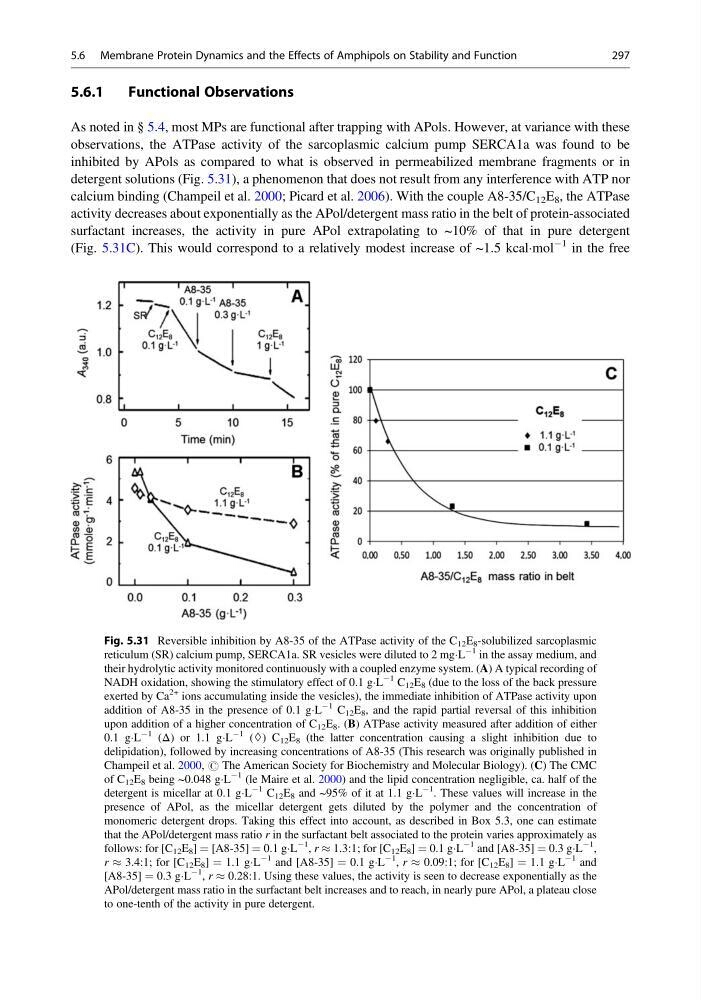
observations, the ATPase activity of the sarcoplasmic calcium pump SERCA1a was found to be
inhibited by APols as compared to what is observed in permeabilized membrane fragments or in
detergent solutions (Fig. 5.31), a phenomenon that does not result from any interference with ATP nor
calcium binding (Champeil et al. 2000; Picard et al. 2006). With the couple A8-35/C 12 E 8 , the ATPase
activity decreases about exponentially as the APol/detergent mass ratio in the belt of protein-associated
surfactant increases, the activity in pure APol extrapolating to ~10% of that in pure detergent
(Fig. 5.31C). This would correspond to a relatively modest increase of ~1.5 kcalÁmol
À1 in the free
Fig. 5.31 Reversible inhibition by A8-35 of the ATPase activity of the C 12 E 8 -solubilized sarcoplasmic
reticulum (SR) calcium pump, SERCA1a. SR vesicles were diluted to 2 mgÁL
À1 in the assay medium, and
their hydrolytic activity monitored continuously with a coupled enzyme system. (A) A typical recording of
NADH oxidation, showing the stimulatory effect of 0.1 gÁL
À1 C 12 E 8 (due to the loss of the back pressure
exerted by Ca
2+ ions accumulating inside the vesicles), the immediate inhibition of ATPase activity upon
addition of A8-35 in the presence of 0.1 gÁL
À1 C 12 E 8 , and the rapid partial reversal of this inhibition
upon addition of a higher concentration of C 12 E 8 . (B) ATPase activity measured after addition of either
0.1 gÁL
À1 (Δ) or 1.1 gÁL
À1 (◊) C 12 E 8 (the latter concentration causing a slight inhibition due to
delipidation), followed by increasing concentrations of A8-35 (This research was originally published in
Champeil et al. 2000, # The American Society for Biochemistry and Molecular Biology). (C) The CMC
of C 12 E 8 being ~0.048 gÁL
À1 (le Maire et al. 2000) and the lipid concentration negligible, ca. half of the
detergent is micellar at 0.1 gÁL
À1 C 12 E 8 and ~95% of it at 1.1 gÁL
À1
. These values will increase in the
presence of APol, as the micellar detergent gets diluted by the polymer and the concentration of
monomeric detergent drops. Taking this effect into account, as described in Box 5.3, one can estimate
that the APol/detergent mass ratio r in the surfactant belt associated to the protein varies approximately as
follows: for [C 12 E 8 ] ¼ [A8-35] ¼ 0.1 gÁL
À1
, r % 1.3:1; for [C 12 E 8 ] ¼ 0.1 gÁL
À1 and [A8-35] ¼ 0.3 gÁL
À1
,
r % 3.4:1; for [C 12 E 8 ] ¼ 1.1 gÁL
À1 and [A8-35] ¼ 0.1 gÁL
À1
, r % 0.09:1; for [C 12 E 8 ] ¼ 1.1 gÁL
À1 and
[A8-35] ¼ 0.3 gÁL
À1
, r % 0.28:1. Using these values, the activity is seen to decrease exponentially as the
APol/detergent mass ratio in the surfactant belt increases and to reach, in nearly pure APol, a plateau close
to one-tenth of the activity in pure detergent.
5.6 Membrane Protein Dynamics and the Effects of Amphipols on Stability and Function
297
Functional Observations
As noted in § 5.4, most MPs are functional after trapping with APols. However, at variance with these
observations, the ATPase activity of the sarcoplasmic calcium pump SERCA1a was found to be
inhibited by APols as compared to what is observed in permeabilized membrane fragments or in
detergent solutions (Fig. 5.31), a phenomenon that does not result from any interference with ATP nor
calcium binding (Champeil et al. 2000; Picard et al. 2006). With the couple A8-35/C 12 E 8 , the ATPase
activity decreases about exponentially as the APol/detergent mass ratio in the belt of protein-associated
surfactant increases, the activity in pure APol extrapolating to ~10% of that in pure detergent
(Fig. 5.31C). This would correspond to a relatively modest increase of ~1.5 kcalÁmol
À1 in the free
Fig. 5.31 Reversible inhibition by A8-35 of the ATPase activity of the C 12 E 8 -solubilized sarcoplasmic
reticulum (SR) calcium pump, SERCA1a. SR vesicles were diluted to 2 mgÁL
À1 in the assay medium, and
their hydrolytic activity monitored continuously with a coupled enzyme system. (A) A typical recording of
NADH oxidation, showing the stimulatory effect of 0.1 gÁL
À1 C 12 E 8 (due to the loss of the back pressure
exerted by Ca
2+ ions accumulating inside the vesicles), the immediate inhibition of ATPase activity upon
addition of A8-35 in the presence of 0.1 gÁL
À1 C 12 E 8 , and the rapid partial reversal of this inhibition
upon addition of a higher concentration of C 12 E 8 . (B) ATPase activity measured after addition of either
0.1 gÁL
À1 (Δ) or 1.1 gÁL
À1 (◊) C 12 E 8 (the latter concentration causing a slight inhibition due to
delipidation), followed by increasing concentrations of A8-35 (This research was originally published in
Champeil et al. 2000, # The American Society for Biochemistry and Molecular Biology). (C) The CMC
of C 12 E 8 being ~0.048 gÁL
À1 (le Maire et al. 2000) and the lipid concentration negligible, ca. half of the
detergent is micellar at 0.1 gÁL
À1 C 12 E 8 and ~95% of it at 1.1 gÁL
À1
. These values will increase in the
presence of APol, as the micellar detergent gets diluted by the polymer and the concentration of
monomeric detergent drops. Taking this effect into account, as described in Box 5.3, one can estimate
that the APol/detergent mass ratio r in the surfactant belt associated to the protein varies approximately as
follows: for [C 12 E 8 ] ¼ [A8-35] ¼ 0.1 gÁL
À1
, r % 1.3:1; for [C 12 E 8 ] ¼ 0.1 gÁL
À1 and [A8-35] ¼ 0.3 gÁL
À1
,
r % 3.4:1; for [C 12 E 8 ] ¼ 1.1 gÁL
À1 and [A8-35] ¼ 0.1 gÁL
À1
, r % 0.09:1; for [C 12 E 8 ] ¼ 1.1 gÁL
À1 and
[A8-35] ¼ 0.3 gÁL
À1
, r % 0.28:1. Using these values, the activity is seen to decrease exponentially as the
APol/detergent mass ratio in the surfactant belt increases and to reach, in nearly pure APol, a plateau close
to one-tenth of the activity in pure detergent.
5.6 Membrane Protein Dynamics and the Effects of Amphipols on Stability and Function
297