

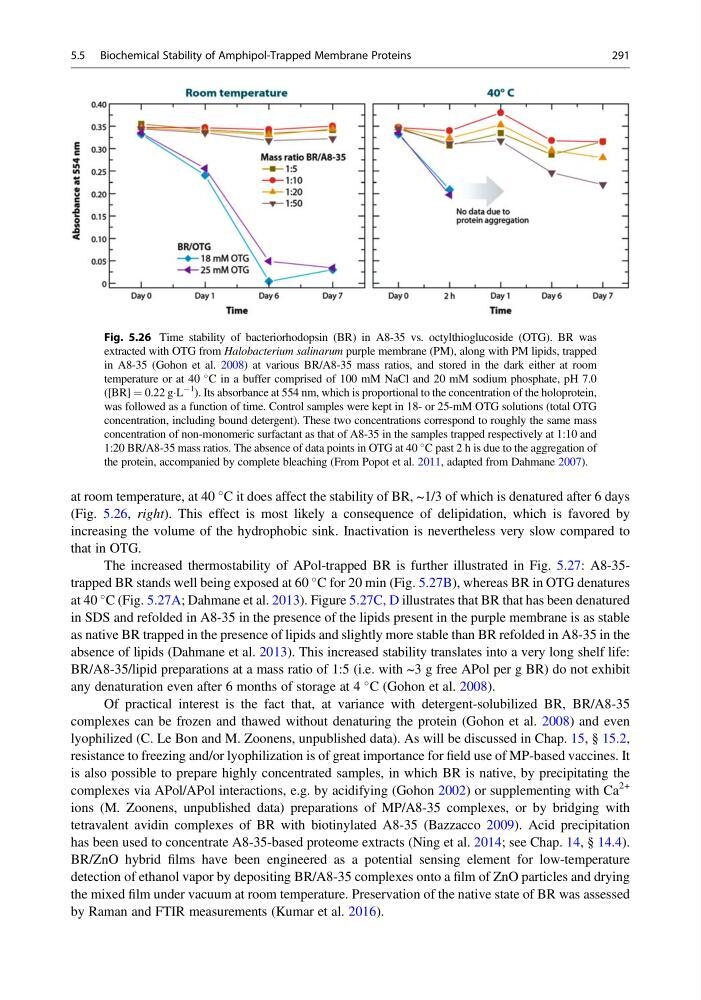
at room temperature, at 40
C it does affect the stability of BR, ~1/3 of which is denatured after 6 days
(Fig. 5.26, right). This effect is most likely a consequence of delipidation, which is favored by
increasing the volume of the hydrophobic sink. Inactivation is nevertheless very slow compared to
that in OTG.
The increased thermostability of APol-trapped BR is further illustrated in Fig. 5.27: A8-35trapped BR stands well being exposed at 60
C for 20 min (Fig. 5.27B), whereas BR in OTG denatures
at 40
C (Fig. 5.27A; Dahmane et al. 2013). Figure 5.27C, D illustrates that BR that has been denatured
in SDS and refolded in A8-35 in the presence of the lipids present in the purple membrane is as stable
as native BR trapped in the presence of lipids and slightly more stable than BR refolded in A8-35 in the
absence of lipids (Dahmane et al. 2013). This increased stability translates into a very long shelf life:
BR/A8-35/lipid preparations at a mass ratio of 1:5 (i.e. with ~3 g free APol per g BR) do not exhibit
any denaturation even after 6 months of storage at 4
C (Gohon et al. 2008).
Of practical interest is the fact that, at variance with detergent-solubilized BR, BR/A8-35
complexes can be frozen and thawed without denaturing the protein (Gohon et al. 2008) and even
lyophilized (C. Le Bon and M. Zoonens, unpublished data). As will be discussed in Chap. 15, § 15.2,
resistance to freezing and/or lyophilization is of great importance for field use of MP-based vaccines. It
is also possible to prepare highly concentrated samples, in which BR is native, by precipitating the
complexes via APol/APol interactions, e.g. by acidifying (Gohon 2002) or supplementing with Ca
2+
ions (M. Zoonens, unpublished data) preparations of MP/A8-35 complexes, or by bridging with
tetravalent avidin complexes of BR with biotinylated A8-35 (Bazzacco 2009). Acid precipitation
has been used to concentrate A8-35-based proteome extracts (Ning et al. 2014; see Chap. 14, § 14.4).
BR/ZnO hybrid films have been engineered as a potential sensing element for low-temperature
detection of ethanol vapor by depositing BR/A8-35 complexes onto a film of ZnO particles and drying
the mixed film under vacuum at room temperature. Preservation of the native state of BR was assessed
by Raman and FTIR measurements (Kumar et al. 2016).
Fig. 5.26 Time stability of bacteriorhodopsin (BR) in A8-35 vs. octylthioglucoside (OTG). BR was
extracted with OTG from Halobacterium salinarum purple membrane (PM), along with PM lipids, trapped
in A8-35 (Gohon et al. 2008) at various BR/A8-35 mass ratios, and stored in the dark either at room
temperature or at 40
C in a buffer comprised of 100 mM NaCl and 20 mM sodium phosphate, pH 7.0
([BR] ¼ 0.22 gÁL
À1
). Its absorbance at 554 nm, which is proportional to the concentration of the holoprotein,
was followed as a function of time. Control samples were kept in 18- or 25-mM OTG solutions (total OTG
concentration, including bound detergent). These two concentrations correspond to roughly the same mass
concentration of non-monomeric surfactant as that of A8-35 in the samples trapped respectively at 1:10 and
1:20 BR/A8-35 mass ratios. The absence of data points in OTG at 40
C past 2 h is due to the aggregation of
the protein, accompanied by complete bleaching (From Popot et al. 2011, adapted from Dahmane 2007).
5.5 Biochemical Stability of Amphipol-Trapped Membrane Proteins
291
C it does affect the stability of BR, ~1/3 of which is denatured after 6 days
(Fig. 5.26, right). This effect is most likely a consequence of delipidation, which is favored by
increasing the volume of the hydrophobic sink. Inactivation is nevertheless very slow compared to
that in OTG.
The increased thermostability of APol-trapped BR is further illustrated in Fig. 5.27: A8-35trapped BR stands well being exposed at 60
C for 20 min (Fig. 5.27B), whereas BR in OTG denatures
at 40
C (Fig. 5.27A; Dahmane et al. 2013). Figure 5.27C, D illustrates that BR that has been denatured
in SDS and refolded in A8-35 in the presence of the lipids present in the purple membrane is as stable
as native BR trapped in the presence of lipids and slightly more stable than BR refolded in A8-35 in the
absence of lipids (Dahmane et al. 2013). This increased stability translates into a very long shelf life:
BR/A8-35/lipid preparations at a mass ratio of 1:5 (i.e. with ~3 g free APol per g BR) do not exhibit
any denaturation even after 6 months of storage at 4
C (Gohon et al. 2008).
Of practical interest is the fact that, at variance with detergent-solubilized BR, BR/A8-35
complexes can be frozen and thawed without denaturing the protein (Gohon et al. 2008) and even
lyophilized (C. Le Bon and M. Zoonens, unpublished data). As will be discussed in Chap. 15, § 15.2,
resistance to freezing and/or lyophilization is of great importance for field use of MP-based vaccines. It
is also possible to prepare highly concentrated samples, in which BR is native, by precipitating the
complexes via APol/APol interactions, e.g. by acidifying (Gohon 2002) or supplementing with Ca
2+
ions (M. Zoonens, unpublished data) preparations of MP/A8-35 complexes, or by bridging with
tetravalent avidin complexes of BR with biotinylated A8-35 (Bazzacco 2009). Acid precipitation
has been used to concentrate A8-35-based proteome extracts (Ning et al. 2014; see Chap. 14, § 14.4).
BR/ZnO hybrid films have been engineered as a potential sensing element for low-temperature
detection of ethanol vapor by depositing BR/A8-35 complexes onto a film of ZnO particles and drying
the mixed film under vacuum at room temperature. Preservation of the native state of BR was assessed
by Raman and FTIR measurements (Kumar et al. 2016).
Fig. 5.26 Time stability of bacteriorhodopsin (BR) in A8-35 vs. octylthioglucoside (OTG). BR was
extracted with OTG from Halobacterium salinarum purple membrane (PM), along with PM lipids, trapped
in A8-35 (Gohon et al. 2008) at various BR/A8-35 mass ratios, and stored in the dark either at room
temperature or at 40
C in a buffer comprised of 100 mM NaCl and 20 mM sodium phosphate, pH 7.0
([BR] ¼ 0.22 gÁL
À1
). Its absorbance at 554 nm, which is proportional to the concentration of the holoprotein,
was followed as a function of time. Control samples were kept in 18- or 25-mM OTG solutions (total OTG
concentration, including bound detergent). These two concentrations correspond to roughly the same mass
concentration of non-monomeric surfactant as that of A8-35 in the samples trapped respectively at 1:10 and
1:20 BR/A8-35 mass ratios. The absence of data points in OTG at 40
C past 2 h is due to the aggregation of
the protein, accompanied by complete bleaching (From Popot et al. 2011, adapted from Dahmane 2007).
5.5 Biochemical Stability of Amphipol-Trapped Membrane Proteins
291