

5.3.3
Protein/Polymer Interactions
Most of the information on MP/APol interactions is derived from either NMR measurements or MD
simulations. NMR data will be discussed in detail in Chap. 10. They show, in brief, that contacts
between the polymer and the protein, as deduced from magnetization transfer between the
two partners, are essentially limited to the TM surface of the latter (Zoonens et al. 2005; Catoire
et al. 2009; Planchard et al. 2014). The polymer restricts water accessibility to this surface, as observed
by
1
H/
2
H exchange (Catoire et al. 2010b) or sensitivity to a water-soluble paramagnetic agent (Etzkorn
et al. 2014). The relaxivities of OmpX amide protons in A8-35 correlate remarkably well with those in
diC 6 PC, showing that both surfactants adsorb specifically onto the hydrophobic surface of OmpX
and with a similar distribution (Etzkorn et al. 2014; see e.g. Fig. 10.13 in Chap. 10).
Fast photochemical oxidation coupled with liquid chromatography and MS/MS has been used to
compare the accessibility of the surface of OmpT, either kept in solution by DDM or trapped with
A8-35, to hydroxyl radicals generated by laser photolysis of H 2 O 2 (Watkinson et al. 2017). The study
shows that the distribution of the two surfactants is qualitatively similar, with the same residues being
protected in each case. However, a quantitative analysis of the degree of modification indicates that
A8-35 affords a better protection to the surface of the β-barrel that extends into the extracellular space
beyond the TM region, suggesting either the existence of extramembrane contacts or an effect on the
dynamics of the protein (see § 5.6), whereas the DDM belt appears to cover better some regions of the
TM surface on the periplasmic side of the membrane (Watkinson et al. 2017; see Fig. 14.14 in
Chap. 14). These experiments will be described in more detail in Chap. 14, § 14.3.3.
Experimental data have been complemented by MD simulations of an A8-35-trapped MP,
OmpX (Perlmutter et al. 2014), using the parametrization and procedures developed previously for
the simulation of A8-35 particles (Perlmutter et al. 2011; see Chap. 4, § 4.3.1.2.3). Because no
experimental measurement of the mass of A8-35 bound by OmpX is yet available, a first step of the
MD analysis was to determine the minimal amount of polymer needed to cover the whole TM surface,
in conformity with NMR data (Catoire et al. 2009, 2010b; Etzkorn et al. 2014). One copy of OmpX
was placed in a simulation box, supplemented with increasing amounts of A8-35, and left to
equilibrate. For practical reasons, A8-35 increments from one simulation to the next were set to the
relatively high mass of ~11 kDa (~90 polymer units). As shown in Fig. 5.21, three increments
(~33 kDa) did adsorb onto the TM surface of OmpX, but did not suffice to cover it entirely; four
increments (~44 kDa) achieved complete coverage, whereas five increments (~55 kDa) resulted only
in increasing the thickness of the APol belt. The value of 44 kDa is significantly higher than the value
of ~25 kDa determined for the binding of A8-35 to tOmpA, a protein with a similar structure and size
as OmpX (Zoonens 2004; Zoonens et al. 2007). The experimental value, however, for reasons
discussed in § 5.3.1.1, is likely to be an underestimate (Zoonens et al. 2007). On the contrary, the
MD value of 44 kDa may be a slight excess as compared to what actually binds in vitro, given that
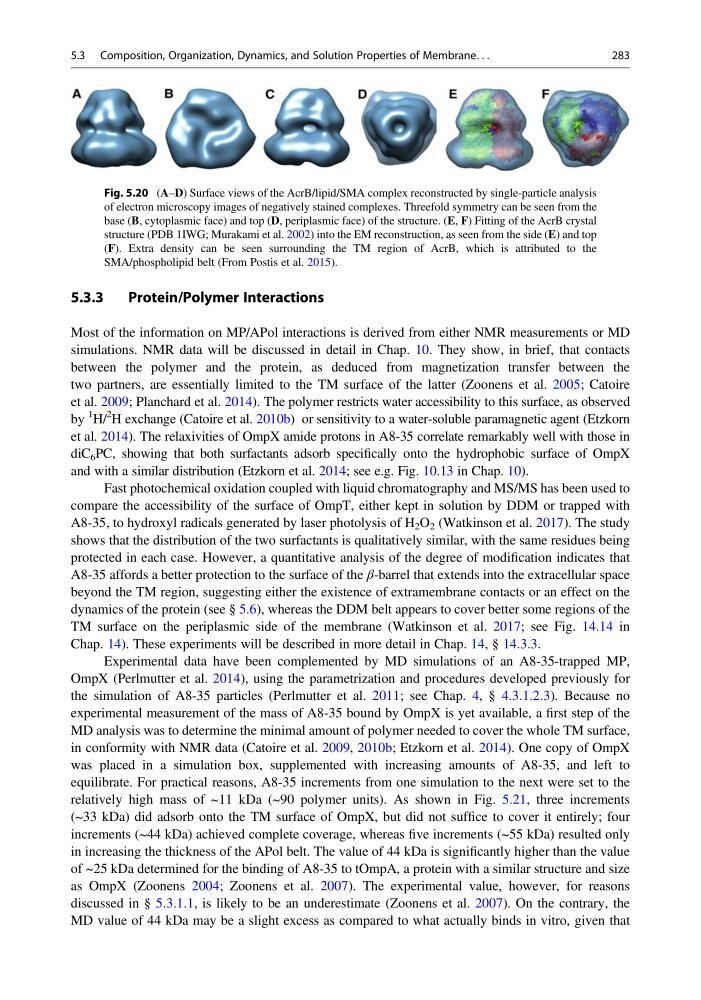
Fig. 5.20 (A–D) Surface views of the AcrB/lipid/SMA complex reconstructed by single-particle analysis
of electron microscopy images of negatively stained complexes. Threefold symmetry can be seen from the
base (B, cytoplasmic face) and top (D, periplasmic face) of the structure. (E, F) Fitting of the AcrB crystal
structure (PDB 1IWG; Murakami et al. 2002) into the EM reconstruction, as seen from the side (E) and top
(F). Extra density can be seen surrounding the TM region of AcrB, which is attributed to the
SMA/phospholipid belt (From Postis et al. 2015).
5.3 Composition, Organization, Dynamics, and Solution Properties of Membrane. . .
283
Protein/Polymer Interactions
Most of the information on MP/APol interactions is derived from either NMR measurements or MD
simulations. NMR data will be discussed in detail in Chap. 10. They show, in brief, that contacts
between the polymer and the protein, as deduced from magnetization transfer between the
two partners, are essentially limited to the TM surface of the latter (Zoonens et al. 2005; Catoire
et al. 2009; Planchard et al. 2014). The polymer restricts water accessibility to this surface, as observed
by
1
H/
2
H exchange (Catoire et al. 2010b) or sensitivity to a water-soluble paramagnetic agent (Etzkorn
et al. 2014). The relaxivities of OmpX amide protons in A8-35 correlate remarkably well with those in
diC 6 PC, showing that both surfactants adsorb specifically onto the hydrophobic surface of OmpX
and with a similar distribution (Etzkorn et al. 2014; see e.g. Fig. 10.13 in Chap. 10).
Fast photochemical oxidation coupled with liquid chromatography and MS/MS has been used to
compare the accessibility of the surface of OmpT, either kept in solution by DDM or trapped with
A8-35, to hydroxyl radicals generated by laser photolysis of H 2 O 2 (Watkinson et al. 2017). The study
shows that the distribution of the two surfactants is qualitatively similar, with the same residues being
protected in each case. However, a quantitative analysis of the degree of modification indicates that
A8-35 affords a better protection to the surface of the β-barrel that extends into the extracellular space
beyond the TM region, suggesting either the existence of extramembrane contacts or an effect on the
dynamics of the protein (see § 5.6), whereas the DDM belt appears to cover better some regions of the
TM surface on the periplasmic side of the membrane (Watkinson et al. 2017; see Fig. 14.14 in
Chap. 14). These experiments will be described in more detail in Chap. 14, § 14.3.3.
Experimental data have been complemented by MD simulations of an A8-35-trapped MP,
OmpX (Perlmutter et al. 2014), using the parametrization and procedures developed previously for
the simulation of A8-35 particles (Perlmutter et al. 2011; see Chap. 4, § 4.3.1.2.3). Because no
experimental measurement of the mass of A8-35 bound by OmpX is yet available, a first step of the
MD analysis was to determine the minimal amount of polymer needed to cover the whole TM surface,
in conformity with NMR data (Catoire et al. 2009, 2010b; Etzkorn et al. 2014). One copy of OmpX
was placed in a simulation box, supplemented with increasing amounts of A8-35, and left to
equilibrate. For practical reasons, A8-35 increments from one simulation to the next were set to the
relatively high mass of ~11 kDa (~90 polymer units). As shown in Fig. 5.21, three increments
(~33 kDa) did adsorb onto the TM surface of OmpX, but did not suffice to cover it entirely; four
increments (~44 kDa) achieved complete coverage, whereas five increments (~55 kDa) resulted only
in increasing the thickness of the APol belt. The value of 44 kDa is significantly higher than the value
of ~25 kDa determined for the binding of A8-35 to tOmpA, a protein with a similar structure and size
as OmpX (Zoonens 2004; Zoonens et al. 2007). The experimental value, however, for reasons
discussed in § 5.3.1.1, is likely to be an underestimate (Zoonens et al. 2007). On the contrary, the
MD value of 44 kDa may be a slight excess as compared to what actually binds in vitro, given that
Fig. 5.20 (A–D) Surface views of the AcrB/lipid/SMA complex reconstructed by single-particle analysis
of electron microscopy images of negatively stained complexes. Threefold symmetry can be seen from the
base (B, cytoplasmic face) and top (D, periplasmic face) of the structure. (E, F) Fitting of the AcrB crystal
structure (PDB 1IWG; Murakami et al. 2002) into the EM reconstruction, as seen from the side (E) and top
(F). Extra density can be seen surrounding the TM region of AcrB, which is attributed to the
SMA/phospholipid belt (From Postis et al. 2015).
5.3 Composition, Organization, Dynamics, and Solution Properties of Membrane. . .
283