

Sterols contribute to smoothing out fluidity changes of membrane lipids over a broad range of
temperatures. From one organism to another, and from one compartment to another within a single
cell in a given organism, the lipid composition of membranes is extremely variable. Furthermore, the
two monolayers (leaflets) that comprise a bilayer do not usually have the same composition: in
eukaryotic plasma membranes, for instance, the outer monolayer is devoid of negatively charged
lipids, which are confined to the inner one. This asymmetry is actively maintained by the cell.
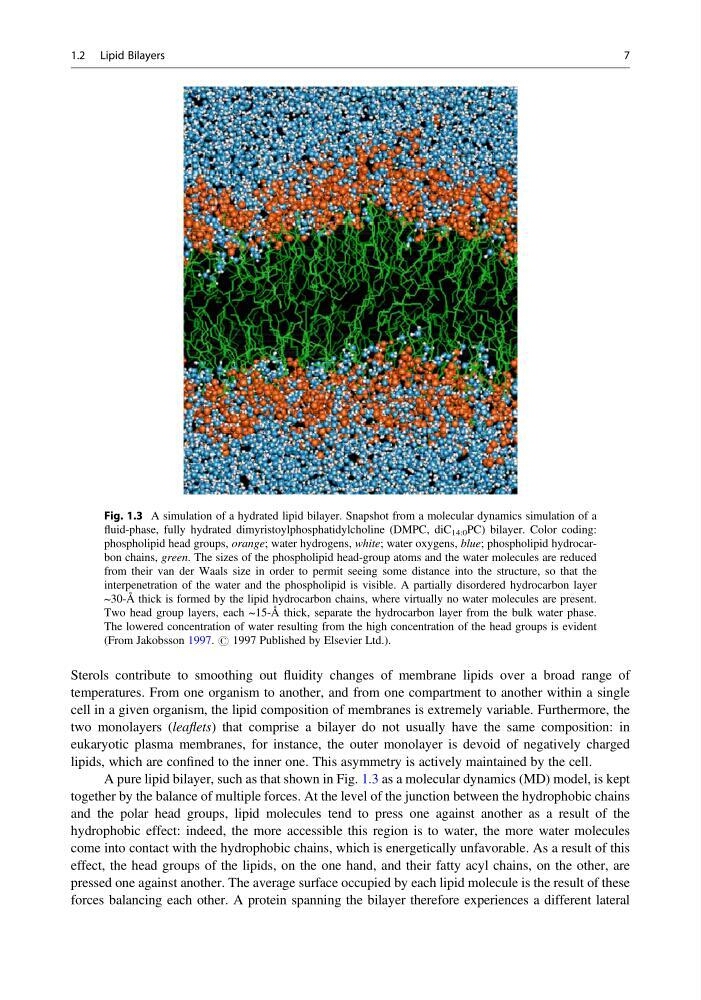
A pure lipid bilayer, such as that shown in Fig. 1.3 as a molecular dynamics (MD) model, is kept
together by the balance of multiple forces. At the level of the junction between the hydrophobic chains
and the polar head groups, lipid molecules tend to press one against another as a result of the
hydrophobic effect: indeed, the more accessible this region is to water, the more water molecules
come into contact with the hydrophobic chains, which is energetically unfavorable. As a result of this
effect, the head groups of the lipids, on the one hand, and their fatty acyl chains, on the other, are
pressed one against another. The average surface occupied by each lipid molecule is the result of these
forces balancing each other. A protein spanning the bilayer therefore experiences a different lateral
Fig. 1.3 A simulation of a hydrated lipid bilayer. Snapshot from a molecular dynamics simulation of a
fluid-phase, fully hydrated dimyristoylphosphatidylcholine (DMPC, diC 14:0 PC) bilayer. Color coding:
phospholipid head groups, orange; water hydrogens, white; water oxygens, blue; phospholipid hydrocarbon chains, green. The sizes of the phospholipid head-group atoms and the water molecules are reduced
from their van der Waals size in order to permit seeing some distance into the structure, so that the
interpenetration of the water and the phospholipid is visible. A partially disordered hydrocarbon layer
~30-Å thick is formed by the lipid hydrocarbon chains, where virtually no water molecules are present.
Two head group layers, each ~15-Å thick, separate the hydrocarbon layer from the bulk water phase.
The lowered concentration of water resulting from the high concentration of the head groups is evident
(From Jakobsson 1997. # 1997 Published by Elsevier Ltd.).
1.2 Lipid Bilayers
7
temperatures. From one organism to another, and from one compartment to another within a single
cell in a given organism, the lipid composition of membranes is extremely variable. Furthermore, the
two monolayers (leaflets) that comprise a bilayer do not usually have the same composition: in
eukaryotic plasma membranes, for instance, the outer monolayer is devoid of negatively charged
lipids, which are confined to the inner one. This asymmetry is actively maintained by the cell.
A pure lipid bilayer, such as that shown in Fig. 1.3 as a molecular dynamics (MD) model, is kept
together by the balance of multiple forces. At the level of the junction between the hydrophobic chains
and the polar head groups, lipid molecules tend to press one against another as a result of the
hydrophobic effect: indeed, the more accessible this region is to water, the more water molecules
come into contact with the hydrophobic chains, which is energetically unfavorable. As a result of this
effect, the head groups of the lipids, on the one hand, and their fatty acyl chains, on the other, are
pressed one against another. The average surface occupied by each lipid molecule is the result of these
forces balancing each other. A protein spanning the bilayer therefore experiences a different lateral
Fig. 1.3 A simulation of a hydrated lipid bilayer. Snapshot from a molecular dynamics simulation of a
fluid-phase, fully hydrated dimyristoylphosphatidylcholine (DMPC, diC 14:0 PC) bilayer. Color coding:
phospholipid head groups, orange; water hydrogens, white; water oxygens, blue; phospholipid hydrocarbon chains, green. The sizes of the phospholipid head-group atoms and the water molecules are reduced
from their van der Waals size in order to permit seeing some distance into the structure, so that the
interpenetration of the water and the phospholipid is visible. A partially disordered hydrocarbon layer
~30-Å thick is formed by the lipid hydrocarbon chains, where virtually no water molecules are present.
Two head group layers, each ~15-Å thick, separate the hydrocarbon layer from the bulk water phase.
The lowered concentration of water resulting from the high concentration of the head groups is evident
(From Jakobsson 1997. # 1997 Published by Elsevier Ltd.).
1.2 Lipid Bilayers
7