

5.3.1.1 Amphipol vs. Detergent Binding
Table 5.5 summarizes existing data about the composition of MP/APol complexes (no data are
currently available about the protein/polymer ratio in MP/SMA and MP/NVoy complexes). When a
comparison of APol vs. detergent (DDM) binding is possible, one notes a marked tendency for MPs to
bind less APols than DDM, whether surfactant binding is expressed in mass ratio to the protein or as
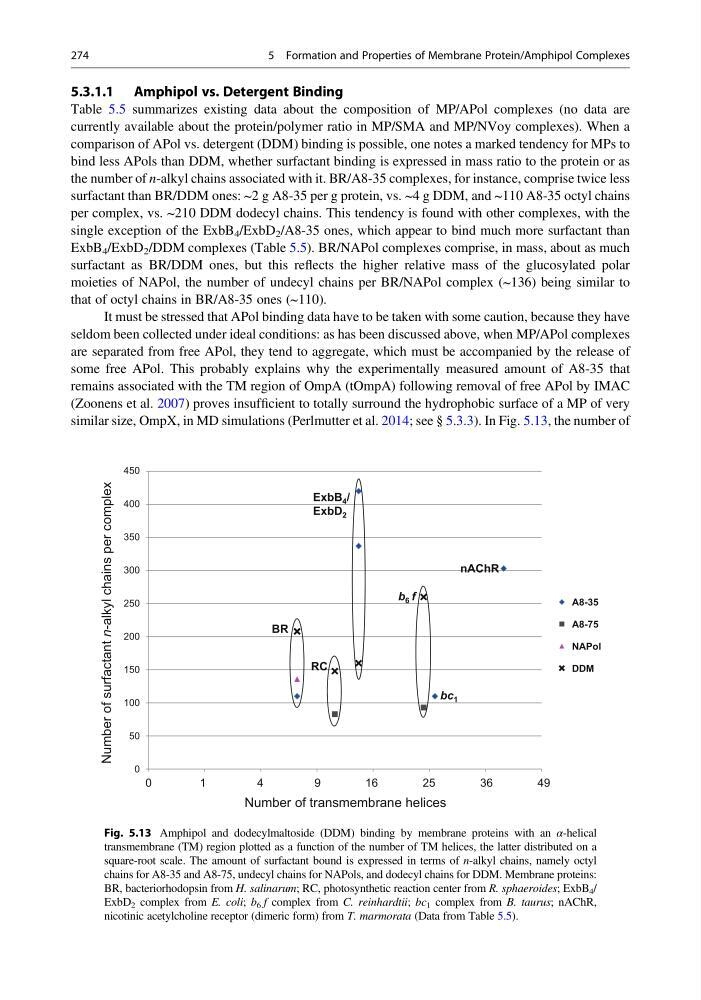
the number of n-alkyl chains associated with it. BR/A8-35 complexes, for instance, comprise twice less
surfactant than BR/DDM ones: ~2 g A8-35 per g protein, vs. ~4 g DDM, and ~110 A8-35 octyl chains
per complex, vs. ~210 DDM dodecyl chains. This tendency is found with other complexes, with the
single exception of the ExbB 4 /ExbD 2 /A8-35 ones, which appear to bind much more surfactant than
ExbB 4 /ExbD 2 /DDM complexes (Table 5.5). BR/NAPol complexes comprise, in mass, about as much
surfactant as BR/DDM ones, but this reflects the higher relative mass of the glucosylated polar
moieties of NAPol, the number of undecyl chains per BR/NAPol complex (~136) being similar to
that of octyl chains in BR/A8-35 ones (~110).
It must be stressed that APol binding data have to be taken with some caution, because they have
seldom been collected under ideal conditions: as has been discussed above, when MP/APol complexes
are separated from free APol, they tend to aggregate, which must be accompanied by the release of
some free APol. This probably explains why the experimentally measured amount of A8-35 that
remains associated with the TM region of OmpA (tOmpA) following removal of free APol by IMAC
(Zoonens et al. 2007) proves insufficient to totally surround the hydrophobic surface of a MP of very
similar size, OmpX, in MD simulations (Perlmutter et al. 2014; see § 5.3.3). In Fig. 5.13, the number of
Number of transmembrane helices
Number of surfactant
n-alkyl chains per complex
450
400
350
300
250
200
150
100
50
0
0
1
4
9
16
25
36
49
A8-35
A8-75
NAPol
DDM
BR
b 6 f
RC
ExbB 4 /
ExbD 2
bc 1
nAChR
Fig. 5.13 Amphipol and dodecylmaltoside (DDM) binding by membrane proteins with an α-helical
transmembrane (TM) region plotted as a function of the number of TM helices, the latter distributed on a
square-root scale. The amount of surfactant bound is expressed in terms of n-alkyl chains, namely octyl
chains for A8-35 and A8-75, undecyl chains for NAPols, and dodecyl chains for DDM. Membrane proteins:
BR, bacteriorhodopsin from H. salinarum; RC, photosynthetic reaction center from R. sphaeroides; ExbB 4 /
ExbD 2 complex from E. coli; b 6 f complex from C. reinhardtii; bc 1 complex from B. taurus; nAChR,
nicotinic acetylcholine receptor (dimeric form) from T. marmorata (Data from Table 5.5).
274
5 Formation and Properties of Membrane Protein/Amphipol Complexes
Table 5.5 summarizes existing data about the composition of MP/APol complexes (no data are
currently available about the protein/polymer ratio in MP/SMA and MP/NVoy complexes). When a
comparison of APol vs. detergent (DDM) binding is possible, one notes a marked tendency for MPs to
bind less APols than DDM, whether surfactant binding is expressed in mass ratio to the protein or as
the number of n-alkyl chains associated with it. BR/A8-35 complexes, for instance, comprise twice less
surfactant than BR/DDM ones: ~2 g A8-35 per g protein, vs. ~4 g DDM, and ~110 A8-35 octyl chains
per complex, vs. ~210 DDM dodecyl chains. This tendency is found with other complexes, with the
single exception of the ExbB 4 /ExbD 2 /A8-35 ones, which appear to bind much more surfactant than
ExbB 4 /ExbD 2 /DDM complexes (Table 5.5). BR/NAPol complexes comprise, in mass, about as much
surfactant as BR/DDM ones, but this reflects the higher relative mass of the glucosylated polar
moieties of NAPol, the number of undecyl chains per BR/NAPol complex (~136) being similar to
that of octyl chains in BR/A8-35 ones (~110).
It must be stressed that APol binding data have to be taken with some caution, because they have
seldom been collected under ideal conditions: as has been discussed above, when MP/APol complexes
are separated from free APol, they tend to aggregate, which must be accompanied by the release of
some free APol. This probably explains why the experimentally measured amount of A8-35 that
remains associated with the TM region of OmpA (tOmpA) following removal of free APol by IMAC
(Zoonens et al. 2007) proves insufficient to totally surround the hydrophobic surface of a MP of very
similar size, OmpX, in MD simulations (Perlmutter et al. 2014; see § 5.3.3). In Fig. 5.13, the number of
Number of transmembrane helices
Number of surfactant
n-alkyl chains per complex
450
400
350
300
250
200
150
100
50
0
0
1
4
9
16
25
36
49
A8-35
A8-75
NAPol
DDM
BR
b 6 f
RC
ExbB 4 /
ExbD 2
bc 1
nAChR
Fig. 5.13 Amphipol and dodecylmaltoside (DDM) binding by membrane proteins with an α-helical
transmembrane (TM) region plotted as a function of the number of TM helices, the latter distributed on a
square-root scale. The amount of surfactant bound is expressed in terms of n-alkyl chains, namely octyl
chains for A8-35 and A8-75, undecyl chains for NAPols, and dodecyl chains for DDM. Membrane proteins:
BR, bacteriorhodopsin from H. salinarum; RC, photosynthetic reaction center from R. sphaeroides; ExbB 4 /
ExbD 2 complex from E. coli; b 6 f complex from C. reinhardtii; bc 1 complex from B. taurus; nAChR,
nicotinic acetylcholine receptor (dimeric form) from T. marmorata (Data from Table 5.5).
274
5 Formation and Properties of Membrane Protein/Amphipol Complexes