

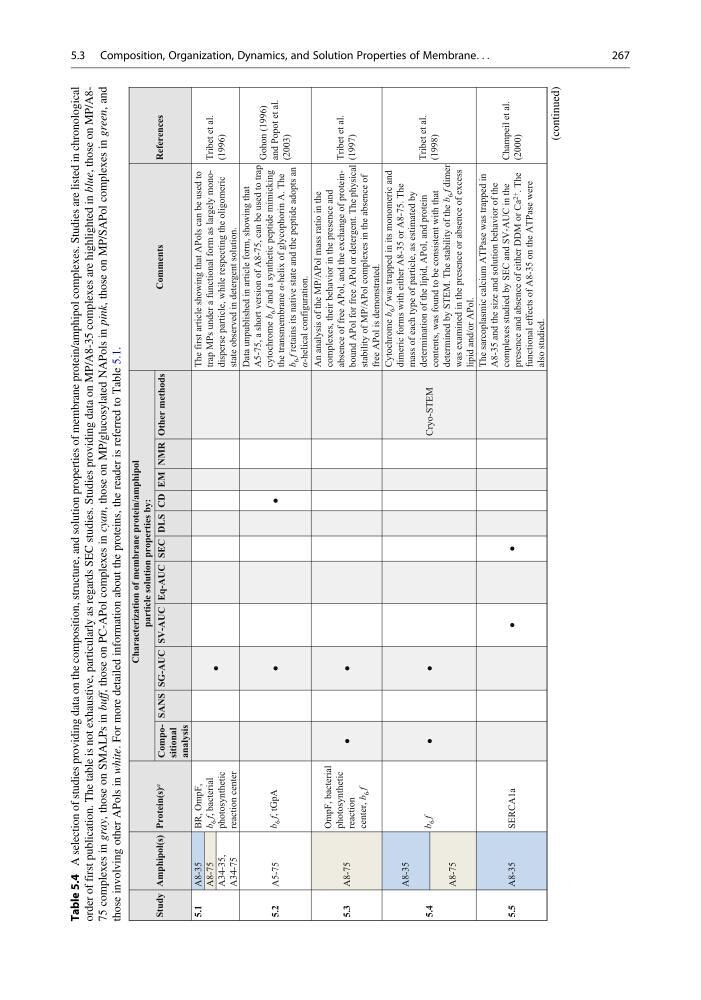
Table 5.4
A selection of studies providing data on the composition, structure, and solution properties of membrane protein/amphipol complexes. Studies are listed in chronological
order of first publication. The table is not exhaustive, particularly as regards SEC studies. Studies providing data on MP/A8-35 complexes are highlighted in blue,
those on MP/A875 complexes in gray,
those on SMALPs in buff,
those on PC-APol complexes in cyan,
those on MP/glucosylated NAPols in pink,
those on MP/SAPol complexes in green,
and
those involving other APols in white.
For more detailed information about the proteins, the reader is referred to Table 5.1.
Study Amphipol(s) Protein(s) a
Characterization of membrane protein/amphipol
particle solution properties by:
Comments
References
Compositional
analysis
SANS SG-AUC SV-AUC Eq-AUC SEC DLS CD EM NMR Other methods
5.1
A8-35
BR, OmpF,
b
6 f, bacterial
photosynthetic
reaction center
●
The first article showing that APols can be used to
trap MPs under a functional form as largely monodisperse particle, while respecting the oligomeric
state observed in detergent solution.
Tribet et al.
(1996)
A8-75
A34-35,
A34-75
5.2
A5-75
b
6 f, tGpA
●
●
Data unpublished in article form, showing that
A5-75, a short version of A8-75, can be used to trap
cytochrome b
6 f and a synthetic peptide mimicking
the transmembrane α-helix of glycophorin A. The
b
6 f retains its native state and the peptide adopts an
α-helical configuration.
Gohon (1996)
and Popot et al.
(2003)
5.3
A8-75
OmpF, bacterial
photosynthetic
reaction
center, b
6 f
●
●
An analysis of the MP/APol mass ratio in the
complexes, their behavior in the presence and
absence of free APol, and the exchange of proteinbound APol for free APol or detergent. The physical
stability of MP/APol complexes in the absence of
free APol is demonstrated.
Tribet et al.
(1997)
5.4
A8-35
b
6 f
●
●
Cryo-STEM
Cytochrome b
6 f was trapped in its monomeric and
dimeric forms with either A8-35 or A8-75. The
mass of each type of particle, as estimated by
determination of the lipid, APol, and protein
contents, was found to be consistent with that
determined by STEM. The stability of the b
6 f dimer
was examined in the presence or absence of excess
lipid and/or APol.
Tribet et al.
(1998)
A8-75
5.5
A8-35
SERCA1a
●
●
The sarcoplasmic calcium ATPase was trapped in
A8-35 and the size and solution behavior of the
complexes studied by SEC and SV-AUC in the
presence and absence of either DDM or Ca 2+
. The
functional effects of A8-35 on the ATPase were
also studied.
Champeil et al.
(2000)
(continued)
5.3 Composition, Organization, Dynamics, and Solution Properties of Membrane. . .
267
A selection of studies providing data on the composition, structure, and solution properties of membrane protein/amphipol complexes. Studies are listed in chronological
order of first publication. The table is not exhaustive, particularly as regards SEC studies. Studies providing data on MP/A8-35 complexes are highlighted in blue,
those on MP/A875 complexes in gray,
those on SMALPs in buff,
those on PC-APol complexes in cyan,
those on MP/glucosylated NAPols in pink,
those on MP/SAPol complexes in green,
and
those involving other APols in white.
For more detailed information about the proteins, the reader is referred to Table 5.1.
Study Amphipol(s) Protein(s) a
Characterization of membrane protein/amphipol
particle solution properties by:
Comments
References
Compositional
analysis
SANS SG-AUC SV-AUC Eq-AUC SEC DLS CD EM NMR Other methods
5.1
A8-35
BR, OmpF,
b
6 f, bacterial
photosynthetic
reaction center
●
The first article showing that APols can be used to
trap MPs under a functional form as largely monodisperse particle, while respecting the oligomeric
state observed in detergent solution.
Tribet et al.
(1996)
A8-75
A34-35,
A34-75
5.2
A5-75
b
6 f, tGpA
●
●
Data unpublished in article form, showing that
A5-75, a short version of A8-75, can be used to trap
cytochrome b
6 f and a synthetic peptide mimicking
the transmembrane α-helix of glycophorin A. The
b
6 f retains its native state and the peptide adopts an
α-helical configuration.
Gohon (1996)
and Popot et al.
(2003)
5.3
A8-75
OmpF, bacterial
photosynthetic
reaction
center, b
6 f
●
●
An analysis of the MP/APol mass ratio in the
complexes, their behavior in the presence and
absence of free APol, and the exchange of proteinbound APol for free APol or detergent. The physical
stability of MP/APol complexes in the absence of
free APol is demonstrated.
Tribet et al.
(1997)
5.4
A8-35
b
6 f
●
●
Cryo-STEM
Cytochrome b
6 f was trapped in its monomeric and
dimeric forms with either A8-35 or A8-75. The
mass of each type of particle, as estimated by
determination of the lipid, APol, and protein
contents, was found to be consistent with that
determined by STEM. The stability of the b
6 f dimer
was examined in the presence or absence of excess
lipid and/or APol.
Tribet et al.
(1998)
A8-75
5.5
A8-35
SERCA1a
●
●
The sarcoplasmic calcium ATPase was trapped in
A8-35 and the size and solution behavior of the
complexes studied by SEC and SV-AUC in the
presence and absence of either DDM or Ca 2+
. The
functional effects of A8-35 on the ATPase were
also studied.
Champeil et al.
(2000)
(continued)
5.3 Composition, Organization, Dynamics, and Solution Properties of Membrane. . .
267