

(see Chap. 12, § 12.3.1). Cross-linking data suggest the same behavior of diacylglycerol kinase
(DAGK) complexed by either OAPA-20 or PMAL-B when the excess APol is removed (Nagy et al.
2001).
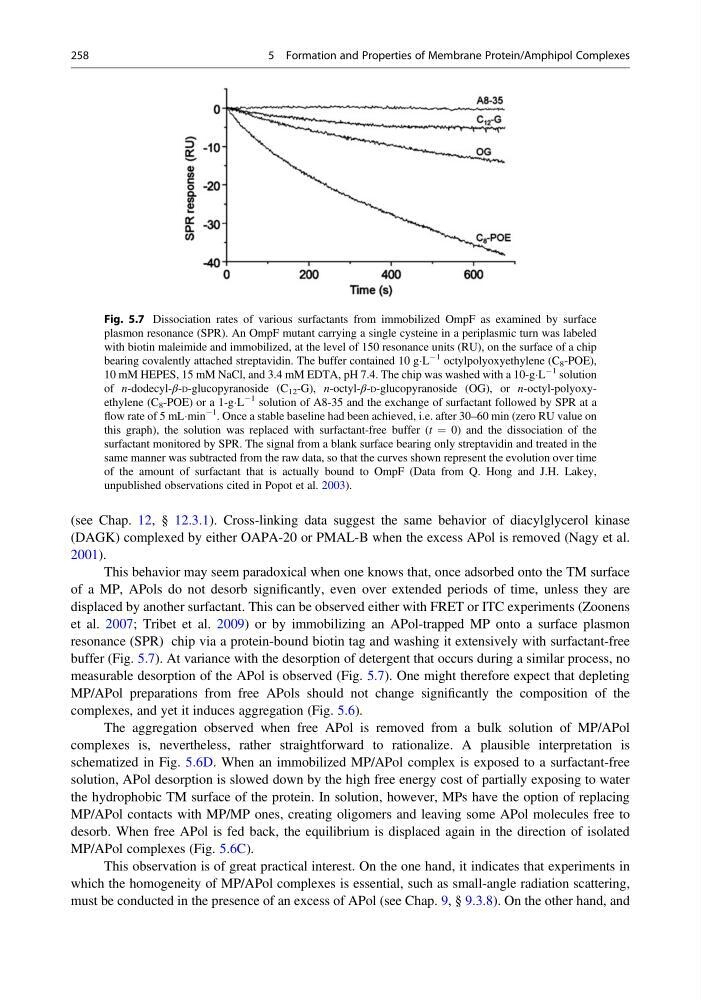
This behavior may seem paradoxical when one knows that, once adsorbed onto the TM surface
of a MP, APols do not desorb significantly, even over extended periods of time, unless they are
displaced by another surfactant. This can be observed either with FRET or ITC experiments (Zoonens
et al. 2007; Tribet et al. 2009) or by immobilizing an APol-trapped MP onto a surface plasmon
resonance (SPR) chip via a protein-bound biotin tag and washing it extensively with surfactant-free
buffer (Fig. 5.7). At variance with the desorption of detergent that occurs during a similar process, no
measurable desorption of the APol is observed (Fig. 5.7). One might therefore expect that depleting
MP/APol preparations from free APols should not change significantly the composition of the
complexes, and yet it induces aggregation (Fig. 5.6).
The aggregation observed when free APol is removed from a bulk solution of MP/APol
complexes is, nevertheless, rather straightforward to rationalize. A plausible interpretation is
schematized in Fig. 5.6D. When an immobilized MP/APol complex is exposed to a surfactant-free
solution, APol desorption is slowed down by the high free energy cost of partially exposing to water
the hydrophobic TM surface of the protein. In solution, however, MPs have the option of replacing
MP/APol contacts with MP/MP ones, creating oligomers and leaving some APol molecules free to
desorb. When free APol is fed back, the equilibrium is displaced again in the direction of isolated
MP/APol complexes (Fig. 5.6C).
This observation is of great practical interest. On the one hand, it indicates that experiments in
which the homogeneity of MP/APol complexes is essential, such as small-angle radiation scattering,
must be conducted in the presence of an excess of APol (see Chap. 9, § 9.3.8). On the other hand, and
Fig. 5.7 Dissociation rates of various surfactants from immobilized OmpF as examined by surface
plasmon resonance (SPR). An OmpF mutant carrying a single cysteine in a periplasmic turn was labeled
with biotin maleimide and immobilized, at the level of 150 resonance units (RU), on the surface of a chip
bearing covalently attached streptavidin. The buffer contained 10 gÁL
À1 octylpolyoxyethylene (C 8 -POE),
10 mM HEPES, 15 mM NaCl, and 3.4 mM EDTA, pH 7.4. The chip was washed with a 10-gÁL
À1 solution
of n-dodecyl-β-D-glucopyranoside (C 12 -G), n-octyl-β-D-glucopyranoside (OG), or n-octyl-polyoxyethylene (C 8 -POE) or a 1-gÁL
À1 solution of A8-35 and the exchange of surfactant followed by SPR at a
flow rate of 5 mLÁmin
À1
. Once a stable baseline had been achieved, i.e. after 30–60 min (zero RU value on
this graph), the solution was replaced with surfactant-free buffer (t ¼ 0) and the dissociation of the
surfactant monitored by SPR. The signal from a blank surface bearing only streptavidin and treated in the
same manner was subtracted from the raw data, so that the curves shown represent the evolution over time
of the amount of surfactant that is actually bound to OmpF (Data from Q. Hong and J.H. Lakey,
unpublished observations cited in Popot et al. 2003).
258
5 Formation and Properties of Membrane Protein/Amphipol Complexes
(DAGK) complexed by either OAPA-20 or PMAL-B when the excess APol is removed (Nagy et al.
2001).
This behavior may seem paradoxical when one knows that, once adsorbed onto the TM surface
of a MP, APols do not desorb significantly, even over extended periods of time, unless they are
displaced by another surfactant. This can be observed either with FRET or ITC experiments (Zoonens
et al. 2007; Tribet et al. 2009) or by immobilizing an APol-trapped MP onto a surface plasmon
resonance (SPR) chip via a protein-bound biotin tag and washing it extensively with surfactant-free
buffer (Fig. 5.7). At variance with the desorption of detergent that occurs during a similar process, no
measurable desorption of the APol is observed (Fig. 5.7). One might therefore expect that depleting
MP/APol preparations from free APols should not change significantly the composition of the
complexes, and yet it induces aggregation (Fig. 5.6).
The aggregation observed when free APol is removed from a bulk solution of MP/APol
complexes is, nevertheless, rather straightforward to rationalize. A plausible interpretation is
schematized in Fig. 5.6D. When an immobilized MP/APol complex is exposed to a surfactant-free
solution, APol desorption is slowed down by the high free energy cost of partially exposing to water
the hydrophobic TM surface of the protein. In solution, however, MPs have the option of replacing
MP/APol contacts with MP/MP ones, creating oligomers and leaving some APol molecules free to
desorb. When free APol is fed back, the equilibrium is displaced again in the direction of isolated
MP/APol complexes (Fig. 5.6C).
This observation is of great practical interest. On the one hand, it indicates that experiments in
which the homogeneity of MP/APol complexes is essential, such as small-angle radiation scattering,
must be conducted in the presence of an excess of APol (see Chap. 9, § 9.3.8). On the other hand, and
Fig. 5.7 Dissociation rates of various surfactants from immobilized OmpF as examined by surface
plasmon resonance (SPR). An OmpF mutant carrying a single cysteine in a periplasmic turn was labeled
with biotin maleimide and immobilized, at the level of 150 resonance units (RU), on the surface of a chip
bearing covalently attached streptavidin. The buffer contained 10 gÁL
À1 octylpolyoxyethylene (C 8 -POE),
10 mM HEPES, 15 mM NaCl, and 3.4 mM EDTA, pH 7.4. The chip was washed with a 10-gÁL
À1 solution
of n-dodecyl-β-D-glucopyranoside (C 12 -G), n-octyl-β-D-glucopyranoside (OG), or n-octyl-polyoxyethylene (C 8 -POE) or a 1-gÁL
À1 solution of A8-35 and the exchange of surfactant followed by SPR at a
flow rate of 5 mLÁmin
À1
. Once a stable baseline had been achieved, i.e. after 30–60 min (zero RU value on
this graph), the solution was replaced with surfactant-free buffer (t ¼ 0) and the dissociation of the
surfactant monitored by SPR. The signal from a blank surface bearing only streptavidin and treated in the
same manner was subtracted from the raw data, so that the curves shown represent the evolution over time
of the amount of surfactant that is actually bound to OmpF (Data from Q. Hong and J.H. Lakey,
unpublished observations cited in Popot et al. 2003).
258
5 Formation and Properties of Membrane Protein/Amphipol Complexes