

several functions (thiols, peroxides, other oxidants and reducers, etc.), this offers obvious opportunities for end-chain
modification and subsequent end-group functionalization.
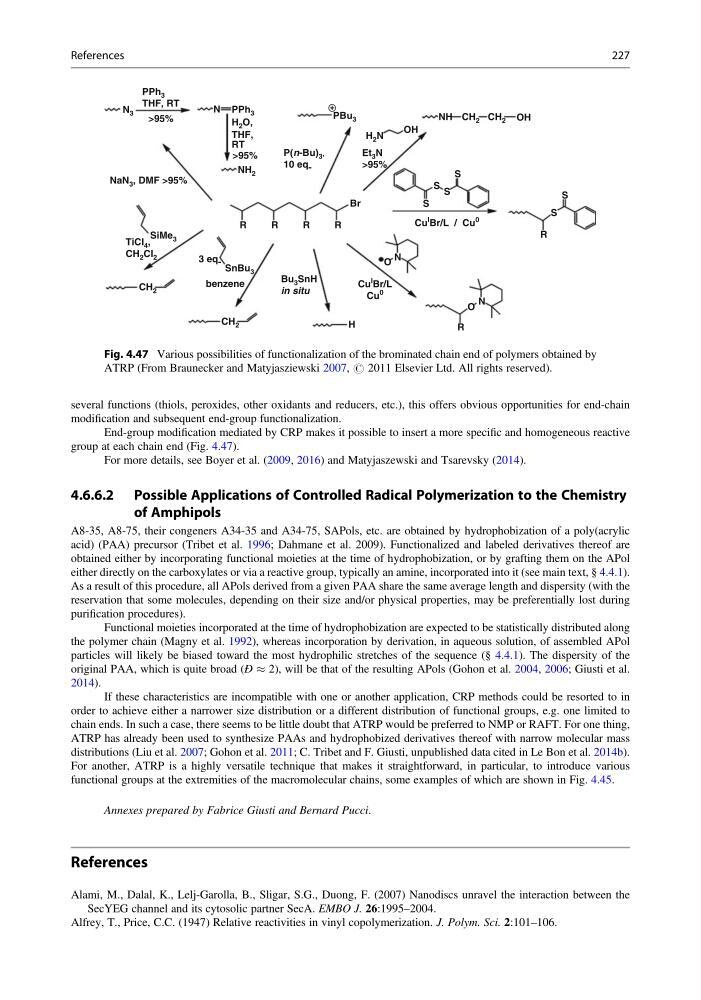
End-group modification mediated by CRP makes it possible to insert a more specific and homogeneous reactive
group at each chain end (Fig. 4.47).
For more details, see Boyer et al. (2009, 2016) and Matyjaszewski and Tsarevsky (2014).
4.6.6.2 Possible Applications of Controlled Radical Polymerization to the Chemistry
of Amphipols
A8-35, A8-75, their congeners A34-35 and A34-75, SAPols, etc. are obtained by hydrophobization of a poly(acrylic
acid) (PAA) precursor (Tribet et al. 1996; Dahmane et al. 2009). Functionalized and labeled derivatives thereof are
obtained either by incorporating functional moieties at the time of hydrophobization, or by grafting them on the APol
either directly on the carboxylates or via a reactive group, typically an amine, incorporated into it (see main text, § 4.4.1).
As a result of this procedure, all APols derived from a given PAA share the same average length and dispersity (with the
reservation that some molecules, depending on their size and/or physical properties, may be preferentially lost during
purification procedures).
Functional moieties incorporated at the time of hydrophobization are expected to be statistically distributed along
the polymer chain (Magny et al. 1992), whereas incorporation by derivation, in aqueous solution, of assembled APol
particles will likely be biased toward the most hydrophilic stretches of the sequence (§ 4.4.1). The dispersity of the
original PAA, which is quite broad (Đ % 2), will be that of the resulting APols (Gohon et al. 2004, 2006; Giusti et al.
2014).
If these characteristics are incompatible with one or another application, CRP methods could be resorted to in
order to achieve either a narrower size distribution or a different distribution of functional groups, e.g. one limited to
chain ends. In such a case, there seems to be little doubt that ATRP would be preferred to NMP or RAFT. For one thing,
ATRP has already been used to synthesize PAAs and hydrophobized derivatives thereof with narrow molecular mass
distributions (Liu et al. 2007; Gohon et al. 2011; C. Tribet and F. Giusti, unpublished data cited in Le Bon et al. 2014b).
For another, ATRP is a highly versatile technique that makes it straightforward, in particular, to introduce various
functional groups at the extremities of the macromolecular chains, some examples of which are shown in Fig. 4.45.
Annexes prepared by Fabrice Giusti and Bernard Pucci.
References
Alami, M., Dalal, K., Lelj-Garolla, B., Sligar, S.G., Duong, F. (2007) Nanodiscs unravel the interaction between the
SecYEG channel and its cytosolic partner SecA. EMBO J. 26:1995–2004.
Alfrey, T., Price, C.C. (1947) Relative reactivities in vinyl copolymerization. J. Polym. Sci. 2:101–106.
N 3
NaN 3 , DMF >95%
OH
S
S
S
S
S
S
R
R
O
N
N
O
H
R
R
R
R
Br
OH
PPh 3
THF, RT
PPh 3
PBu 3
H 2 N
CH 2
CH 2
CH 2
CH 2
benzene
Cu
I
Br/L / Cu
0
Cu
I
Br/L
Cu
0
3 eq - SnBu 3
TiCI 4 ,
CH 2 CI 2
Bu 3 SnH
in situ
P(n-Bu) 3 ,
10 eq -
SiMe 3
NH
Et 3 N
>95%
H 2 O,
THF,
RT
NH 2
>95%
>95%
N
+
Fig. 4.47 Various possibilities of functionalization of the brominated chain end of polymers obtained by
ATRP (From Braunecker and Matyjasziewski 2007, # 2011 Elsevier Ltd. All rights reserved).
References
227
modification and subsequent end-group functionalization.
End-group modification mediated by CRP makes it possible to insert a more specific and homogeneous reactive
group at each chain end (Fig. 4.47).
For more details, see Boyer et al. (2009, 2016) and Matyjaszewski and Tsarevsky (2014).
4.6.6.2 Possible Applications of Controlled Radical Polymerization to the Chemistry
of Amphipols
A8-35, A8-75, their congeners A34-35 and A34-75, SAPols, etc. are obtained by hydrophobization of a poly(acrylic
acid) (PAA) precursor (Tribet et al. 1996; Dahmane et al. 2009). Functionalized and labeled derivatives thereof are
obtained either by incorporating functional moieties at the time of hydrophobization, or by grafting them on the APol
either directly on the carboxylates or via a reactive group, typically an amine, incorporated into it (see main text, § 4.4.1).
As a result of this procedure, all APols derived from a given PAA share the same average length and dispersity (with the
reservation that some molecules, depending on their size and/or physical properties, may be preferentially lost during
purification procedures).
Functional moieties incorporated at the time of hydrophobization are expected to be statistically distributed along
the polymer chain (Magny et al. 1992), whereas incorporation by derivation, in aqueous solution, of assembled APol
particles will likely be biased toward the most hydrophilic stretches of the sequence (§ 4.4.1). The dispersity of the
original PAA, which is quite broad (Đ % 2), will be that of the resulting APols (Gohon et al. 2004, 2006; Giusti et al.
2014).
If these characteristics are incompatible with one or another application, CRP methods could be resorted to in
order to achieve either a narrower size distribution or a different distribution of functional groups, e.g. one limited to
chain ends. In such a case, there seems to be little doubt that ATRP would be preferred to NMP or RAFT. For one thing,
ATRP has already been used to synthesize PAAs and hydrophobized derivatives thereof with narrow molecular mass
distributions (Liu et al. 2007; Gohon et al. 2011; C. Tribet and F. Giusti, unpublished data cited in Le Bon et al. 2014b).
For another, ATRP is a highly versatile technique that makes it straightforward, in particular, to introduce various
functional groups at the extremities of the macromolecular chains, some examples of which are shown in Fig. 4.45.
Annexes prepared by Fabrice Giusti and Bernard Pucci.
References
Alami, M., Dalal, K., Lelj-Garolla, B., Sligar, S.G., Duong, F. (2007) Nanodiscs unravel the interaction between the
SecYEG channel and its cytosolic partner SecA. EMBO J. 26:1995–2004.
Alfrey, T., Price, C.C. (1947) Relative reactivities in vinyl copolymerization. J. Polym. Sci. 2:101–106.
N 3
NaN 3 , DMF >95%
OH
S
S
S
S
S
S
R
R
O
N
N
O
H
R
R
R
R
Br
OH
PPh 3
THF, RT
PPh 3
PBu 3
H 2 N
CH 2
CH 2
CH 2
CH 2
benzene
Cu
I
Br/L / Cu
0
Cu
I
Br/L
Cu
0
3 eq - SnBu 3
TiCI 4 ,
CH 2 CI 2
Bu 3 SnH
in situ
P(n-Bu) 3 ,
10 eq -
SiMe 3
NH
Et 3 N
>95%
H 2 O,
THF,
RT
NH 2
>95%
>95%
N
+
Fig. 4.47 Various possibilities of functionalization of the brominated chain end of polymers obtained by
ATRP (From Braunecker and Matyjasziewski 2007, # 2011 Elsevier Ltd. All rights reserved).
References
227