

target either the extremities or internal, lateral reactive sites, depending on the desired location and number of functional
groups, etc.
Note that post-polymerization modification of polymer end chain would be easily conceivable for most polymers
without involving specific and sophisticated methods. Indeed, because of termination mechanisms, a polymer obtained
by RP is systematically prefunctionnalized at its extremities, either by the initiator (Ini-M 2n -Ini) or the initiator and an
olefin (Ini-M n -¼) or an alkane, depending on whether termination operates via recombination or disproportionation.
Because unreactive initiator moieties can be converted to more reactive group and because olefins are reactive toward
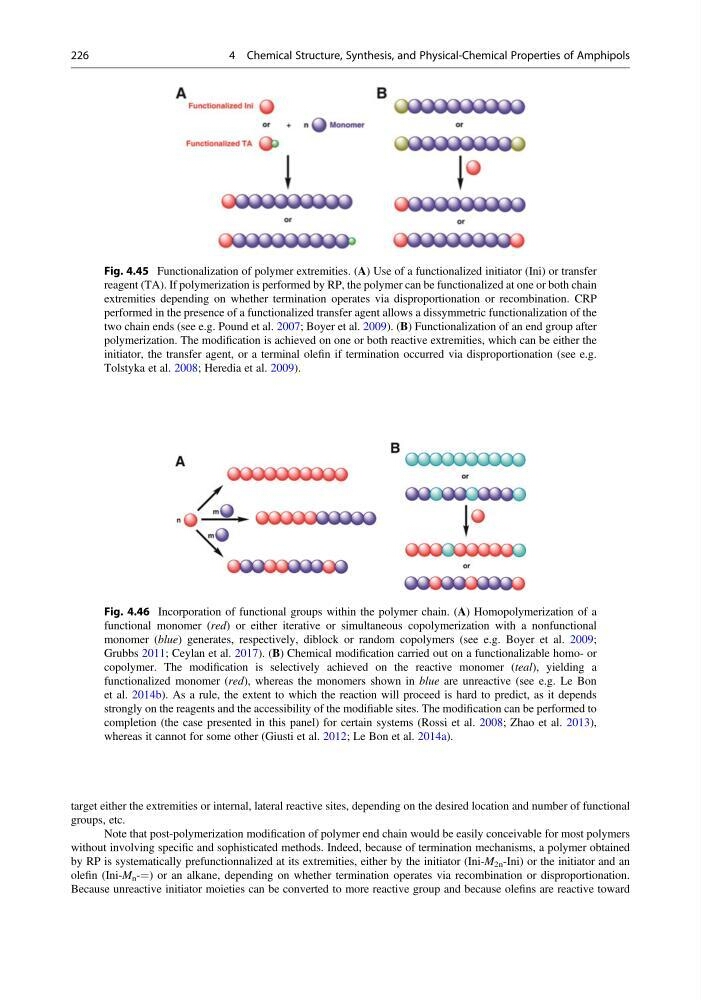
Fig. 4.45 Functionalization of polymer extremities. (A) Use of a functionalized initiator (Ini) or transfer
reagent (TA). If polymerization is performed by RP, the polymer can be functionalized at one or both chain
extremities depending on whether termination operates via disproportionation or recombination. CRP
performed in the presence of a functionalized transfer agent allows a dissymmetric functionalization of the
two chain ends (see e.g. Pound et al. 2007; Boyer et al. 2009). (B) Functionalization of an end group after
polymerization. The modification is achieved on one or both reactive extremities, which can be either the
initiator, the transfer agent, or a terminal olefin if termination occurred via disproportionation (see e.g.
Tolstyka et al. 2008; Heredia et al. 2009).
Fig. 4.46 Incorporation of functional groups within the polymer chain. (A) Homopolymerization of a
functional monomer (red) or either iterative or simultaneous copolymerization with a nonfunctional
monomer (blue) generates, respectively, diblock or random copolymers (see e.g. Boyer et al. 2009;
Grubbs 2011; Ceylan et al. 2017). (B) Chemical modification carried out on a functionalizable homo- or
copolymer. The modification is selectively achieved on the reactive monomer (teal), yielding a
functionalized monomer (red), whereas the monomers shown in blue are unreactive (see e.g. Le Bon
et al. 2014b). As a rule, the extent to which the reaction will proceed is hard to predict, as it depends
strongly on the reagents and the accessibility of the modifiable sites. The modification can be performed to
completion (the case presented in this panel) for certain systems (Rossi et al. 2008; Zhao et al. 2013),
whereas it cannot for some other (Giusti et al. 2012; Le Bon et al. 2014a).
226
4 Chemical Structure, Synthesis, and Physical-Chemical Properties of Amphipols
groups, etc.
Note that post-polymerization modification of polymer end chain would be easily conceivable for most polymers
without involving specific and sophisticated methods. Indeed, because of termination mechanisms, a polymer obtained
by RP is systematically prefunctionnalized at its extremities, either by the initiator (Ini-M 2n -Ini) or the initiator and an
olefin (Ini-M n -¼) or an alkane, depending on whether termination operates via recombination or disproportionation.
Because unreactive initiator moieties can be converted to more reactive group and because olefins are reactive toward
Fig. 4.45 Functionalization of polymer extremities. (A) Use of a functionalized initiator (Ini) or transfer
reagent (TA). If polymerization is performed by RP, the polymer can be functionalized at one or both chain
extremities depending on whether termination operates via disproportionation or recombination. CRP
performed in the presence of a functionalized transfer agent allows a dissymmetric functionalization of the
two chain ends (see e.g. Pound et al. 2007; Boyer et al. 2009). (B) Functionalization of an end group after
polymerization. The modification is achieved on one or both reactive extremities, which can be either the
initiator, the transfer agent, or a terminal olefin if termination occurred via disproportionation (see e.g.
Tolstyka et al. 2008; Heredia et al. 2009).
Fig. 4.46 Incorporation of functional groups within the polymer chain. (A) Homopolymerization of a
functional monomer (red) or either iterative or simultaneous copolymerization with a nonfunctional
monomer (blue) generates, respectively, diblock or random copolymers (see e.g. Boyer et al. 2009;
Grubbs 2011; Ceylan et al. 2017). (B) Chemical modification carried out on a functionalizable homo- or
copolymer. The modification is selectively achieved on the reactive monomer (teal), yielding a
functionalized monomer (red), whereas the monomers shown in blue are unreactive (see e.g. Le Bon
et al. 2014b). As a rule, the extent to which the reaction will proceed is hard to predict, as it depends
strongly on the reagents and the accessibility of the modifiable sites. The modification can be performed to
completion (the case presented in this panel) for certain systems (Rossi et al. 2008; Zhao et al. 2013),
whereas it cannot for some other (Giusti et al. 2012; Le Bon et al. 2014a).
226
4 Chemical Structure, Synthesis, and Physical-Chemical Properties of Amphipols