

d M 1
½
d M 2
½
¼
M 1
½
M 2
½
ð4:31Þ
• r 1 % r 2 % 0 or r 1 Ár 2 % 0: each comonomer shows a strong preference for cross-propagation (reaction with the
other comonomer), and in the extreme case, depending on the feed composition, the generated copolymer
presents a nearly perfect alternated sequence (such as styrene and maleic anhydride, which are the two
components of SMA, when present in a 1:1 ratio; see Di Cola et al. 2004). Equation 4.28 becomes:
d M 1
½
d M 2
½
¼ 1
ð4:32Þ
• r 1 < 1 and r 2 < 1: the preference for cross-propagation is not absolute, and the copolymerization is ruled by the
trend to a less pronounced alternation. For Eq. 4.31 to be verified, the composition (called azeotropic
composition) in the feed must be as follows:
M 1
½
M 2
½
¼
1 À r 2
1 À r 1
ð4:33Þ
• r 1 > 1 and r 2 < 1: each monomer reacts preferentially with M 1 , so the copolymer will be enriched in M 1 .
A special case is when r 1 Ár 2 % 1 and Eq. 4.28 becomes:
d M 1
½
d M 2
½
¼ r 1
M 1
½
M 2
½
ð4:34Þ
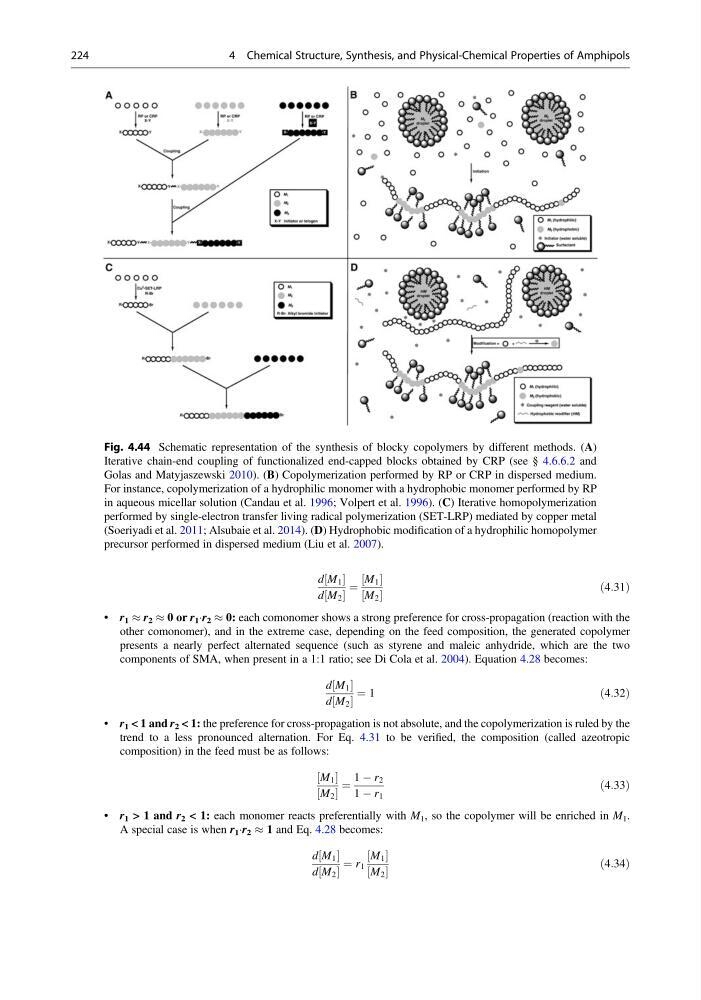
Fig. 4.44 Schematic representation of the synthesis of blocky copolymers by different methods. (A)
Iterative chain-end coupling of functionalized end-capped blocks obtained by CRP (see § 4.6.6.2 and
Golas and Matyjaszewski 2010). (B) Copolymerization performed by RP or CRP in dispersed medium.
For instance, copolymerization of a hydrophilic monomer with a hydrophobic monomer performed by RP
in aqueous micellar solution (Candau et al. 1996; Volpert et al. 1996). (C) Iterative homopolymerization
performed by single-electron transfer living radical polymerization (SET-LRP) mediated by copper metal
(Soeriyadi et al. 2011; Alsubaie et al. 2014). (D) Hydrophobic modification of a hydrophilic homopolymer
precursor performed in dispersed medium (Liu et al. 2007).
224
4 Chemical Structure, Synthesis, and Physical-Chemical Properties of Amphipols
½
d M 2
½
¼
M 1
½
M 2
½
ð4:31Þ
• r 1 % r 2 % 0 or r 1 Ár 2 % 0: each comonomer shows a strong preference for cross-propagation (reaction with the
other comonomer), and in the extreme case, depending on the feed composition, the generated copolymer
presents a nearly perfect alternated sequence (such as styrene and maleic anhydride, which are the two
components of SMA, when present in a 1:1 ratio; see Di Cola et al. 2004). Equation 4.28 becomes:
d M 1
½
d M 2
½
¼ 1
ð4:32Þ
• r 1 < 1 and r 2 < 1: the preference for cross-propagation is not absolute, and the copolymerization is ruled by the
trend to a less pronounced alternation. For Eq. 4.31 to be verified, the composition (called azeotropic
composition) in the feed must be as follows:
M 1
½
M 2
½
¼
1 À r 2
1 À r 1
ð4:33Þ
• r 1 > 1 and r 2 < 1: each monomer reacts preferentially with M 1 , so the copolymer will be enriched in M 1 .
A special case is when r 1 Ár 2 % 1 and Eq. 4.28 becomes:
d M 1
½
d M 2
½
¼ r 1
M 1
½
M 2
½
ð4:34Þ
Fig. 4.44 Schematic representation of the synthesis of blocky copolymers by different methods. (A)
Iterative chain-end coupling of functionalized end-capped blocks obtained by CRP (see § 4.6.6.2 and
Golas and Matyjaszewski 2010). (B) Copolymerization performed by RP or CRP in dispersed medium.
For instance, copolymerization of a hydrophilic monomer with a hydrophobic monomer performed by RP
in aqueous micellar solution (Candau et al. 1996; Volpert et al. 1996). (C) Iterative homopolymerization
performed by single-electron transfer living radical polymerization (SET-LRP) mediated by copper metal
(Soeriyadi et al. 2011; Alsubaie et al. 2014). (D) Hydrophobic modification of a hydrophilic homopolymer
precursor performed in dispersed medium (Liu et al. 2007).
224
4 Chemical Structure, Synthesis, and Physical-Chemical Properties of Amphipols