

Array (TDA) including a differential refractive index (RI) detector, a right-angle (90
) and a low-angle
(7
) light scattering (LS) detector (RALS/LALS), a four-capillary differential viscometer, and a diode
array UV detector. THF was used as the mobile phase at a flow rate of 1 mL‧min
À1 and toluene as a
flow rate marker. 100-μL samples of polymer solution (10 g‧L
À1 ) were injected after filtration through
a 0.45-μm pore-size membrane. The separation was carried out on three Polymer Laboratories columns
(3 Â PL gel; 5-μm Mixed C; 300 Â 7.5 mm) and a guard column (PL gel 5 μm). Columns and
detectors were kept at 40
C. The OmniSEC 4.6.2 software was used for data acquisition and analysis.
hM n i, hM w i, and the molar mass dispersity, Ð ¼ hM w i/hM n i (cf. § 4.6.1, Annex 4.1), were deduced
from a calibration curve based on narrow polystyrene standards (from Polymer Standards ServiceUSA), using only the RI detector (simple detection). In addition, hM n i was also calculated using the
combined signals from RALS/LALS, RI, and the viscometer (triple detection).
4.5.2
Hydrophobic Modification of the PAA Precursor
Procedures for PAA hydrophobization, developed by Wang et al. (1988), were adapted by Tribet
et al. (1996), to synthesize the first batches of A8-35. More detailed protocols are given in Gohon et al.
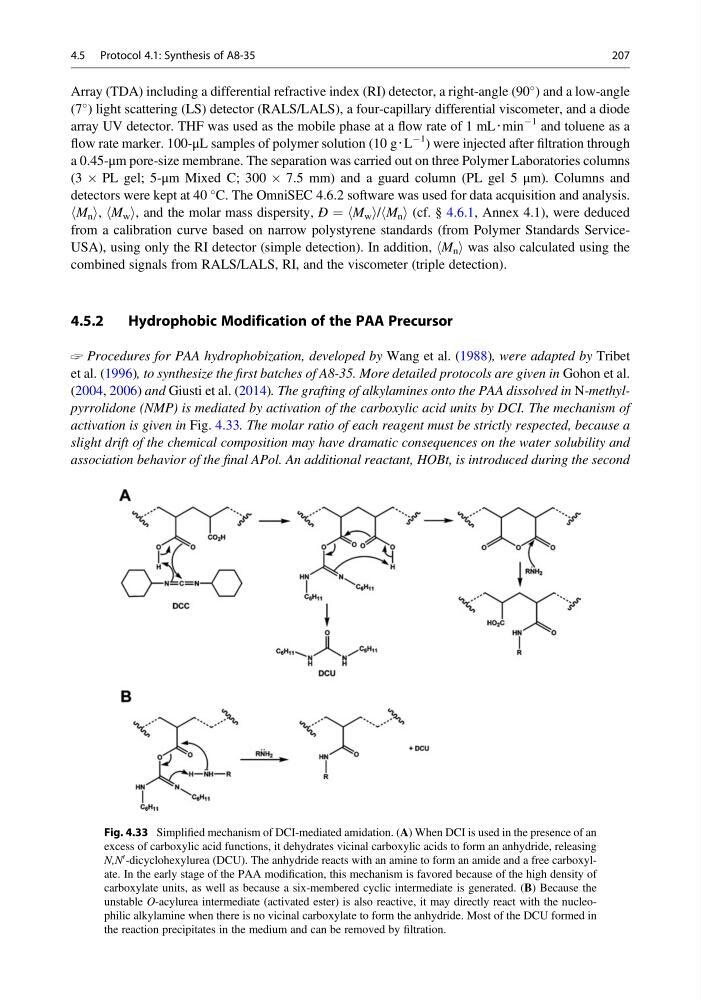
(2004, 2006) and Giusti et al. (2014). The grafting of alkylamines onto the PAA dissolved in N-methylpyrrolidone (NMP) is mediated by activation of the carboxylic acid units by DCI. The mechanism of
activation is given in Fig. 4.33. The molar ratio of each reagent must be strictly respected, because a
slight drift of the chemical composition may have dramatic consequences on the water solubility and
association behavior of the final APol. An additional reactant, HOBt, is introduced during the second
Fig. 4.33 Simplified mechanism of DCI-mediated amidation. (A) When DCI is used in the presence of an
excess of carboxylic acid functions, it dehydrates vicinal carboxylic acids to form an anhydride, releasing
N,N
0 -dicyclohexylurea (DCU). The anhydride reacts with an amine to form an amide and a free carboxylate. In the early stage of the PAA modification, this mechanism is favored because of the high density of
carboxylate units, as well as because a six-membered cyclic intermediate is generated. (B) Because the
unstable O-acylurea intermediate (activated ester) is also reactive, it may directly react with the nucleophilic alkylamine when there is no vicinal carboxylate to form the anhydride. Most of the DCU formed in
the reaction precipitates in the medium and can be removed by filtration.
4.5 Protocol 4.1: Synthesis of A8-35
207
) and a low-angle
(7
) light scattering (LS) detector (RALS/LALS), a four-capillary differential viscometer, and a diode
array UV detector. THF was used as the mobile phase at a flow rate of 1 mL‧min
À1 and toluene as a
flow rate marker. 100-μL samples of polymer solution (10 g‧L
À1 ) were injected after filtration through
a 0.45-μm pore-size membrane. The separation was carried out on three Polymer Laboratories columns
(3 Â PL gel; 5-μm Mixed C; 300 Â 7.5 mm) and a guard column (PL gel 5 μm). Columns and
detectors were kept at 40
C. The OmniSEC 4.6.2 software was used for data acquisition and analysis.
hM n i, hM w i, and the molar mass dispersity, Ð ¼ hM w i/hM n i (cf. § 4.6.1, Annex 4.1), were deduced
from a calibration curve based on narrow polystyrene standards (from Polymer Standards ServiceUSA), using only the RI detector (simple detection). In addition, hM n i was also calculated using the
combined signals from RALS/LALS, RI, and the viscometer (triple detection).
4.5.2
Hydrophobic Modification of the PAA Precursor
Procedures for PAA hydrophobization, developed by Wang et al. (1988), were adapted by Tribet
et al. (1996), to synthesize the first batches of A8-35. More detailed protocols are given in Gohon et al.
(2004, 2006) and Giusti et al. (2014). The grafting of alkylamines onto the PAA dissolved in N-methylpyrrolidone (NMP) is mediated by activation of the carboxylic acid units by DCI. The mechanism of
activation is given in Fig. 4.33. The molar ratio of each reagent must be strictly respected, because a
slight drift of the chemical composition may have dramatic consequences on the water solubility and
association behavior of the final APol. An additional reactant, HOBt, is introduced during the second
Fig. 4.33 Simplified mechanism of DCI-mediated amidation. (A) When DCI is used in the presence of an
excess of carboxylic acid functions, it dehydrates vicinal carboxylic acids to form an anhydride, releasing
N,N
0 -dicyclohexylurea (DCU). The anhydride reacts with an amine to form an amide and a free carboxylate. In the early stage of the PAA modification, this mechanism is favored because of the high density of
carboxylate units, as well as because a six-membered cyclic intermediate is generated. (B) Because the
unstable O-acylurea intermediate (activated ester) is also reactive, it may directly react with the nucleophilic alkylamine when there is no vicinal carboxylate to form the anhydride. Most of the DCU formed in
the reaction precipitates in the medium and can be removed by filtration.
4.5 Protocol 4.1: Synthesis of A8-35
207