

Size and homogeneity. Because the size and size distribution of the PAA are not precisely known
(the supplier provides only hM w i) and because the polymer has been handled in order to disaggregate it,
its average size and size distribution must be evaluated by SEC (cf. Annex 4.1). SEC can be performed
either in aqueous solution (Gohon et al. 2004, 2006) or in organic solvents (Giusti et al. 2014), the two
approaches yielding significantly different results (for a discussion, see Giusti et al. 2014). Whichever
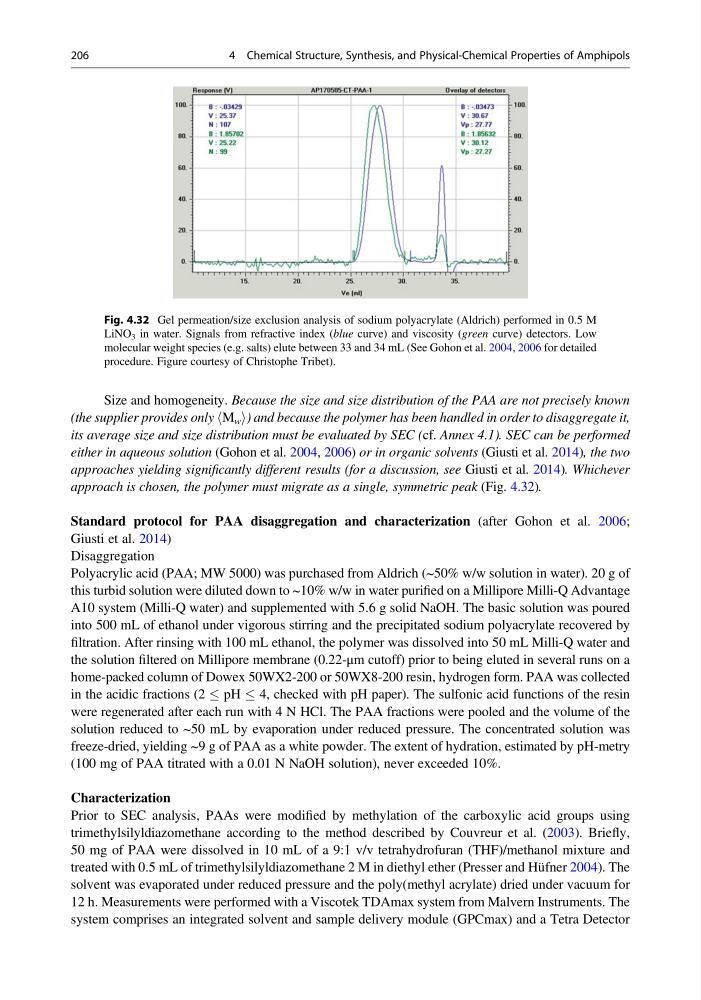
approach is chosen, the polymer must migrate as a single, symmetric peak (Fig. 4.32).
Standard protocol for PAA disaggregation and characterization (after Gohon et al. 2006;
Giusti et al. 2014)
Disaggregation
Polyacrylic acid (PAA; MW 5000) was purchased from Aldrich (~50% w/w solution in water). 20 g of
this turbid solution were diluted down to ~10% w/w in water purified on a Millipore Milli-Q Advantage
A10 system (Milli-Q water) and supplemented with 5.6 g solid NaOH. The basic solution was poured
into 500 mL of ethanol under vigorous stirring and the precipitated sodium polyacrylate recovered by
filtration. After rinsing with 100 mL ethanol, the polymer was dissolved into 50 mL Milli-Q water and
the solution filtered on Millipore membrane (0.22-μm cutoff) prior to being eluted in several runs on a
home-packed column of Dowex 50WX2-200 or 50WX8-200 resin, hydrogen form. PAA was collected
in the acidic fractions (2 pH 4, checked with pH paper). The sulfonic acid functions of the resin
were regenerated after each run with 4 N HCl. The PAA fractions were pooled and the volume of the
solution reduced to ~50 mL by evaporation under reduced pressure. The concentrated solution was
freeze-dried, yielding ~9 g of PAA as a white powder. The extent of hydration, estimated by pH-metry
(100 mg of PAA titrated with a 0.01 N NaOH solution), never exceeded 10%.
Characterization
Prior to SEC analysis, PAAs were modified by methylation of the carboxylic acid groups using
trimethylsilyldiazomethane according to the method described by Couvreur et al. (2003). Briefly,
50 mg of PAA were dissolved in 10 mL of a 9:1 v/v tetrahydrofuran (THF)/methanol mixture and
treated with 0.5 mL of trimethylsilyldiazomethane 2 M in diethyl ether (Presser and Hüfner 2004). The
solvent was evaporated under reduced pressure and the poly(methyl acrylate) dried under vacuum for
12 h. Measurements were performed with a Viscotek TDAmax system from Malvern Instruments. The
system comprises an integrated solvent and sample delivery module (GPCmax) and a Tetra Detector
Fig. 4.32 Gel permeation/size exclusion analysis of sodium polyacrylate (Aldrich) performed in 0.5 M
LiNO 3 in water. Signals from refractive index (blue curve) and viscosity (green curve) detectors. Low
molecular weight species (e.g. salts) elute between 33 and 34 mL (See Gohon et al. 2004, 2006 for detailed
procedure. Figure courtesy of Christophe Tribet).
206
4 Chemical Structure, Synthesis, and Physical-Chemical Properties of Amphipols
(the supplier provides only hM w i) and because the polymer has been handled in order to disaggregate it,
its average size and size distribution must be evaluated by SEC (cf. Annex 4.1). SEC can be performed
either in aqueous solution (Gohon et al. 2004, 2006) or in organic solvents (Giusti et al. 2014), the two
approaches yielding significantly different results (for a discussion, see Giusti et al. 2014). Whichever
approach is chosen, the polymer must migrate as a single, symmetric peak (Fig. 4.32).
Standard protocol for PAA disaggregation and characterization (after Gohon et al. 2006;
Giusti et al. 2014)
Disaggregation
Polyacrylic acid (PAA; MW 5000) was purchased from Aldrich (~50% w/w solution in water). 20 g of
this turbid solution were diluted down to ~10% w/w in water purified on a Millipore Milli-Q Advantage
A10 system (Milli-Q water) and supplemented with 5.6 g solid NaOH. The basic solution was poured
into 500 mL of ethanol under vigorous stirring and the precipitated sodium polyacrylate recovered by
filtration. After rinsing with 100 mL ethanol, the polymer was dissolved into 50 mL Milli-Q water and
the solution filtered on Millipore membrane (0.22-μm cutoff) prior to being eluted in several runs on a
home-packed column of Dowex 50WX2-200 or 50WX8-200 resin, hydrogen form. PAA was collected
in the acidic fractions (2 pH 4, checked with pH paper). The sulfonic acid functions of the resin
were regenerated after each run with 4 N HCl. The PAA fractions were pooled and the volume of the
solution reduced to ~50 mL by evaporation under reduced pressure. The concentrated solution was
freeze-dried, yielding ~9 g of PAA as a white powder. The extent of hydration, estimated by pH-metry
(100 mg of PAA titrated with a 0.01 N NaOH solution), never exceeded 10%.
Characterization
Prior to SEC analysis, PAAs were modified by methylation of the carboxylic acid groups using
trimethylsilyldiazomethane according to the method described by Couvreur et al. (2003). Briefly,
50 mg of PAA were dissolved in 10 mL of a 9:1 v/v tetrahydrofuran (THF)/methanol mixture and
treated with 0.5 mL of trimethylsilyldiazomethane 2 M in diethyl ether (Presser and Hüfner 2004). The
solvent was evaporated under reduced pressure and the poly(methyl acrylate) dried under vacuum for
12 h. Measurements were performed with a Viscotek TDAmax system from Malvern Instruments. The
system comprises an integrated solvent and sample delivery module (GPCmax) and a Tetra Detector
Fig. 4.32 Gel permeation/size exclusion analysis of sodium polyacrylate (Aldrich) performed in 0.5 M
LiNO 3 in water. Signals from refractive index (blue curve) and viscosity (green curve) detectors. Low
molecular weight species (e.g. salts) elute between 33 and 34 mL (See Gohon et al. 2004, 2006 for detailed
procedure. Figure courtesy of Christophe Tribet).
206
4 Chemical Structure, Synthesis, and Physical-Chemical Properties of Amphipols