

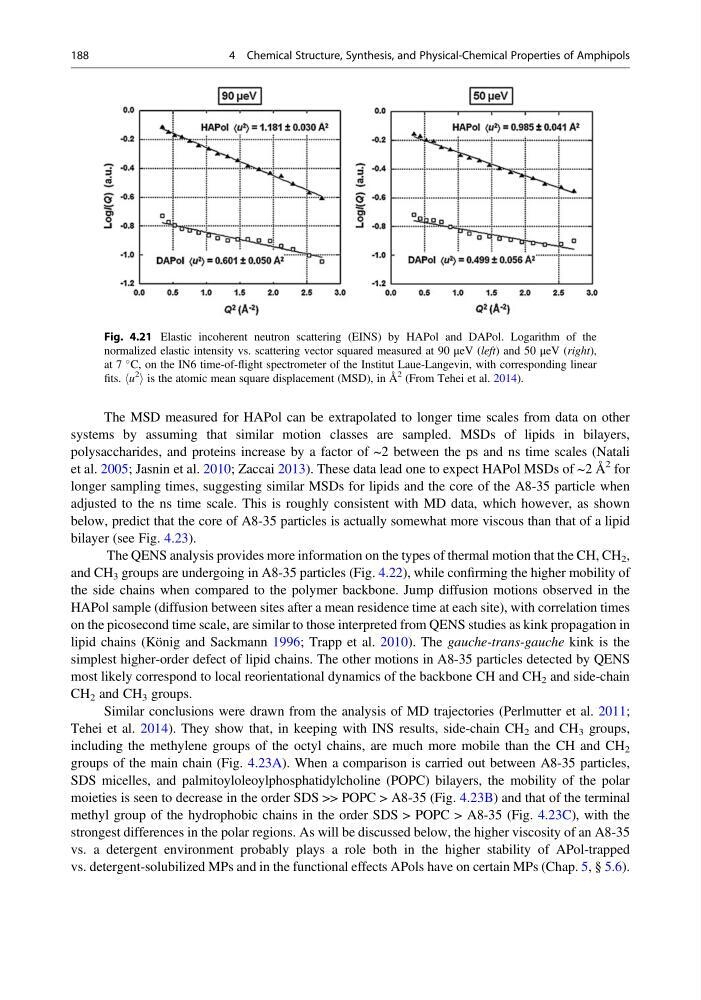
The MSD measured for HAPol can be extrapolated to longer time scales from data on other
systems by assuming that similar motion classes are sampled. MSDs of lipids in bilayers,
polysaccharides, and proteins increase by a factor of ~2 between the ps and ns time scales (Natali
et al. 2005; Jasnin et al. 2010; Zaccai 2013). These data lead one to expect HAPol MSDs of ~2 Å
2 for
longer sampling times, suggesting similar MSDs for lipids and the core of the A8-35 particle when
adjusted to the ns time scale. This is roughly consistent with MD data, which however, as shown
below, predict that the core of A8-35 particles is actually somewhat more viscous than that of a lipid
bilayer (see Fig. 4.23).
The QENS analysis provides more information on the types of thermal motion that the CH, CH 2 ,
and CH 3 groups are undergoing in A8-35 particles (Fig. 4.22), while confirming the higher mobility of
the side chains when compared to the polymer backbone. Jump diffusion motions observed in the
HAPol sample (diffusion between sites after a mean residence time at each site), with correlation times
on the picosecond time scale, are similar to those interpreted from QENS studies as kink propagation in
lipid chains (König and Sackmann 1996; Trapp et al. 2010). The gauche-trans-gauche kink is the
simplest higher-order defect of lipid chains. The other motions in A8-35 particles detected by QENS
most likely correspond to local reorientational dynamics of the backbone CH and CH 2 and side-chain
CH 2 and CH 3 groups.
Similar conclusions were drawn from the analysis of MD trajectories (Perlmutter et al. 2011;
Tehei et al. 2014). They show that, in keeping with INS results, side-chain CH 2 and CH 3 groups,
including the methylene groups of the octyl chains, are much more mobile than the CH and CH 2
groups of the main chain (Fig. 4.23A). When a comparison is carried out between A8-35 particles,
SDS micelles, and palmitoyloleoylphosphatidylcholine (POPC) bilayers, the mobility of the polar
moieties is seen to decrease in the order SDS >> POPC > A8-35 (Fig. 4.23B) and that of the terminal
methyl group of the hydrophobic chains in the order SDS > POPC > A8-35 (Fig. 4.23C), with the
strongest differences in the polar regions. As will be discussed below, the higher viscosity of an A8-35
vs. a detergent environment probably plays a role both in the higher stability of APol-trapped
vs. detergent-solubilized MPs and in the functional effects APols have on certain MPs (Chap. 5, § 5.6).
Fig. 4.21 Elastic incoherent neutron scattering (EINS) by HAPol and DAPol. Logarithm of the
normalized elastic intensity vs. scattering vector squared measured at 90 μeV (left) and 50 μeV (right),
at 7
C, on the IN6 time-of-flight spectrometer of the Institut Laue-Langevin, with corresponding linear
fits. hu
2
i is the atomic mean square displacement (MSD), in Å
2 (From Tehei et al. 2014).
188
4 Chemical Structure, Synthesis, and Physical-Chemical Properties of Amphipols
systems by assuming that similar motion classes are sampled. MSDs of lipids in bilayers,
polysaccharides, and proteins increase by a factor of ~2 between the ps and ns time scales (Natali
et al. 2005; Jasnin et al. 2010; Zaccai 2013). These data lead one to expect HAPol MSDs of ~2 Å
2 for
longer sampling times, suggesting similar MSDs for lipids and the core of the A8-35 particle when
adjusted to the ns time scale. This is roughly consistent with MD data, which however, as shown
below, predict that the core of A8-35 particles is actually somewhat more viscous than that of a lipid
bilayer (see Fig. 4.23).
The QENS analysis provides more information on the types of thermal motion that the CH, CH 2 ,
and CH 3 groups are undergoing in A8-35 particles (Fig. 4.22), while confirming the higher mobility of
the side chains when compared to the polymer backbone. Jump diffusion motions observed in the
HAPol sample (diffusion between sites after a mean residence time at each site), with correlation times
on the picosecond time scale, are similar to those interpreted from QENS studies as kink propagation in
lipid chains (König and Sackmann 1996; Trapp et al. 2010). The gauche-trans-gauche kink is the
simplest higher-order defect of lipid chains. The other motions in A8-35 particles detected by QENS
most likely correspond to local reorientational dynamics of the backbone CH and CH 2 and side-chain
CH 2 and CH 3 groups.
Similar conclusions were drawn from the analysis of MD trajectories (Perlmutter et al. 2011;
Tehei et al. 2014). They show that, in keeping with INS results, side-chain CH 2 and CH 3 groups,
including the methylene groups of the octyl chains, are much more mobile than the CH and CH 2
groups of the main chain (Fig. 4.23A). When a comparison is carried out between A8-35 particles,
SDS micelles, and palmitoyloleoylphosphatidylcholine (POPC) bilayers, the mobility of the polar
moieties is seen to decrease in the order SDS >> POPC > A8-35 (Fig. 4.23B) and that of the terminal
methyl group of the hydrophobic chains in the order SDS > POPC > A8-35 (Fig. 4.23C), with the
strongest differences in the polar regions. As will be discussed below, the higher viscosity of an A8-35
vs. a detergent environment probably plays a role both in the higher stability of APol-trapped
vs. detergent-solubilized MPs and in the functional effects APols have on certain MPs (Chap. 5, § 5.6).
Fig. 4.21 Elastic incoherent neutron scattering (EINS) by HAPol and DAPol. Logarithm of the
normalized elastic intensity vs. scattering vector squared measured at 90 μeV (left) and 50 μeV (right),
at 7
C, on the IN6 time-of-flight spectrometer of the Institut Laue-Langevin, with corresponding linear
fits. hu
2
i is the atomic mean square displacement (MSD), in Å
2 (From Tehei et al. 2014).
188
4 Chemical Structure, Synthesis, and Physical-Chemical Properties of Amphipols