

those used in the main analysis, as well as particles made up of a single 40-kDa molecule, present
similar values of R g and ellipsoid axial ratios (Perlmutter et al. 2011). This is consistent with
experimental data indicating that particles formed from chains that are, on average, either ~4Â times
longer (Tribet et al. 1996) or ~1.5Â shorter (Gohon 1996) than those of A8-35 behave similarly upon
SEC (C. Tribet, unpublished data) and appear equally efficient at keeping MPs water-soluble (Gohon
1996; Tribet et al. 1996).
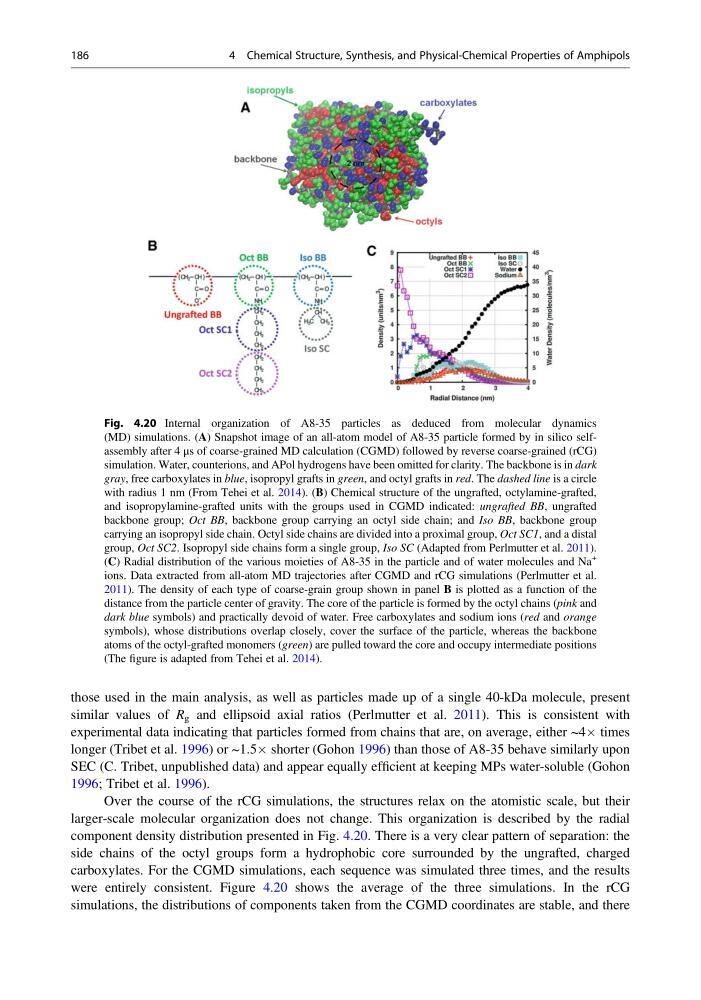
Over the course of the rCG simulations, the structures relax on the atomistic scale, but their
larger-scale molecular organization does not change. This organization is described by the radial
component density distribution presented in Fig. 4.20. There is a very clear pattern of separation: the
side chains of the octyl groups form a hydrophobic core surrounded by the ungrafted, charged
carboxylates. For the CGMD simulations, each sequence was simulated three times, and the results
were entirely consistent. Figure 4.20 shows the average of the three simulations. In the rCG
simulations, the distributions of components taken from the CGMD coordinates are stable, and there
Fig. 4.20 Internal organization of A8-35 particles as deduced from molecular dynamics
(MD) simulations. (A) Snapshot image of an all-atom model of A8-35 particle formed by in silico selfassembly after 4 μs of coarse-grained MD calculation (CGMD) followed by reverse coarse-grained (rCG)
simulation. Water, counterions, and APol hydrogens have been omitted for clarity. The backbone is in dark
gray, free carboxylates in blue, isopropyl grafts in green, and octyl grafts in red. The dashed line is a circle
with radius 1 nm (From Tehei et al. 2014). (B) Chemical structure of the ungrafted, octylamine-grafted,
and isopropylamine-grafted units with the groups used in CGMD indicated: ungrafted BB, ungrafted
backbone group; Oct BB, backbone group carrying an octyl side chain; and Iso BB, backbone group
carrying an isopropyl side chain. Octyl side chains are divided into a proximal group, Oct SC1, and a distal
group, Oct SC2. Isopropyl side chains form a single group, Iso SC (Adapted from Perlmutter et al. 2011).
(C) Radial distribution of the various moieties of A8-35 in the particle and of water molecules and Na
+
ions. Data extracted from all-atom MD trajectories after CGMD and rCG simulations (Perlmutter et al.
2011). The density of each type of coarse-grain group shown in panel B is plotted as a function of the
distance from the particle center of gravity. The core of the particle is formed by the octyl chains (pink and
dark blue symbols) and practically devoid of water. Free carboxylates and sodium ions (red and orange
symbols), whose distributions overlap closely, cover the surface of the particle, whereas the backbone
atoms of the octyl-grafted monomers (green) are pulled toward the core and occupy intermediate positions
(The figure is adapted from Tehei et al. 2014).
186
4 Chemical Structure, Synthesis, and Physical-Chemical Properties of Amphipols
similar values of R g and ellipsoid axial ratios (Perlmutter et al. 2011). This is consistent with
experimental data indicating that particles formed from chains that are, on average, either ~4Â times
longer (Tribet et al. 1996) or ~1.5Â shorter (Gohon 1996) than those of A8-35 behave similarly upon
SEC (C. Tribet, unpublished data) and appear equally efficient at keeping MPs water-soluble (Gohon
1996; Tribet et al. 1996).
Over the course of the rCG simulations, the structures relax on the atomistic scale, but their
larger-scale molecular organization does not change. This organization is described by the radial
component density distribution presented in Fig. 4.20. There is a very clear pattern of separation: the
side chains of the octyl groups form a hydrophobic core surrounded by the ungrafted, charged
carboxylates. For the CGMD simulations, each sequence was simulated three times, and the results
were entirely consistent. Figure 4.20 shows the average of the three simulations. In the rCG
simulations, the distributions of components taken from the CGMD coordinates are stable, and there
Fig. 4.20 Internal organization of A8-35 particles as deduced from molecular dynamics
(MD) simulations. (A) Snapshot image of an all-atom model of A8-35 particle formed by in silico selfassembly after 4 μs of coarse-grained MD calculation (CGMD) followed by reverse coarse-grained (rCG)
simulation. Water, counterions, and APol hydrogens have been omitted for clarity. The backbone is in dark
gray, free carboxylates in blue, isopropyl grafts in green, and octyl grafts in red. The dashed line is a circle
with radius 1 nm (From Tehei et al. 2014). (B) Chemical structure of the ungrafted, octylamine-grafted,
and isopropylamine-grafted units with the groups used in CGMD indicated: ungrafted BB, ungrafted
backbone group; Oct BB, backbone group carrying an octyl side chain; and Iso BB, backbone group
carrying an isopropyl side chain. Octyl side chains are divided into a proximal group, Oct SC1, and a distal
group, Oct SC2. Isopropyl side chains form a single group, Iso SC (Adapted from Perlmutter et al. 2011).
(C) Radial distribution of the various moieties of A8-35 in the particle and of water molecules and Na
+
ions. Data extracted from all-atom MD trajectories after CGMD and rCG simulations (Perlmutter et al.
2011). The density of each type of coarse-grain group shown in panel B is plotted as a function of the
distance from the particle center of gravity. The core of the particle is formed by the octyl chains (pink and
dark blue symbols) and practically devoid of water. Free carboxylates and sodium ions (red and orange
symbols), whose distributions overlap closely, cover the surface of the particle, whereas the backbone
atoms of the octyl-grafted monomers (green) are pulled toward the core and occupy intermediate positions
(The figure is adapted from Tehei et al. 2014).
186
4 Chemical Structure, Synthesis, and Physical-Chemical Properties of Amphipols