

cationic, which may bear on their use in isoelectrofocusing experiments. PC-APols with average
masses in the range of ~22–45 kDa have been validated for MP trapping (Diab et al. 2007a). BR/PCAPol complexes remained soluble in aqueous media at pH ! 5, as well as in the presence of 1 M NaCl
or 12 mM Ca
2+ ions (ibid.).
4.2.2.3 PMAL Series
The first alternative APols to be validated following the original publication belong to the PMAL series
(Nagy et al. 2001). They are synthesized according to a proprietary procedure whose details have not
been released (see legend in Fig. 4.1). Their structure is significantly different from that of the APols
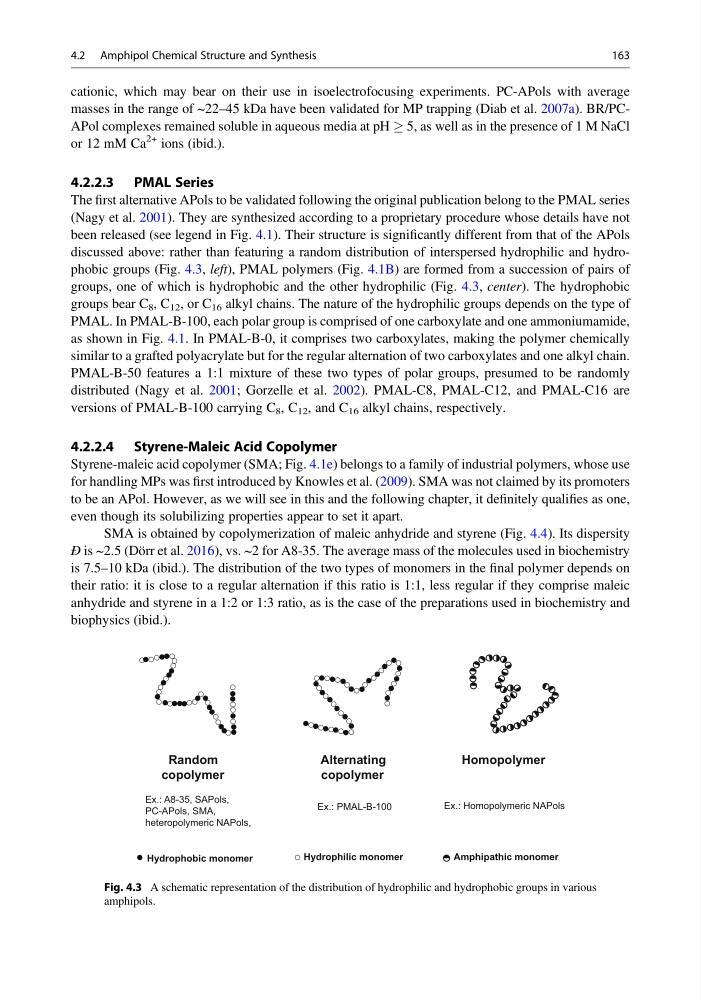
discussed above: rather than featuring a random distribution of interspersed hydrophilic and hydrophobic groups (Fig. 4.3, left), PMAL polymers (Fig. 4.1B) are formed from a succession of pairs of
groups, one of which is hydrophobic and the other hydrophilic (Fig. 4.3, center). The hydrophobic
groups bear C 8 , C 12 , or C 16 alkyl chains. The nature of the hydrophilic groups depends on the type of
PMAL. In PMAL-B-100, each polar group is comprised of one carboxylate and one ammoniumamide,
as shown in Fig. 4.1. In PMAL-B-0, it comprises two carboxylates, making the polymer chemically
similar to a grafted polyacrylate but for the regular alternation of two carboxylates and one alkyl chain.
PMAL-B-50 features a 1:1 mixture of these two types of polar groups, presumed to be randomly
distributed (Nagy et al. 2001; Gorzelle et al. 2002). PMAL-C8, PMAL-C12, and PMAL-C16 are
versions of PMAL-B-100 carrying C 8 , C 12 , and C 16 alkyl chains, respectively.
4.2.2.4 Styrene-Maleic Acid Copolymer
Styrene-maleic acid copolymer (SMA; Fig. 4.1e) belongs to a family of industrial polymers, whose use
for handling MPs was first introduced by Knowles et al. (2009). SMA was not claimed by its promoters
to be an APol. However, as we will see in this and the following chapter, it definitely qualifies as one,
even though its solubilizing properties appear to set it apart.
SMA is obtained by copolymerization of maleic anhydride and styrene (Fig. 4.4). Its dispersity
Ð is ~2.5 (Dörr et al. 2016), vs. ~2 for A8-35. The average mass of the molecules used in biochemistry
is 7.5–10 kDa (ibid.). The distribution of the two types of monomers in the final polymer depends on
their ratio: it is close to a regular alternation if this ratio is 1:1, less regular if they comprise maleic
anhydride and styrene in a 1:2 or 1:3 ratio, as is the case of the preparations used in biochemistry and
biophysics (ibid.).
●
○ ●
●
●
●
●
●
●
●
○ ○
○
○
○
○
○
○
○
○
○
●
○
Hydrophobic monomer
Hydrophilic monomer
Amphipathic monomer
●○
Random
Alternating
Homopolymer
copolymer
copolymer
Ex.: A8-35, SAPols,
PC-APols, SMA,
heteropolymeric NAPols,
Ex.: Homopolymeric NAPols
Ex.: PMAL-B-100
●
●
●
○
○
○
○
○
○
○
○
○
●
●
●
●
●
● ●
●
○
● ●
●○
●○
Fig. 4.3 A schematic representation of the distribution of hydrophilic and hydrophobic groups in various
amphipols.
4.2 Amphipol Chemical Structure and Synthesis
163
masses in the range of ~22–45 kDa have been validated for MP trapping (Diab et al. 2007a). BR/PCAPol complexes remained soluble in aqueous media at pH ! 5, as well as in the presence of 1 M NaCl
or 12 mM Ca
2+ ions (ibid.).
4.2.2.3 PMAL Series
The first alternative APols to be validated following the original publication belong to the PMAL series
(Nagy et al. 2001). They are synthesized according to a proprietary procedure whose details have not
been released (see legend in Fig. 4.1). Their structure is significantly different from that of the APols
discussed above: rather than featuring a random distribution of interspersed hydrophilic and hydrophobic groups (Fig. 4.3, left), PMAL polymers (Fig. 4.1B) are formed from a succession of pairs of
groups, one of which is hydrophobic and the other hydrophilic (Fig. 4.3, center). The hydrophobic
groups bear C 8 , C 12 , or C 16 alkyl chains. The nature of the hydrophilic groups depends on the type of
PMAL. In PMAL-B-100, each polar group is comprised of one carboxylate and one ammoniumamide,
as shown in Fig. 4.1. In PMAL-B-0, it comprises two carboxylates, making the polymer chemically
similar to a grafted polyacrylate but for the regular alternation of two carboxylates and one alkyl chain.
PMAL-B-50 features a 1:1 mixture of these two types of polar groups, presumed to be randomly
distributed (Nagy et al. 2001; Gorzelle et al. 2002). PMAL-C8, PMAL-C12, and PMAL-C16 are
versions of PMAL-B-100 carrying C 8 , C 12 , and C 16 alkyl chains, respectively.
4.2.2.4 Styrene-Maleic Acid Copolymer
Styrene-maleic acid copolymer (SMA; Fig. 4.1e) belongs to a family of industrial polymers, whose use
for handling MPs was first introduced by Knowles et al. (2009). SMA was not claimed by its promoters
to be an APol. However, as we will see in this and the following chapter, it definitely qualifies as one,
even though its solubilizing properties appear to set it apart.
SMA is obtained by copolymerization of maleic anhydride and styrene (Fig. 4.4). Its dispersity
Ð is ~2.5 (Dörr et al. 2016), vs. ~2 for A8-35. The average mass of the molecules used in biochemistry
is 7.5–10 kDa (ibid.). The distribution of the two types of monomers in the final polymer depends on
their ratio: it is close to a regular alternation if this ratio is 1:1, less regular if they comprise maleic
anhydride and styrene in a 1:2 or 1:3 ratio, as is the case of the preparations used in biochemistry and
biophysics (ibid.).
●
○ ●
●
●
●
●
●
●
●
○ ○
○
○
○
○
○
○
○
○
○
●
○
Hydrophobic monomer
Hydrophilic monomer
Amphipathic monomer
●○
Random
Alternating
Homopolymer
copolymer
copolymer
Ex.: A8-35, SAPols,
PC-APols, SMA,
heteropolymeric NAPols,
Ex.: Homopolymeric NAPols
Ex.: PMAL-B-100
●
●
●
○
○
○
○
○
○
○
○
○
●
●
●
●
●
● ●
●
○
● ●
●○
●○
Fig. 4.3 A schematic representation of the distribution of hydrophilic and hydrophobic groups in various
amphipols.
4.2 Amphipol Chemical Structure and Synthesis
163