

to form a thinner film than those at the center (Siuda and Tieleman 2015). Overall, the number of lipid
molecules that can be accommodated inside a ND is quite precisely predicted by the overall length of
the amphipathic helices than stabilize them, assuming the MSP belt to be approximately circular and
the average area occupied by lipids to be similar to that in liposomes (Denisov et al. 2004; Ritchie et al.
2009; Grinkova et al. 2010; Hagn et al. 2013), but lipids in NDs tend to be somewhat more compressed
and have a lower conformational entropy (reviewed in Denisov and Sligar 2017). Indeed, both NMR
data (Mörs et al. 2013) and MD simulations (Debnath and Schäfer 2015) show their dynamics to be
restricted as compared to that in lipid vesicles (reviewed in Viegas et al. 2016).
3.3.4
Membrane Protein/Nanodisc Complexes
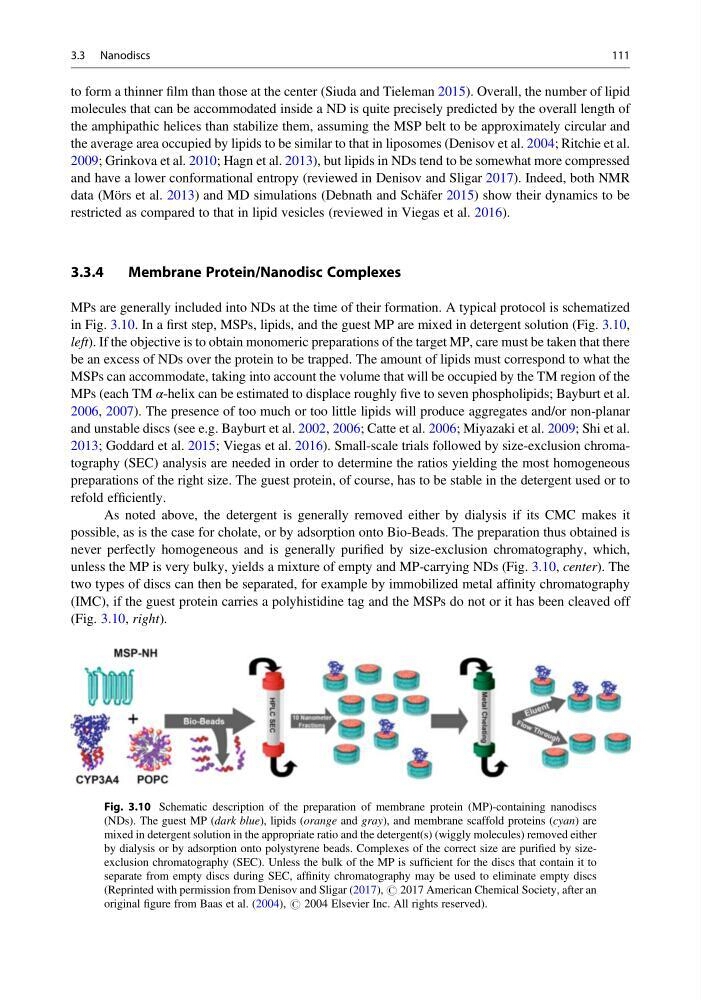
MPs are generally included into NDs at the time of their formation. A typical protocol is schematized
in Fig. 3.10. In a first step, MSPs, lipids, and the guest MP are mixed in detergent solution (Fig. 3.10,
left). If the objective is to obtain monomeric preparations of the target MP, care must be taken that there
be an excess of NDs over the protein to be trapped. The amount of lipids must correspond to what the
MSPs can accommodate, taking into account the volume that will be occupied by the TM region of the
MPs (each TM α-helix can be estimated to displace roughly five to seven phospholipids; Bayburt et al.
2006, 2007). The presence of too much or too little lipids will produce aggregates and/or non-planar
and unstable discs (see e.g. Bayburt et al. 2002, 2006; Catte et al. 2006; Miyazaki et al. 2009; Shi et al.
2013; Goddard et al. 2015; Viegas et al. 2016). Small-scale trials followed by size-exclusion chromatography (SEC) analysis are needed in order to determine the ratios yielding the most homogeneous
preparations of the right size. The guest protein, of course, has to be stable in the detergent used or to
refold efficiently.
As noted above, the detergent is generally removed either by dialysis if its CMC makes it
possible, as is the case for cholate, or by adsorption onto Bio-Beads. The preparation thus obtained is
never perfectly homogeneous and is generally purified by size-exclusion chromatography, which,
unless the MP is very bulky, yields a mixture of empty and MP-carrying NDs (Fig. 3.10, center). The
two types of discs can then be separated, for example by immobilized metal affinity chromatography
(IMC), if the guest protein carries a polyhistidine tag and the MSPs do not or it has been cleaved off
(Fig. 3.10, right).
Fig. 3.10 Schematic description of the preparation of membrane protein (MP)-containing nanodiscs
(NDs). The guest MP (dark blue), lipids (orange and gray), and membrane scaffold proteins (cyan) are
mixed in detergent solution in the appropriate ratio and the detergent(s) (wiggly molecules) removed either
by dialysis or by adsorption onto polystyrene beads. Complexes of the correct size are purified by sizeexclusion chromatography (SEC). Unless the bulk of the MP is sufficient for the discs that contain it to
separate from empty discs during SEC, affinity chromatography may be used to eliminate empty discs
(Reprinted with permission from Denisov and Sligar (2017), # 2017 American Chemical Society, after an
original figure from Baas et al. (2004), # 2004 Elsevier Inc. All rights reserved).
3.3 Nanodiscs
111
molecules that can be accommodated inside a ND is quite precisely predicted by the overall length of
the amphipathic helices than stabilize them, assuming the MSP belt to be approximately circular and
the average area occupied by lipids to be similar to that in liposomes (Denisov et al. 2004; Ritchie et al.
2009; Grinkova et al. 2010; Hagn et al. 2013), but lipids in NDs tend to be somewhat more compressed
and have a lower conformational entropy (reviewed in Denisov and Sligar 2017). Indeed, both NMR
data (Mörs et al. 2013) and MD simulations (Debnath and Schäfer 2015) show their dynamics to be
restricted as compared to that in lipid vesicles (reviewed in Viegas et al. 2016).
3.3.4
Membrane Protein/Nanodisc Complexes
MPs are generally included into NDs at the time of their formation. A typical protocol is schematized
in Fig. 3.10. In a first step, MSPs, lipids, and the guest MP are mixed in detergent solution (Fig. 3.10,
left). If the objective is to obtain monomeric preparations of the target MP, care must be taken that there
be an excess of NDs over the protein to be trapped. The amount of lipids must correspond to what the
MSPs can accommodate, taking into account the volume that will be occupied by the TM region of the
MPs (each TM α-helix can be estimated to displace roughly five to seven phospholipids; Bayburt et al.
2006, 2007). The presence of too much or too little lipids will produce aggregates and/or non-planar
and unstable discs (see e.g. Bayburt et al. 2002, 2006; Catte et al. 2006; Miyazaki et al. 2009; Shi et al.
2013; Goddard et al. 2015; Viegas et al. 2016). Small-scale trials followed by size-exclusion chromatography (SEC) analysis are needed in order to determine the ratios yielding the most homogeneous
preparations of the right size. The guest protein, of course, has to be stable in the detergent used or to
refold efficiently.
As noted above, the detergent is generally removed either by dialysis if its CMC makes it
possible, as is the case for cholate, or by adsorption onto Bio-Beads. The preparation thus obtained is
never perfectly homogeneous and is generally purified by size-exclusion chromatography, which,
unless the MP is very bulky, yields a mixture of empty and MP-carrying NDs (Fig. 3.10, center). The
two types of discs can then be separated, for example by immobilized metal affinity chromatography
(IMC), if the guest protein carries a polyhistidine tag and the MSPs do not or it has been cleaved off
(Fig. 3.10, right).
Fig. 3.10 Schematic description of the preparation of membrane protein (MP)-containing nanodiscs
(NDs). The guest MP (dark blue), lipids (orange and gray), and membrane scaffold proteins (cyan) are
mixed in detergent solution in the appropriate ratio and the detergent(s) (wiggly molecules) removed either
by dialysis or by adsorption onto polystyrene beads. Complexes of the correct size are purified by sizeexclusion chromatography (SEC). Unless the bulk of the MP is sufficient for the discs that contain it to
separate from empty discs during SEC, affinity chromatography may be used to eliminate empty discs
(Reprinted with permission from Denisov and Sligar (2017), # 2017 American Chemical Society, after an
original figure from Baas et al. (2004), # 2004 Elsevier Inc. All rights reserved).
3.3 Nanodiscs
111