

The functionality and stability of bicelle-integrated MPs are important points to establish before
engaging into time-consuming structural investigations. Thus, diacylglycerol kinase (DAGK) has been
shown to be functional in DMPC/CHAPSO and dipalmitoylphosphatidylcholine (diC 16:0 PC, DPPC)/
CHAPSO bicelles, by preference to diC 12:0 PC/CHAPSO or diC 6 PC-based bicelles (Czerski and
Sanders 2000). Smr, the small multidrug-resistance protein from Staphylococcus aureus, binds its
ligand tetraphenylphosphonium more efficiently in DMPC/diC 6 PC bicelles than it does in most
detergents (Poget et al. 2007). The achievement of a native-like three-dimensional conformation,
long-term stability, and ability to bind specific drugs of Smr required careful tuning of bicelle
composition (Poget and Girvin 2007). The DMPC/diC 6 PC system is nowadays the most frequently
used for NMR measurements and that which tends to yield the best data (Kim et al. 2009). Many
variations exist, however, bearing on the nature of the lipid(s), of the detergent, on doping with
paramagnetic ions (see below), and so forth (for recent examples, see e.g. Beaugrand et al. 2016,
Mineev et al. 2017, Smrt et al. 2017, and references therein, and for an overview, Dürr et al. 2013).
An interesting property of bicelles, of particular value for NMR studies, is that large enough
bicelles align in magnetic fields (Fig. 3.2). The degree of orientation depends on several factors, such
as their overall concentration, the temperature, and their size, the latter depending on the ratio of large
to small surfactant. Two cases of figures are encountered. Pure bicelles orient with their planes parallel
to the magnetic field, as illustrated in Fig. 3.2, center. By doping them with paramagnetic ions, often
with the help of a small fraction of lipids tagged so as to bind these ions, the orientation can flip to the
orthogonal one, which is more convenient for NMR experiments, in which the bicelle plane is
perpendicular to the magnetic field (Fig. 3.2, right; see e.g. Sanders et al. 1994; Prosser et al. 1996,
1998; Vold and Prosser 1996; Tiburu et al. 2001). Solid-state NMR analysis of such samples permits to
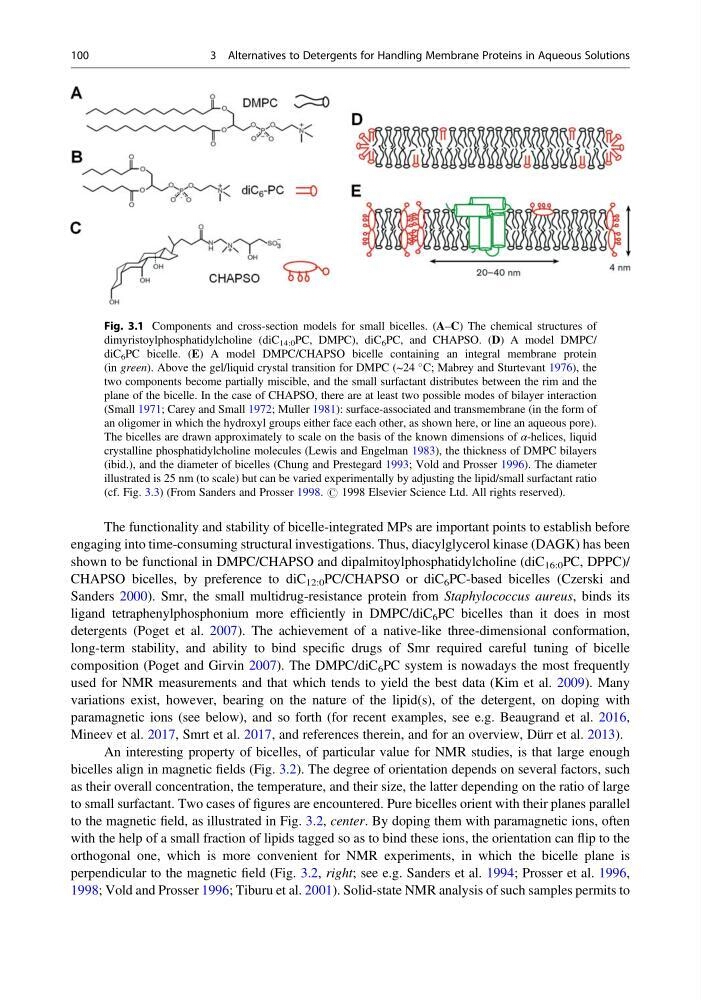
Fig. 3.1 Components and cross-section models for small bicelles. (A–C) The chemical structures of
dimyristoylphosphatidylcholine (diC 14:0 PC, DMPC), diC 6 PC, and CHAPSO. (D) A model DMPC/
diC 6 PC bicelle. (E) A model DMPC/CHAPSO bicelle containing an integral membrane protein
(in green). Above the gel/liquid crystal transition for DMPC (~24
C; Mabrey and Sturtevant 1976), the
two components become partially miscible, and the small surfactant distributes between the rim and the
plane of the bicelle. In the case of CHAPSO, there are at least two possible modes of bilayer interaction
(Small 1971; Carey and Small 1972; Muller 1981): surface-associated and transmembrane (in the form of
an oligomer in which the hydroxyl groups either face each other, as shown here, or line an aqueous pore).
The bicelles are drawn approximately to scale on the basis of the known dimensions of α-helices, liquid
crystalline phosphatidylcholine molecules (Lewis and Engelman 1983), the thickness of DMPC bilayers
(ibid.), and the diameter of bicelles (Chung and Prestegard 1993; Vold and Prosser 1996). The diameter
illustrated is 25 nm (to scale) but can be varied experimentally by adjusting the lipid/small surfactant ratio
(cf. Fig. 3.3) (From Sanders and Prosser 1998. # 1998 Elsevier Science Ltd. All rights reserved).
100
3 Alternatives to Detergents for Handling Membrane Proteins in Aqueous Solutions
engaging into time-consuming structural investigations. Thus, diacylglycerol kinase (DAGK) has been
shown to be functional in DMPC/CHAPSO and dipalmitoylphosphatidylcholine (diC 16:0 PC, DPPC)/
CHAPSO bicelles, by preference to diC 12:0 PC/CHAPSO or diC 6 PC-based bicelles (Czerski and
Sanders 2000). Smr, the small multidrug-resistance protein from Staphylococcus aureus, binds its
ligand tetraphenylphosphonium more efficiently in DMPC/diC 6 PC bicelles than it does in most
detergents (Poget et al. 2007). The achievement of a native-like three-dimensional conformation,
long-term stability, and ability to bind specific drugs of Smr required careful tuning of bicelle
composition (Poget and Girvin 2007). The DMPC/diC 6 PC system is nowadays the most frequently
used for NMR measurements and that which tends to yield the best data (Kim et al. 2009). Many
variations exist, however, bearing on the nature of the lipid(s), of the detergent, on doping with
paramagnetic ions (see below), and so forth (for recent examples, see e.g. Beaugrand et al. 2016,
Mineev et al. 2017, Smrt et al. 2017, and references therein, and for an overview, Dürr et al. 2013).
An interesting property of bicelles, of particular value for NMR studies, is that large enough
bicelles align in magnetic fields (Fig. 3.2). The degree of orientation depends on several factors, such
as their overall concentration, the temperature, and their size, the latter depending on the ratio of large
to small surfactant. Two cases of figures are encountered. Pure bicelles orient with their planes parallel
to the magnetic field, as illustrated in Fig. 3.2, center. By doping them with paramagnetic ions, often
with the help of a small fraction of lipids tagged so as to bind these ions, the orientation can flip to the
orthogonal one, which is more convenient for NMR experiments, in which the bicelle plane is
perpendicular to the magnetic field (Fig. 3.2, right; see e.g. Sanders et al. 1994; Prosser et al. 1996,
1998; Vold and Prosser 1996; Tiburu et al. 2001). Solid-state NMR analysis of such samples permits to
Fig. 3.1 Components and cross-section models for small bicelles. (A–C) The chemical structures of
dimyristoylphosphatidylcholine (diC 14:0 PC, DMPC), diC 6 PC, and CHAPSO. (D) A model DMPC/
diC 6 PC bicelle. (E) A model DMPC/CHAPSO bicelle containing an integral membrane protein
(in green). Above the gel/liquid crystal transition for DMPC (~24
C; Mabrey and Sturtevant 1976), the
two components become partially miscible, and the small surfactant distributes between the rim and the
plane of the bicelle. In the case of CHAPSO, there are at least two possible modes of bilayer interaction
(Small 1971; Carey and Small 1972; Muller 1981): surface-associated and transmembrane (in the form of
an oligomer in which the hydroxyl groups either face each other, as shown here, or line an aqueous pore).
The bicelles are drawn approximately to scale on the basis of the known dimensions of α-helices, liquid
crystalline phosphatidylcholine molecules (Lewis and Engelman 1983), the thickness of DMPC bilayers
(ibid.), and the diameter of bicelles (Chung and Prestegard 1993; Vold and Prosser 1996). The diameter
illustrated is 25 nm (to scale) but can be varied experimentally by adjusting the lipid/small surfactant ratio
(cf. Fig. 3.3) (From Sanders and Prosser 1998. # 1998 Elsevier Science Ltd. All rights reserved).
100
3 Alternatives to Detergents for Handling Membrane Proteins in Aqueous Solutions