

is trans-4-(trans-4
0 -propylcyclohexyl)cyclohexyl-α-D-maltoside (PCC-a-M). The hydrophobic chain
of PCC-a-M comprising two cyclohexyl rings (see Fig. 2.15) is much easier to distinguish from the
lipid acyl chains than in the case of n-alkyl chains, even at the relatively limited resolution achieved
here (2.8 Å; Hovers et al. 2011). The position of the two lipids, in contact both with the TM anchor of
the Rieske protein and with the surface of the rest of the complex, strongly suggests that their loss is
likely to weaken the association between them. Inactivation and monomerization of the b 6 f complex
by detergent would therefore be initiated by the partitioning of the lipids into an excess of detergent
micelles, thereby destabilizing the association of the Rieske protein with the complex. This loss would
immediately inactivate the complex, the Rieske protein playing a key role in electron transfer, and
would initiate its disaggregation. Such a mechanism readily explains why lowering the volume of the
micellar phase and/or supplementing it with lipids both have a stabilizing effect on the complex.
We have seen in Chap. 1 (§ 1.5.2) that many structures of MPs and MP complexes show bound
lipids that straddle TM segments, are in contact with two subunits, and/or are wedged in TM cranks or
clefts, if not totally buried inside the protein (see e.g. Lee 2011 and other references cited in Chap. 1). It
is my personal conviction that the mechanism I have described in some detail in the case of the
b 6 f complex holds for many, if not most, MPs and that the major causes of MP inactivation by
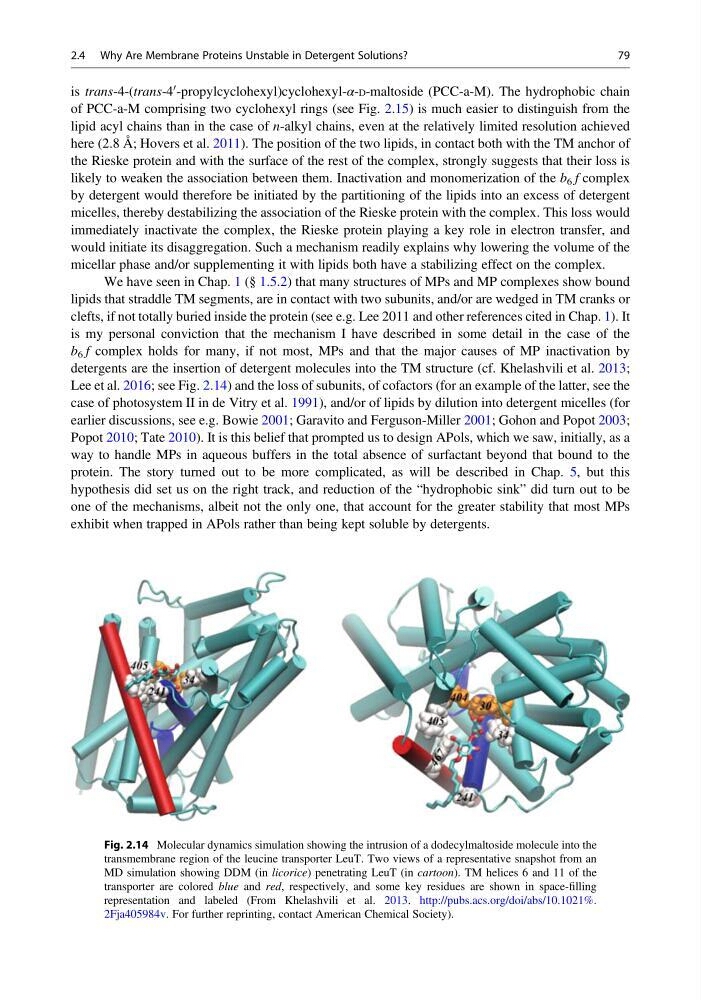
detergents are the insertion of detergent molecules into the TM structure (cf. Khelashvili et al. 2013;
Lee et al. 2016; see Fig. 2.14) and the loss of subunits, of cofactors (for an example of the latter, see the
case of photosystem II in de Vitry et al. 1991), and/or of lipids by dilution into detergent micelles (for
earlier discussions, see e.g. Bowie 2001; Garavito and Ferguson-Miller 2001; Gohon and Popot 2003;
Popot 2010; Tate 2010). It is this belief that prompted us to design APols, which we saw, initially, as a
way to handle MPs in aqueous buffers in the total absence of surfactant beyond that bound to the
protein. The story turned out to be more complicated, as will be described in Chap. 5, but this
hypothesis did set us on the right track, and reduction of the “hydrophobic sink” did turn out to be
one of the mechanisms, albeit not the only one, that account for the greater stability that most MPs
exhibit when trapped in APols rather than being kept soluble by detergents.
Fig. 2.14 Molecular dynamics simulation showing the intrusion of a dodecylmaltoside molecule into the
transmembrane region of the leucine transporter LeuT. Two views of a representative snapshot from an
MD simulation showing DDM (in licorice) penetrating LeuT (in cartoon). TM helices 6 and 11 of the
transporter are colored blue and red, respectively, and some key residues are shown in space-filling
representation and labeled (From Khelashvili et al. 2013. http://pubs.acs.org/doi/abs/10.1021%.
2Fja405984v. For further reprinting, contact American Chemical Society).
2.4 Why Are Membrane Proteins Unstable in Detergent Solutions?
79
0 -propylcyclohexyl)cyclohexyl-α-D-maltoside (PCC-a-M). The hydrophobic chain
of PCC-a-M comprising two cyclohexyl rings (see Fig. 2.15) is much easier to distinguish from the
lipid acyl chains than in the case of n-alkyl chains, even at the relatively limited resolution achieved
here (2.8 Å; Hovers et al. 2011). The position of the two lipids, in contact both with the TM anchor of
the Rieske protein and with the surface of the rest of the complex, strongly suggests that their loss is
likely to weaken the association between them. Inactivation and monomerization of the b 6 f complex
by detergent would therefore be initiated by the partitioning of the lipids into an excess of detergent
micelles, thereby destabilizing the association of the Rieske protein with the complex. This loss would
immediately inactivate the complex, the Rieske protein playing a key role in electron transfer, and
would initiate its disaggregation. Such a mechanism readily explains why lowering the volume of the
micellar phase and/or supplementing it with lipids both have a stabilizing effect on the complex.
We have seen in Chap. 1 (§ 1.5.2) that many structures of MPs and MP complexes show bound
lipids that straddle TM segments, are in contact with two subunits, and/or are wedged in TM cranks or
clefts, if not totally buried inside the protein (see e.g. Lee 2011 and other references cited in Chap. 1). It
is my personal conviction that the mechanism I have described in some detail in the case of the
b 6 f complex holds for many, if not most, MPs and that the major causes of MP inactivation by
detergents are the insertion of detergent molecules into the TM structure (cf. Khelashvili et al. 2013;
Lee et al. 2016; see Fig. 2.14) and the loss of subunits, of cofactors (for an example of the latter, see the
case of photosystem II in de Vitry et al. 1991), and/or of lipids by dilution into detergent micelles (for
earlier discussions, see e.g. Bowie 2001; Garavito and Ferguson-Miller 2001; Gohon and Popot 2003;
Popot 2010; Tate 2010). It is this belief that prompted us to design APols, which we saw, initially, as a
way to handle MPs in aqueous buffers in the total absence of surfactant beyond that bound to the
protein. The story turned out to be more complicated, as will be described in Chap. 5, but this
hypothesis did set us on the right track, and reduction of the “hydrophobic sink” did turn out to be
one of the mechanisms, albeit not the only one, that account for the greater stability that most MPs
exhibit when trapped in APols rather than being kept soluble by detergents.
Fig. 2.14 Molecular dynamics simulation showing the intrusion of a dodecylmaltoside molecule into the
transmembrane region of the leucine transporter LeuT. Two views of a representative snapshot from an
MD simulation showing DDM (in licorice) penetrating LeuT (in cartoon). TM helices 6 and 11 of the
transporter are colored blue and red, respectively, and some key residues are shown in space-filling
representation and labeled (From Khelashvili et al. 2013. http://pubs.acs.org/doi/abs/10.1021%.
2Fja405984v. For further reprinting, contact American Chemical Society).
2.4 Why Are Membrane Proteins Unstable in Detergent Solutions?
79