

5.5.3 Allosteric Regulation of Enzyme Activity
In allosteric enzyme, there is binding site of activator or inhibitor apart from active
site of enzyme. The binding of one of these effectors affect activity of enzyme
through conformational change of enzyme. Allosteric enzyme is composed of subunits. Theoretical study of allosteric enzyme was studied in hemoglobin of red blood
cell. And two theories were proposed by Monod et al. [4] and Koshland et al. [5],
respectively. When activator binds allosteric site apart from catalytic site, substrate
binds easier by conformational change of the enzyme. On the other hand, binding of
inhibitor on allosteric site makes substrate to be difficult to bind catalytic site. There
are relaxing state and taut state in subunits of allosteric protein. R-state is stable when
substrate or ligand binds allosteric protein, and T-state is stable during no binding.
Monod et al. assume that all subunits change from T-state to R-state cooperatively
by binding of substrate. On the other hand, Koshland et al. assume that change from
T-state from R-state occurs sequentially for each subunit by binding of substrate.
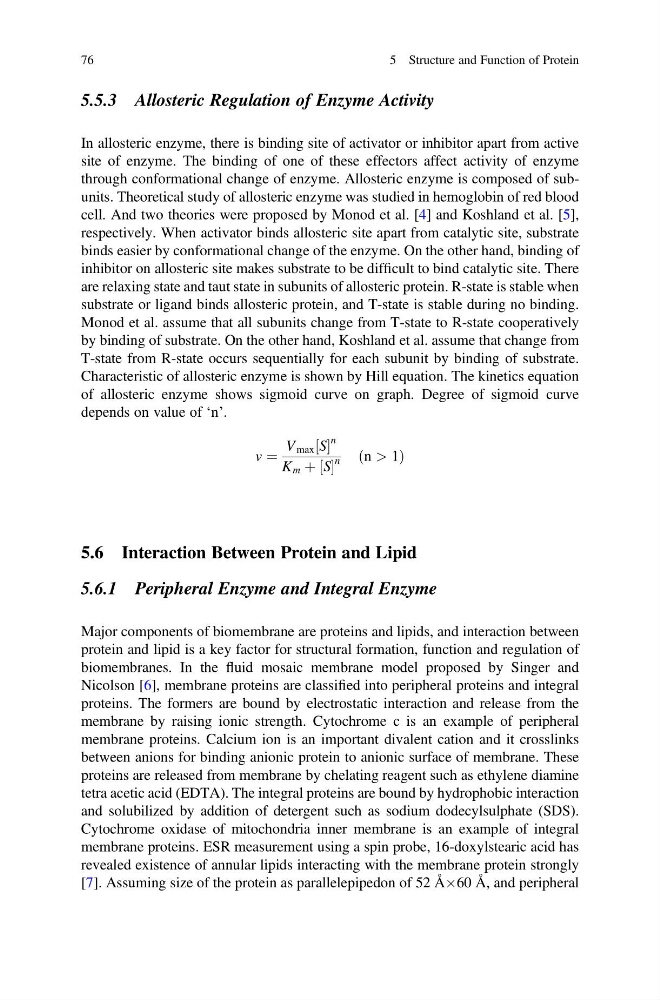
Characteristic of allosteric enzyme is shown by Hill equation. The kinetics equation
of allosteric enzyme shows sigmoid curve on graph. Degree of sigmoid curve
depends on value of ‘n’.
v ¼
V max S
½
n
K m þ S
½
n
n > 1
ð
Þ
5.6 Interaction Between Protein and Lipid
5.6.1 Peripheral Enzyme and Integral Enzyme
Major components of biomembrane are proteins and lipids, and interaction between
protein and lipid is a key factor for structural formation, function and regulation of
biomembranes. In the fluid mosaic membrane model proposed by Singer and
Nicolson [6], membrane proteins are classified into peripheral proteins and integral
proteins. The formers are bound by electrostatic interaction and release from the
membrane by raising ionic strength. Cytochrome c is an example of peripheral
membrane proteins. Calcium ion is an important divalent cation and it crosslinks
between anions for binding anionic protein to anionic surface of membrane. These
proteins are released from membrane by chelating reagent such as ethylene diamine
tetra acetic acid (EDTA). The integral proteins are bound by hydrophobic interaction
and solubilized by addition of detergent such as sodium dodecylsulphate (SDS).
Cytochrome oxidase of mitochondria inner membrane is an example of integral
membrane proteins. ESR measurement using a spin probe, 16-doxylstearic acid has
revealed existence of annular lipids interacting with the membrane protein strongly
[7]. Assuming size of the protein as parallelepipedon of 52 ÅÂ60 Å, and peripheral
76
5 Structure and Function of Protein
In allosteric enzyme, there is binding site of activator or inhibitor apart from active
site of enzyme. The binding of one of these effectors affect activity of enzyme
through conformational change of enzyme. Allosteric enzyme is composed of subunits. Theoretical study of allosteric enzyme was studied in hemoglobin of red blood
cell. And two theories were proposed by Monod et al. [4] and Koshland et al. [5],
respectively. When activator binds allosteric site apart from catalytic site, substrate
binds easier by conformational change of the enzyme. On the other hand, binding of
inhibitor on allosteric site makes substrate to be difficult to bind catalytic site. There
are relaxing state and taut state in subunits of allosteric protein. R-state is stable when
substrate or ligand binds allosteric protein, and T-state is stable during no binding.
Monod et al. assume that all subunits change from T-state to R-state cooperatively
by binding of substrate. On the other hand, Koshland et al. assume that change from
T-state from R-state occurs sequentially for each subunit by binding of substrate.
Characteristic of allosteric enzyme is shown by Hill equation. The kinetics equation
of allosteric enzyme shows sigmoid curve on graph. Degree of sigmoid curve
depends on value of ‘n’.
v ¼
V max S
½
n
K m þ S
½
n
n > 1
ð
Þ
5.6 Interaction Between Protein and Lipid
5.6.1 Peripheral Enzyme and Integral Enzyme
Major components of biomembrane are proteins and lipids, and interaction between
protein and lipid is a key factor for structural formation, function and regulation of
biomembranes. In the fluid mosaic membrane model proposed by Singer and
Nicolson [6], membrane proteins are classified into peripheral proteins and integral
proteins. The formers are bound by electrostatic interaction and release from the
membrane by raising ionic strength. Cytochrome c is an example of peripheral
membrane proteins. Calcium ion is an important divalent cation and it crosslinks
between anions for binding anionic protein to anionic surface of membrane. These
proteins are released from membrane by chelating reagent such as ethylene diamine
tetra acetic acid (EDTA). The integral proteins are bound by hydrophobic interaction
and solubilized by addition of detergent such as sodium dodecylsulphate (SDS).
Cytochrome oxidase of mitochondria inner membrane is an example of integral
membrane proteins. ESR measurement using a spin probe, 16-doxylstearic acid has
revealed existence of annular lipids interacting with the membrane protein strongly
[7]. Assuming size of the protein as parallelepipedon of 52 ÅÂ60 Å, and peripheral
76
5 Structure and Function of Protein