

3.7.1 Fluorescence Polarization Anisotropy
Fluorescence polarization anisotropy is a method used for measuring various physical properties in membranes such as phase transition and membrane fluidity (viscosity) in biomembranes and lipid bilayer membranes by fluorescence molecule as a
probe. Fluorescence molecule excited by polarized light emits polarized light.
Rotational motion of the fluorescence molecule affects direction of the polarized
emission light. And the change of emission light is observed by horizontal and
vertical polarizer. Fluorescence polarization anisotropy, r is calculated by following
equation.
r ¼
I VV ÀI VH ÁG
I VV þ2I VH ÁG , where I VV and I VH are fluorescence intensity of polarized light
parallel to incident polarized light and fluorescence intensity of polarized light
vertical to incident polarized light, respectively. Correction factor of polarizer for
I HH and I VV, G ¼
I VV
I HH
is introduced in the equation (Fig. 3.16).
Quantum yield, φ and fluorescence lifetimeτ are defined by rate constants in
losing processes of excited energy.
φ ¼
k F þk ISC þk Q Q
½ þk ET
k F
, τ ¼
1
k F þk IC þk ISC þk Q Q
½ þk ET
, where k F , k IC , k ISC , k Q and k ET are
rate constants of fluorescence, internal conversion (S1!ground state), intersystem
crossing (S1!triplet state, T), quenching and energy transfer, respectively.
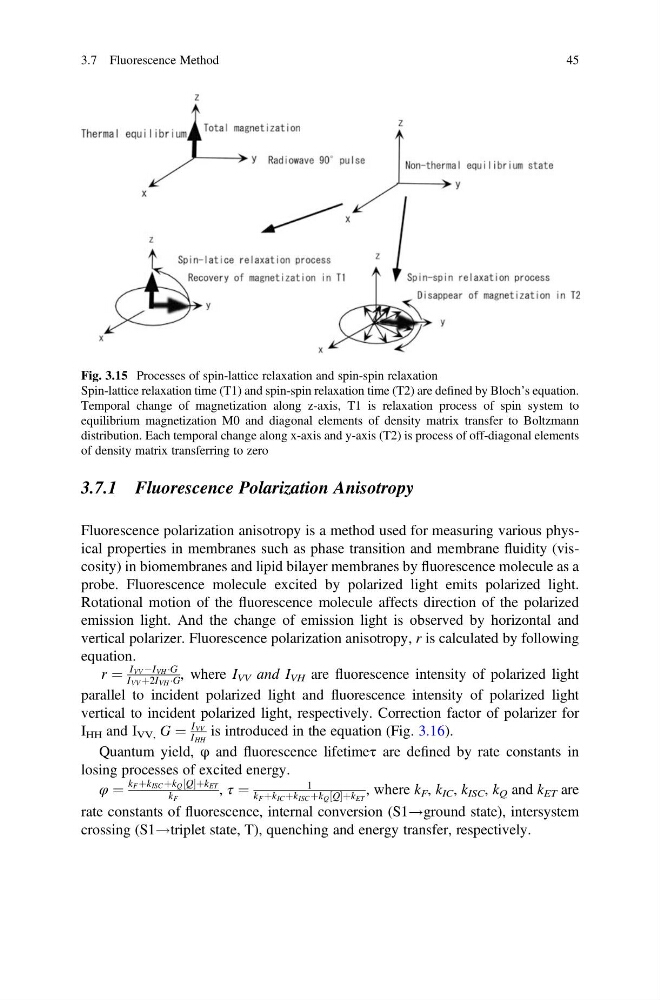
Fig. 3.15 Processes of spin-lattice relaxation and spin-spin relaxation
Spin-lattice relaxation time (T1) and spin-spin relaxation time (T2) are defined by Bloch’s equation.
Temporal change of magnetization along z-axis, T1 is relaxation process of spin system to
equilibrium magnetization M0 and diagonal elements of density matrix transfer to Boltzmann
distribution. Each temporal change along x-axis and y-axis (T2) is process of off-diagonal elements
of density matrix transferring to zero
3.7 Fluorescence Method
45
Fluorescence polarization anisotropy is a method used for measuring various physical properties in membranes such as phase transition and membrane fluidity (viscosity) in biomembranes and lipid bilayer membranes by fluorescence molecule as a
probe. Fluorescence molecule excited by polarized light emits polarized light.
Rotational motion of the fluorescence molecule affects direction of the polarized
emission light. And the change of emission light is observed by horizontal and
vertical polarizer. Fluorescence polarization anisotropy, r is calculated by following
equation.
r ¼
I VV ÀI VH ÁG
I VV þ2I VH ÁG , where I VV and I VH are fluorescence intensity of polarized light
parallel to incident polarized light and fluorescence intensity of polarized light
vertical to incident polarized light, respectively. Correction factor of polarizer for
I HH and I VV, G ¼
I VV
I HH
is introduced in the equation (Fig. 3.16).
Quantum yield, φ and fluorescence lifetimeτ are defined by rate constants in
losing processes of excited energy.
φ ¼
k F þk ISC þk Q Q
½ þk ET
k F
, τ ¼
1
k F þk IC þk ISC þk Q Q
½ þk ET
, where k F , k IC , k ISC , k Q and k ET are
rate constants of fluorescence, internal conversion (S1!ground state), intersystem
crossing (S1!triplet state, T), quenching and energy transfer, respectively.
Fig. 3.15 Processes of spin-lattice relaxation and spin-spin relaxation
Spin-lattice relaxation time (T1) and spin-spin relaxation time (T2) are defined by Bloch’s equation.
Temporal change of magnetization along z-axis, T1 is relaxation process of spin system to
equilibrium magnetization M0 and diagonal elements of density matrix transfer to Boltzmann
distribution. Each temporal change along x-axis and y-axis (T2) is process of off-diagonal elements
of density matrix transferring to zero
3.7 Fluorescence Method
45