

3.6 Magnetic Resonance
When nuclear spin or electron spin is placed in external magnetic field, magnetic
moment generated by its spin interacts with the magnetic field. Classically, compass
indicates angular dependent manner in terrestrial magnetism and finally the compass
directs north-south direction as the lowest energy state. In a case of nuclear spin and
electron spin, their energy states are quantized to discrete energy level. Therefore,
electromagnetic wave resonances with energy equal to difference between high-level
and low-level energy states, and induces transition between these energy levels. The
electromagnetic waves are radio wave and microwave for nuclear magnetic resonance (NMR) and electron magnetic resonance (ESR), respectively.
3.6.1 Electron Magnetic Resonance (ESR)
Electron magnetic resonance is also called electron paramagnetic resonance (EPR),
and initially used for structural analysis of chemical compounds. Spin labeling
method have been developed by use of a unique property of stabilized nitroxide
radical as spin probe [1]. Especially, lipid (fatty acid, cholesterol and phospholipid)
spin probes are introduced for study of biomembranes and successful results are
obtained in measurement of membrane fluidity using order parameter, S [2] and flipflop in lipid bilayer membranes using exchange broadening [3]. The study of
membrane fluidity gave an evidence for fluid mosaic model proposed by Singer
and Nicolson [4]. Electron rotating with its negative charge generates magnetic
moment, μ, and the magnetic moment quantized to two states (S¼+1/2, antiparallel)
and (S¼À1/2, parallel) in external magnetic field. An unaired electron takes one of
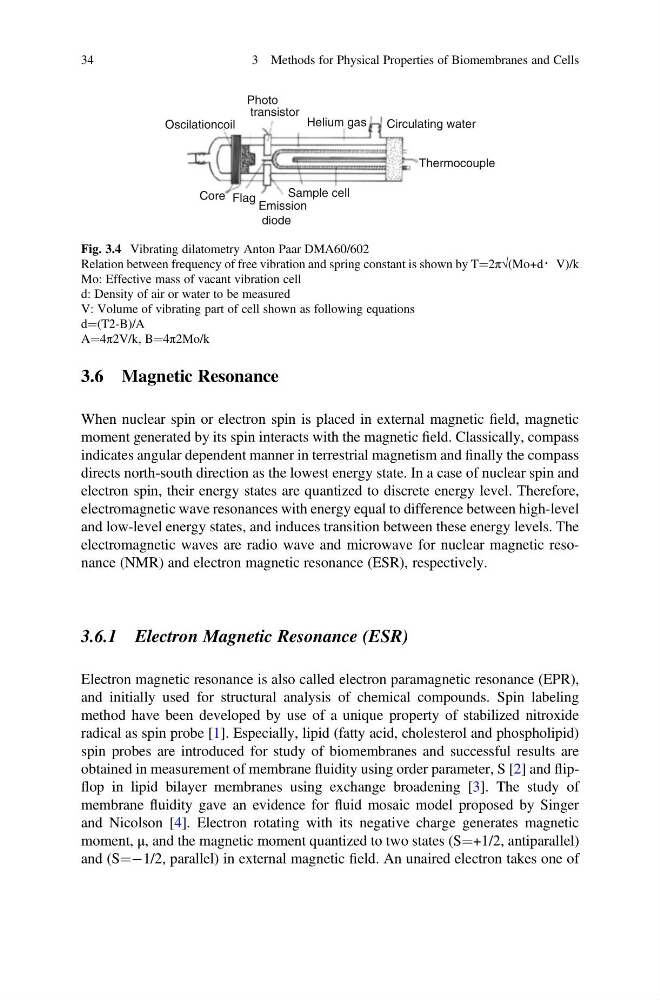
Oscilationcoil
Core
Photo
transistor
Emission
diode
Flag
Circulating water
Helium gas
Thermocouple
Sample cell
Fig. 3.4 Vibrating dilatometry Anton Paar DMA60/602
Relation between frequency of free vibration and spring constant is shown by T¼2π√(Mo+d・V)/k
Mo: Effective mass of vacant vibration cell
d: Density of air or water to be measured
V: Volume of vibrating part of cell shown as following equations
d¼(T2-B)/A
A¼4π2V/k, B¼4π2Mo/k
34
3 Methods for Physical Properties of Biomembranes and Cells
When nuclear spin or electron spin is placed in external magnetic field, magnetic
moment generated by its spin interacts with the magnetic field. Classically, compass
indicates angular dependent manner in terrestrial magnetism and finally the compass
directs north-south direction as the lowest energy state. In a case of nuclear spin and
electron spin, their energy states are quantized to discrete energy level. Therefore,
electromagnetic wave resonances with energy equal to difference between high-level
and low-level energy states, and induces transition between these energy levels. The
electromagnetic waves are radio wave and microwave for nuclear magnetic resonance (NMR) and electron magnetic resonance (ESR), respectively.
3.6.1 Electron Magnetic Resonance (ESR)
Electron magnetic resonance is also called electron paramagnetic resonance (EPR),
and initially used for structural analysis of chemical compounds. Spin labeling
method have been developed by use of a unique property of stabilized nitroxide
radical as spin probe [1]. Especially, lipid (fatty acid, cholesterol and phospholipid)
spin probes are introduced for study of biomembranes and successful results are
obtained in measurement of membrane fluidity using order parameter, S [2] and flipflop in lipid bilayer membranes using exchange broadening [3]. The study of
membrane fluidity gave an evidence for fluid mosaic model proposed by Singer
and Nicolson [4]. Electron rotating with its negative charge generates magnetic
moment, μ, and the magnetic moment quantized to two states (S¼+1/2, antiparallel)
and (S¼À1/2, parallel) in external magnetic field. An unaired electron takes one of
Oscilationcoil
Core
Photo
transistor
Emission
diode
Flag
Circulating water
Helium gas
Thermocouple
Sample cell
Fig. 3.4 Vibrating dilatometry Anton Paar DMA60/602
Relation between frequency of free vibration and spring constant is shown by T¼2π√(Mo+d・V)/k
Mo: Effective mass of vacant vibration cell
d: Density of air or water to be measured
V: Volume of vibrating part of cell shown as following equations
d¼(T2-B)/A
A¼4π2V/k, B¼4π2Mo/k
34
3 Methods for Physical Properties of Biomembranes and Cells