

3.5 Measurement of Density, (Dilatometer)
Phase transition with structural change is accompanied with change of various
physical properties. Change of density is observed by a sophisticated vibration
method of Anton Paar DMA/60/602. In the instrument, liquid sample is injected
into glass U tube, and frequency of the U tube is measured by digital circuit. Density
of the sample is obtained by following equation.
T ¼ 2π
ffiffiffiffiffiffiffiffiffiffiffiffi
M 0 þdÁV
k
q
, where T, k, M 0, d and V are frequency of free vibration, spring
constant, effective mass of empty U tube, density of sample (liquid or gas) and
volume of vibrating region of the U tube (Fig. 3.4). This equation is converted to
d ¼
T
2 ÀB
A , and instrument constants A ¼
4π
2 V
k
and B ¼
4π
2 M 0
k
are obtained by
measurement of known density of air and water at a certain temperature.
Mesuring temperature by thermocouple
Reference
a
b
c
Sample
Heaters
Compensating current
Detection of
temperature
difference
Schematic image of cells
Adiabatic heater
Adiabatic heater
Thermocouple
Thermocouple
Adiabatic wall
Adiabatic wall
Heater for
reference cell
Heater for
sample cell
Thermograph (Melting temperature and heating scan)
Temperature change
of reference
With compensating current
Without compensating current
Recorder
DSC thermograph
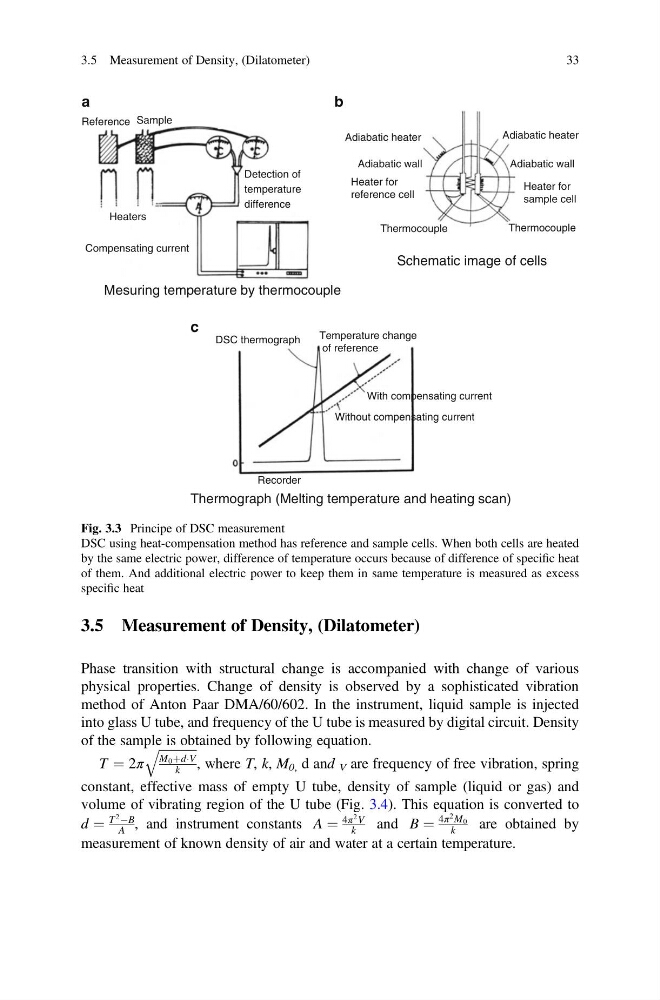
Fig. 3.3 Principe of DSC measurement
DSC using heat-compensation method has reference and sample cells. When both cells are heated
by the same electric power, difference of temperature occurs because of difference of specific heat
of them. And additional electric power to keep them in same temperature is measured as excess
specific heat
3.5 Measurement of Density, (Dilatometer)
33
Phase transition with structural change is accompanied with change of various
physical properties. Change of density is observed by a sophisticated vibration
method of Anton Paar DMA/60/602. In the instrument, liquid sample is injected
into glass U tube, and frequency of the U tube is measured by digital circuit. Density
of the sample is obtained by following equation.
T ¼ 2π
ffiffiffiffiffiffiffiffiffiffiffiffi
M 0 þdÁV
k
q
, where T, k, M 0, d and V are frequency of free vibration, spring
constant, effective mass of empty U tube, density of sample (liquid or gas) and
volume of vibrating region of the U tube (Fig. 3.4). This equation is converted to
d ¼
T
2 ÀB
A , and instrument constants A ¼
4π
2 V
k
and B ¼
4π
2 M 0
k
are obtained by
measurement of known density of air and water at a certain temperature.
Mesuring temperature by thermocouple
Reference
a
b
c
Sample
Heaters
Compensating current
Detection of
temperature
difference
Schematic image of cells
Adiabatic heater
Adiabatic heater
Thermocouple
Thermocouple
Adiabatic wall
Adiabatic wall
Heater for
reference cell
Heater for
sample cell
Thermograph (Melting temperature and heating scan)
Temperature change
of reference
With compensating current
Without compensating current
Recorder
DSC thermograph
Fig. 3.3 Principe of DSC measurement
DSC using heat-compensation method has reference and sample cells. When both cells are heated
by the same electric power, difference of temperature occurs because of difference of specific heat
of them. And additional electric power to keep them in same temperature is measured as excess
specific heat
3.5 Measurement of Density, (Dilatometer)
33