

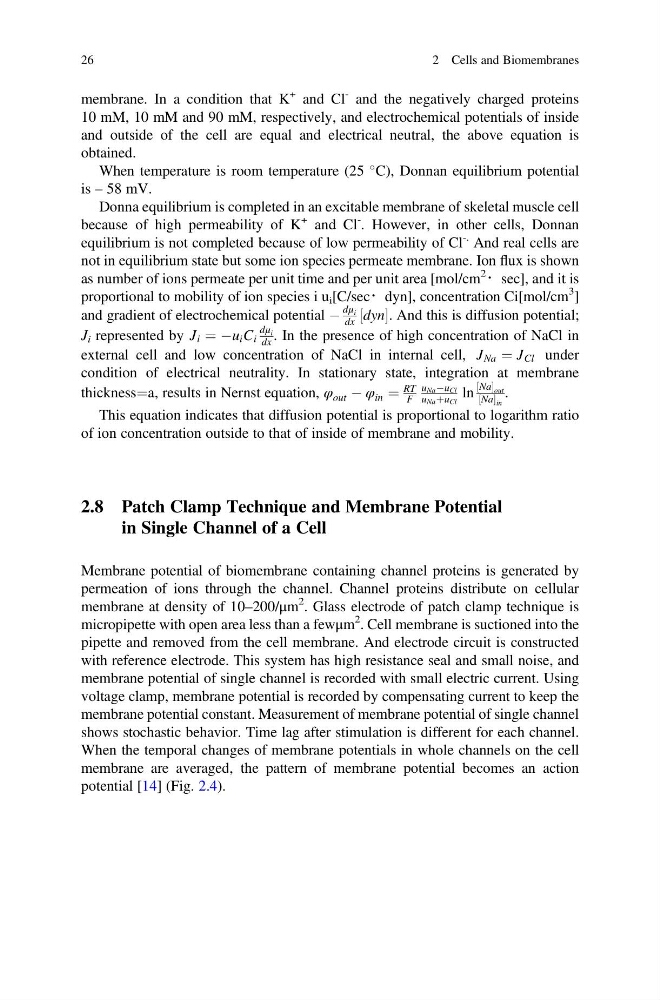
membrane. In a condition that K
+ and Cl
- and the negatively charged proteins
10 mM, 10 mM and 90 mM, respectively, and electrochemical potentials of inside
and outside of the cell are equal and electrical neutral, the above equation is
obtained.
When temperature is room temperature (25
C), Donnan equilibrium potential
is – 58 mV.
Donna equilibrium is completed in an excitable membrane of skeletal muscle cell
because of high permeability of K
+ and Cl
-
. However, in other cells, Donnan
equilibrium is not completed because of low permeability of Cl
-. And real cells are
not in equilibrium state but some ion species permeate membrane. Ion flux is shown
as number of ions permeate per unit time and per unit area [mol/cm
2
・sec], and it is
proportional to mobility of ion species i u i [C/sec・dyn], concentration Ci[mol/cm
3 ]
and gradient of electrochemical potential À
dμ i
dx dyn
½ . And this is diffusion potential;
J i represented by J i ¼ Àu i C i
dμ i
dx . In the presence of high concentration of NaCl in
external cell and low concentration of NaCl in internal cell, J Na ¼ J Cl under
condition of electrical neutrality. In stationary state, integration at membrane
thickness¼a, results in Nernst equation, φ out À φ in ¼
RT
F
u Na Àu Cl
u Na þu Cl
ln
Na
½ out
Na
½ in
.
This equation indicates that diffusion potential is proportional to logarithm ratio
of ion concentration outside to that of inside of membrane and mobility.
2.8 Patch Clamp Technique and Membrane Potential
in Single Channel of a Cell
Membrane potential of biomembrane containing channel proteins is generated by
permeation of ions through the channel. Channel proteins distribute on cellular
membrane at density of 10–200/μm
2 . Glass electrode of patch clamp technique is
micropipette with open area less than a fewμm
2 . Cell membrane is suctioned into the
pipette and removed from the cell membrane. And electrode circuit is constructed
with reference electrode. This system has high resistance seal and small noise, and
membrane potential of single channel is recorded with small electric current. Using
voltage clamp, membrane potential is recorded by compensating current to keep the
membrane potential constant. Measurement of membrane potential of single channel
shows stochastic behavior. Time lag after stimulation is different for each channel.
When the temporal changes of membrane potentials in whole channels on the cell
membrane are averaged, the pattern of membrane potential becomes an action
potential [14] (Fig. 2.4).
26
2 Cells and Biomembranes
+ and Cl
- and the negatively charged proteins
10 mM, 10 mM and 90 mM, respectively, and electrochemical potentials of inside
and outside of the cell are equal and electrical neutral, the above equation is
obtained.
When temperature is room temperature (25
C), Donnan equilibrium potential
is – 58 mV.
Donna equilibrium is completed in an excitable membrane of skeletal muscle cell
because of high permeability of K
+ and Cl
-
. However, in other cells, Donnan
equilibrium is not completed because of low permeability of Cl
-. And real cells are
not in equilibrium state but some ion species permeate membrane. Ion flux is shown
as number of ions permeate per unit time and per unit area [mol/cm
2
・sec], and it is
proportional to mobility of ion species i u i [C/sec・dyn], concentration Ci[mol/cm
3 ]
and gradient of electrochemical potential À
dμ i
dx dyn
½ . And this is diffusion potential;
J i represented by J i ¼ Àu i C i
dμ i
dx . In the presence of high concentration of NaCl in
external cell and low concentration of NaCl in internal cell, J Na ¼ J Cl under
condition of electrical neutrality. In stationary state, integration at membrane
thickness¼a, results in Nernst equation, φ out À φ in ¼
RT
F
u Na Àu Cl
u Na þu Cl
ln
Na
½ out
Na
½ in
.
This equation indicates that diffusion potential is proportional to logarithm ratio
of ion concentration outside to that of inside of membrane and mobility.
2.8 Patch Clamp Technique and Membrane Potential
in Single Channel of a Cell
Membrane potential of biomembrane containing channel proteins is generated by
permeation of ions through the channel. Channel proteins distribute on cellular
membrane at density of 10–200/μm
2 . Glass electrode of patch clamp technique is
micropipette with open area less than a fewμm
2 . Cell membrane is suctioned into the
pipette and removed from the cell membrane. And electrode circuit is constructed
with reference electrode. This system has high resistance seal and small noise, and
membrane potential of single channel is recorded with small electric current. Using
voltage clamp, membrane potential is recorded by compensating current to keep the
membrane potential constant. Measurement of membrane potential of single channel
shows stochastic behavior. Time lag after stimulation is different for each channel.
When the temporal changes of membrane potentials in whole channels on the cell
membrane are averaged, the pattern of membrane potential becomes an action
potential [14] (Fig. 2.4).
26
2 Cells and Biomembranes