

1.3 Stationary State of Living Organism
From view point of energetics, formation and maintenance of biological system can
be understood by the second law of thermodynamics. Highly ordered biological
system is attained in non-equilibrium state. I. Prigogine analyzed the second law of
thermodynamics from viewpoints of micro and macro level of biological system,
and he concluded that ordered system realized even in non-equilibrium system. This
system is in irreversible process and has continuous entropy production, in other
word dissipation of free energy [9]. Considering living organisms thermodynamically, if substances and energy do not exchange with those in external environment is
assumed (isolated system) in the living organisms irreversible processes such as
chemical reaction, diffusion of substances, thermal conduction and so on are proceeding with production of entropy and finally result in equilibrium state where
entropy production is zero. However, living organisms exchange substances and
energy with external environment (open system) and generate entropy; rate of
entropy generation is proportional to difference between non-equilibrium state and
equilibrium state. And the non-equilibrium state of living organism is considered
approximately as stationary state.
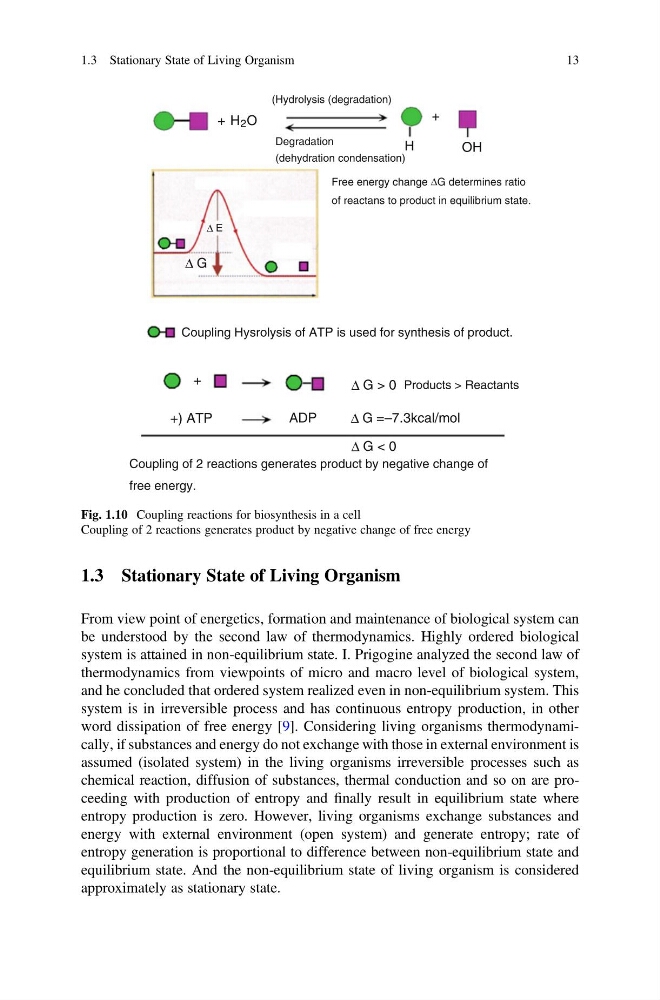
Free energy change ΔG determines ratio
of reactans to product in equilibrium state.
(Hydrolysis (degradation)
Degradation
(dehydration condensation)
Δ G > 0 Products > Reactants
Δ G
Δ E
+) ATP
ADP
Δ G =–7.3kcal/mol
Δ G < 0
+ H 2 O
H
OH
+
+
Coupling Hysrolysis of ATP is used for synthesis of product.
Coupling of 2 reactions generates product by negative change of
free energy.
Fig. 1.10 Coupling reactions for biosynthesis in a cell
Coupling of 2 reactions generates product by negative change of free energy
1.3 Stationary State of Living Organism
13
From view point of energetics, formation and maintenance of biological system can
be understood by the second law of thermodynamics. Highly ordered biological
system is attained in non-equilibrium state. I. Prigogine analyzed the second law of
thermodynamics from viewpoints of micro and macro level of biological system,
and he concluded that ordered system realized even in non-equilibrium system. This
system is in irreversible process and has continuous entropy production, in other
word dissipation of free energy [9]. Considering living organisms thermodynamically, if substances and energy do not exchange with those in external environment is
assumed (isolated system) in the living organisms irreversible processes such as
chemical reaction, diffusion of substances, thermal conduction and so on are proceeding with production of entropy and finally result in equilibrium state where
entropy production is zero. However, living organisms exchange substances and
energy with external environment (open system) and generate entropy; rate of
entropy generation is proportional to difference between non-equilibrium state and
equilibrium state. And the non-equilibrium state of living organism is considered
approximately as stationary state.
Free energy change ΔG determines ratio
of reactans to product in equilibrium state.
(Hydrolysis (degradation)
Degradation
(dehydration condensation)
Δ G > 0 Products > Reactants
Δ G
Δ E
+) ATP
ADP
Δ G =–7.3kcal/mol
Δ G < 0
+ H 2 O
H
OH
+
+
Coupling Hysrolysis of ATP is used for synthesis of product.
Coupling of 2 reactions generates product by negative change of
free energy.
Fig. 1.10 Coupling reactions for biosynthesis in a cell
Coupling of 2 reactions generates product by negative change of free energy
1.3 Stationary State of Living Organism
13