

1.2.4 Coupling Reaction for Synthetic Chemical Reaction
Water molecules play key role in chemical reaction of biological system. In most
cases, association of molecules occurs as dehydration condensation and dissociation
of molecule occurs as hydrolysis. In general, Gibbs’s free energy change of association of molecules is positive, and so synthesis of molecule requires supply of
energy. Gibb’s free energy change of ATP (–7.3 kcal/mol) is used to make the
total Gibb’s energy change be negative (Fig. 1.10).
1.2.5 Non-equilibrium Thermodynamics and Living State
From physical viewpoint, living state of living organisms is a non-equilibrium state
which is different from equilibrium state. For example, Escherichia coli cell is
composed of carbon (5.83 Â 10
9 ), hydrogen (9.83 Â 10
9
), oxygen (2.67 Â 10
9 )
and nitrogen (1.55 Â 10
9 ). In closed system, these atoms form various molecules and
then finally result in equilibrium state where total energy of chemical bonds is in
minimum. On the other hand, these atoms are used for synthesizing various biological molecules such as protein, nucleic acid, lipid, sugar and so on. Total bond
energy of the biological molecules is higher than the total bond energy of various
molecules formed in equilibrium. The difference of total bond energy between
molecules in E. coli cell and molecules in equilibrium is supplied to maintain living
state of E. coli cell [8].
A + B
Δ G
C
Reaction coordinate
Energy
Transition state
Activation energy
Reactants
Product
Free energy change
Gibbs’s free energy:
G=H-TS
Enthalpy: H=U+PV
Entropy: S
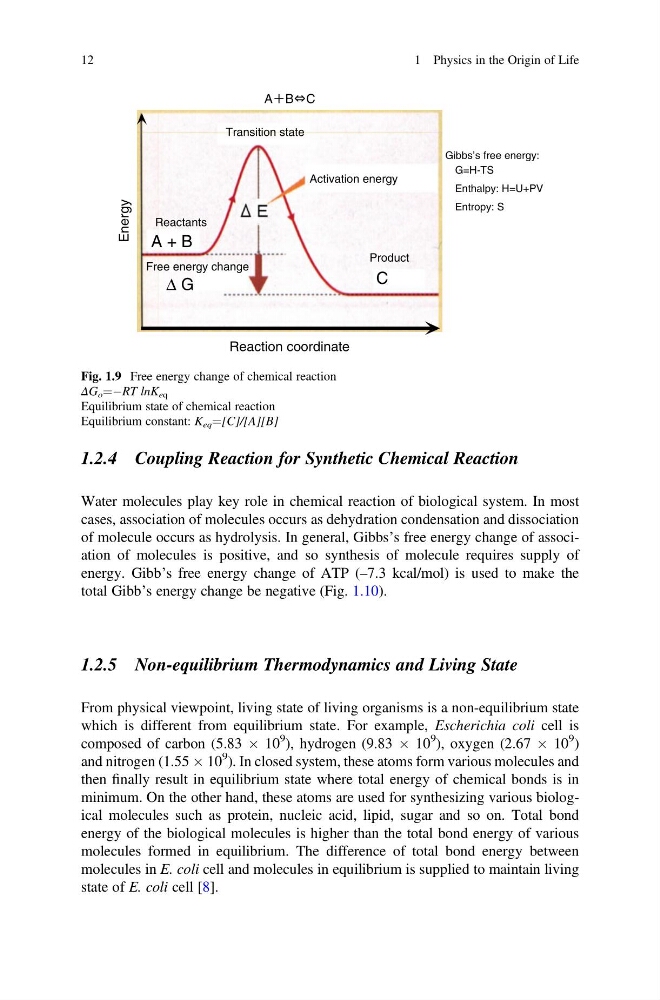
Fig. 1.9 Free energy change of chemical reaction
ΔG o ¼ÀRT lnK eq
Equilibrium state of chemical reaction
Equilibrium constant: K eq ¼[C]/[A][B]
12
1 Physics in the Origin of Life
Water molecules play key role in chemical reaction of biological system. In most
cases, association of molecules occurs as dehydration condensation and dissociation
of molecule occurs as hydrolysis. In general, Gibbs’s free energy change of association of molecules is positive, and so synthesis of molecule requires supply of
energy. Gibb’s free energy change of ATP (–7.3 kcal/mol) is used to make the
total Gibb’s energy change be negative (Fig. 1.10).
1.2.5 Non-equilibrium Thermodynamics and Living State
From physical viewpoint, living state of living organisms is a non-equilibrium state
which is different from equilibrium state. For example, Escherichia coli cell is
composed of carbon (5.83 Â 10
9 ), hydrogen (9.83 Â 10
9
), oxygen (2.67 Â 10
9 )
and nitrogen (1.55 Â 10
9 ). In closed system, these atoms form various molecules and
then finally result in equilibrium state where total energy of chemical bonds is in
minimum. On the other hand, these atoms are used for synthesizing various biological molecules such as protein, nucleic acid, lipid, sugar and so on. Total bond
energy of the biological molecules is higher than the total bond energy of various
molecules formed in equilibrium. The difference of total bond energy between
molecules in E. coli cell and molecules in equilibrium is supplied to maintain living
state of E. coli cell [8].
A + B
Δ G
C
Reaction coordinate
Energy
Transition state
Activation energy
Reactants
Product
Free energy change
Gibbs’s free energy:
G=H-TS
Enthalpy: H=U+PV
Entropy: S
Fig. 1.9 Free energy change of chemical reaction
ΔG o ¼ÀRT lnK eq
Equilibrium state of chemical reaction
Equilibrium constant: K eq ¼[C]/[A][B]
12
1 Physics in the Origin of Life