

Hot water from submarine hydrothermal deposits includes sulfide, and there is
ecological system of clubs, clams, asteroids and annelids which eat population of
sulfur bacteria for their growth.
1.1.4.2 Photosynthetic Bacteria
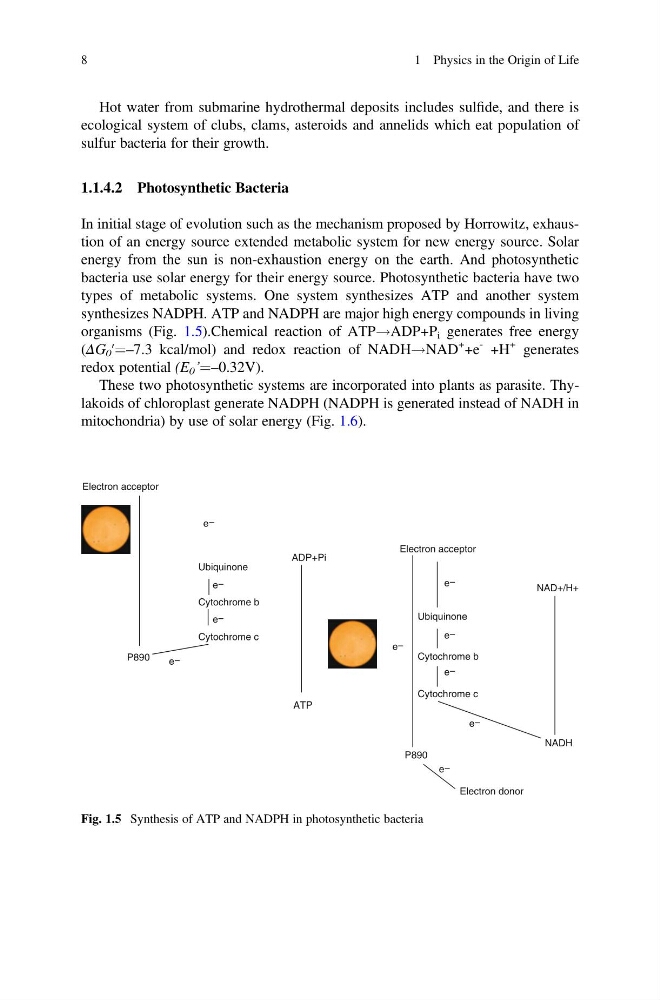
In initial stage of evolution such as the mechanism proposed by Horrowitz, exhaustion of an energy source extended metabolic system for new energy source. Solar
energy from the sun is non-exhaustion energy on the earth. And photosynthetic
bacteria use solar energy for their energy source. Photosynthetic bacteria have two
types of metabolic systems. One system synthesizes ATP and another system
synthesizes NADPH. ATP and NADPH are major high energy compounds in living
organisms (Fig. 1.5).Chemical reaction of ATP!ADP+P i generates free energy
(ΔG 0 '¼–7.3 kcal/mol) and redox reaction of NADH!NAD
+
+e
- +H
+ generates
redox potential (E 0 ’¼–0.32V).
These two photosynthetic systems are incorporated into plants as parasite. Thylakoids of chloroplast generate NADPH (NADPH is generated instead of NADH in
mitochondria) by use of solar energy (Fig. 1.6).
Electron acceptor
Electron acceptor
ADP+Pi
ATP
P890
NAD+/H+
NADH
P890
Electron donor
Ubiquinone
Cytochrome b
Ubiquinone
Cytochrome c
Cytochrome b
e −
e −
e −
e −
e −
e −
e −
e −
Cytochrome c
e −
e −
Fig. 1.5 Synthesis of ATP and NADPH in photosynthetic bacteria
8
1 Physics in the Origin of Life
ecological system of clubs, clams, asteroids and annelids which eat population of
sulfur bacteria for their growth.
1.1.4.2 Photosynthetic Bacteria
In initial stage of evolution such as the mechanism proposed by Horrowitz, exhaustion of an energy source extended metabolic system for new energy source. Solar
energy from the sun is non-exhaustion energy on the earth. And photosynthetic
bacteria use solar energy for their energy source. Photosynthetic bacteria have two
types of metabolic systems. One system synthesizes ATP and another system
synthesizes NADPH. ATP and NADPH are major high energy compounds in living
organisms (Fig. 1.5).Chemical reaction of ATP!ADP+P i generates free energy
(ΔG 0 '¼–7.3 kcal/mol) and redox reaction of NADH!NAD
+
+e
- +H
+ generates
redox potential (E 0 ’¼–0.32V).
These two photosynthetic systems are incorporated into plants as parasite. Thylakoids of chloroplast generate NADPH (NADPH is generated instead of NADH in
mitochondria) by use of solar energy (Fig. 1.6).
Electron acceptor
Electron acceptor
ADP+Pi
ATP
P890
NAD+/H+
NADH
P890
Electron donor
Ubiquinone
Cytochrome b
Ubiquinone
Cytochrome c
Cytochrome b
e −
e −
e −
e −
e −
e −
e −
e −
Cytochrome c
e −
e −
Fig. 1.5 Synthesis of ATP and NADPH in photosynthetic bacteria
8
1 Physics in the Origin of Life