

without proteins and rough area with protein particles in endoplasmic reticulum of
Tetrahymena fed with palmitic acid and cooled to 15
C. For analysis of lipid
composition in each area, rough and smooth endoplasmic fractions were separated
by density gradient centrifugation after homogenizing the cells. Saturated fatty acids
are rich in the smooth area and unsaturated fatty acids are rich in rough area of
Tetrahymena endoplasmic reticulum [7].
10
20
30
40
50
0
10
20
30
40
50
0
Temperature [°C]
Temperature [°C]
Culture at 35 °C
Culture at 25 °C
Excess Heat Capacity
Excess Heat Capacity
Wild type
Wild type
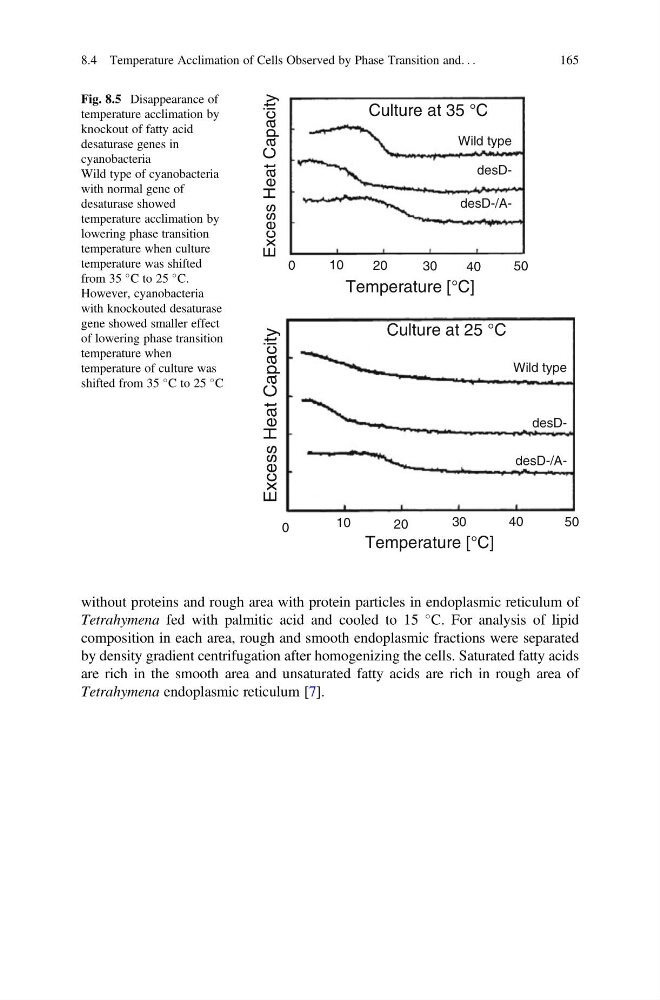
desD-/AFig. 8.5 Disappearance of
temperature acclimation by
knockout of fatty acid
desaturase genes in
cyanobacteria
Wild type of cyanobacteria
with normal gene of
desaturase showed
temperature acclimation by
lowering phase transition
temperature when culture
temperature was shifted
from 35
C to 25
C.
However, cyanobacteria
with knockouted desaturase
gene showed smaller effect
of lowering phase transition
temperature when
temperature of culture was
shifted from 35
C to 25
C
8.4 Temperature Acclimation of Cells Observed by Phase Transition and. . .
165
Tetrahymena fed with palmitic acid and cooled to 15
C. For analysis of lipid
composition in each area, rough and smooth endoplasmic fractions were separated
by density gradient centrifugation after homogenizing the cells. Saturated fatty acids
are rich in the smooth area and unsaturated fatty acids are rich in rough area of
Tetrahymena endoplasmic reticulum [7].
10
20
30
40
50
0
10
20
30
40
50
0
Temperature [°C]
Temperature [°C]
Culture at 35 °C
Culture at 25 °C
Excess Heat Capacity
Excess Heat Capacity
Wild type
Wild type
desD-/AFig. 8.5 Disappearance of
temperature acclimation by
knockout of fatty acid
desaturase genes in
cyanobacteria
Wild type of cyanobacteria
with normal gene of
desaturase showed
temperature acclimation by
lowering phase transition
temperature when culture
temperature was shifted
from 35
C to 25
C.
However, cyanobacteria
with knockouted desaturase
gene showed smaller effect
of lowering phase transition
temperature when
temperature of culture was
shifted from 35
C to 25
C
8.4 Temperature Acclimation of Cells Observed by Phase Transition and. . .
165