

measured at 15
C. On the other hand, when E. coli cells were cultured at different
temperatures such as 37
C, 30
C and 15
C, viscosity measured at the cultured
temperature ranged in 1.9 Æ 0.1 poise. The results indicate that adaptation mechanism is operated to keep viscosity constant even in change of culture temperature.
Viscosity of biomembranes is strongly correlated with composition of lipid molecules. A mechanism synthesizing cis-vaccenic acid with cis-double bond at higher
temperature was found in E. coli. In Tetrahymena cells, desaturases introducing
double bond into fatty acyl chains of phospholipids are sequentially activated when
culture temperature is lowered from 39.5
C to 15
C as shown in Figs. 8.3 and 8.4
shows temporal change of fatty acid composition of Tetrahymena cells during
temperature change from 39.5
C to 15
C. The result indicates that change of
culture temperature induces activation of fatty acid desaturases to convert the
membrane lipids to those of lower phase transition temperature by introducing
double bonds. In order to prove this adaptation mechanism, an experiment of
knock outing desaturase genes was performed in cyanobacteria [6]. Phase transition
profiles of wild type cyanobacteria and knockouted desaturases are shown in
Fig. 8.5. Cyanobacteria cells are grown by photosynthesis using solar energy.
When cyanobacteria cells were cultured at 35
C, both wild type cells and
50
40
30
20
10
0
Temperature [°C]
0.9
0.8
0.7
0.6
0.5
Order
parameter,
S
3.0
3.1
3.2
3.3
3.4
3.5
3.6 ×10 -3
1/T [K -1 ]
:DPPC (D16:0)
:DMPC(C14:0)
:DEPC(C18:1t)
:POPC(C16:0/C18:1c)
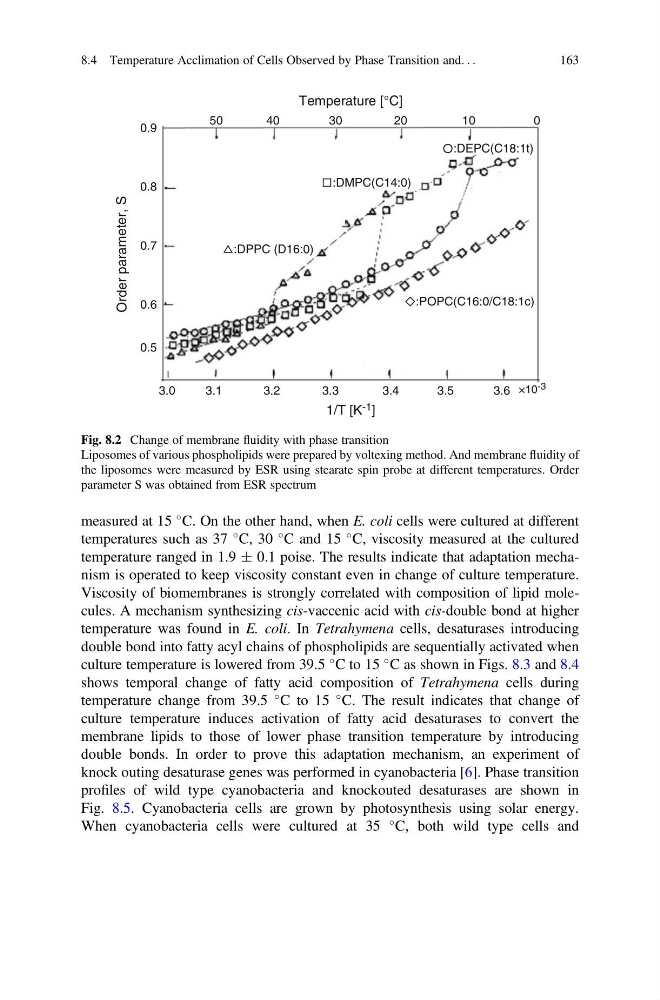
Fig. 8.2 Change of membrane fluidity with phase transition
Liposomes of various phospholipids were prepared by voltexing method. And membrane fluidity of
the liposomes were measured by ESR using stearate spin probe at different temperatures. Order
parameter S was obtained from ESR spectrum
8.4 Temperature Acclimation of Cells Observed by Phase Transition and. . .
163
C. On the other hand, when E. coli cells were cultured at different
temperatures such as 37
C, 30
C and 15
C, viscosity measured at the cultured
temperature ranged in 1.9 Æ 0.1 poise. The results indicate that adaptation mechanism is operated to keep viscosity constant even in change of culture temperature.
Viscosity of biomembranes is strongly correlated with composition of lipid molecules. A mechanism synthesizing cis-vaccenic acid with cis-double bond at higher
temperature was found in E. coli. In Tetrahymena cells, desaturases introducing
double bond into fatty acyl chains of phospholipids are sequentially activated when
culture temperature is lowered from 39.5
C to 15
C as shown in Figs. 8.3 and 8.4
shows temporal change of fatty acid composition of Tetrahymena cells during
temperature change from 39.5
C to 15
C. The result indicates that change of
culture temperature induces activation of fatty acid desaturases to convert the
membrane lipids to those of lower phase transition temperature by introducing
double bonds. In order to prove this adaptation mechanism, an experiment of
knock outing desaturase genes was performed in cyanobacteria [6]. Phase transition
profiles of wild type cyanobacteria and knockouted desaturases are shown in
Fig. 8.5. Cyanobacteria cells are grown by photosynthesis using solar energy.
When cyanobacteria cells were cultured at 35
C, both wild type cells and
50
40
30
20
10
0
Temperature [°C]
0.9
0.8
0.7
0.6
0.5
Order
parameter,
S
3.0
3.1
3.2
3.3
3.4
3.5
3.6 ×10 -3
1/T [K -1 ]
:DPPC (D16:0)
:DMPC(C14:0)
:DEPC(C18:1t)
:POPC(C16:0/C18:1c)
Fig. 8.2 Change of membrane fluidity with phase transition
Liposomes of various phospholipids were prepared by voltexing method. And membrane fluidity of
the liposomes were measured by ESR using stearate spin probe at different temperatures. Order
parameter S was obtained from ESR spectrum
8.4 Temperature Acclimation of Cells Observed by Phase Transition and. . .
163