

determined by its molecular structure. Membrane fluidity increases with transition
from solid phase to fluid phase as temperature is raised. Membrane fluidity of lipid
bilayer membranes composed of various lipid molecules is measured as order
parameter by ESR using lipid spin probe. Change of membrane fluidity in various
lipid molecules with phase transition is shown in Fig. 8.2. Phase transition of each
molecular species of phosphatidylcholine appears on change of order parameter and
decrease of order parameter indicates increase of membrane fluidity with phase
transition from gel phase to fluid phase by raising temperature. Sinensky has
found that Escherichia coli has ability to maintain constant viscosity of
biomembranes and lipid membranes formed by extracted lipids even in change of
culture temperature. This biological phenomenon is called ‘homeoviscous adaptation’ [5]. In the experiment, viscosity was measured by RSR using fatty acid spin
probe. Viscosity of E.coli biomembranes cultured at 43
C showed 2 poise measured
at 43
C. However, the viscosity increased to 15 poise when the viscosity was
39 °C
33 °C
27 °C
21 °C
15 °C
Cultured
at each temperature
Excess Heat Capacity
0
2 0
4 0
6 0
80
Temperature [°C]
Temperature of culture indicated by allow
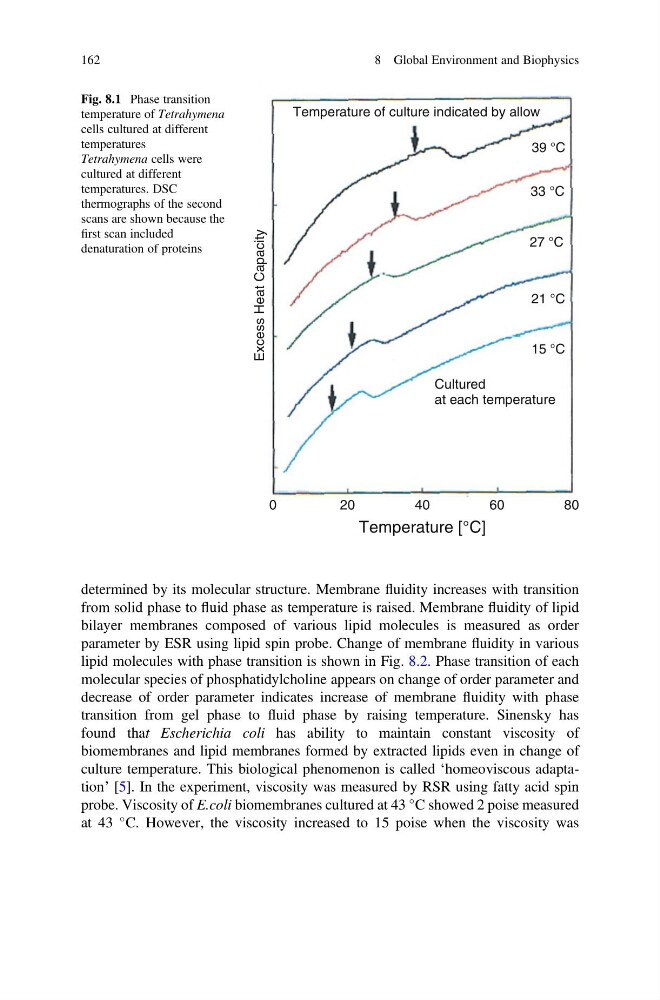
Fig. 8.1 Phase transition
temperature of Tetrahymena
cells cultured at different
temperatures
Tetrahymena cells were
cultured at different
temperatures. DSC
thermographs of the second
scans are shown because the
first scan included
denaturation of proteins
162
8 Global Environment and Biophysics
from solid phase to fluid phase as temperature is raised. Membrane fluidity of lipid
bilayer membranes composed of various lipid molecules is measured as order
parameter by ESR using lipid spin probe. Change of membrane fluidity in various
lipid molecules with phase transition is shown in Fig. 8.2. Phase transition of each
molecular species of phosphatidylcholine appears on change of order parameter and
decrease of order parameter indicates increase of membrane fluidity with phase
transition from gel phase to fluid phase by raising temperature. Sinensky has
found that Escherichia coli has ability to maintain constant viscosity of
biomembranes and lipid membranes formed by extracted lipids even in change of
culture temperature. This biological phenomenon is called ‘homeoviscous adaptation’ [5]. In the experiment, viscosity was measured by RSR using fatty acid spin
probe. Viscosity of E.coli biomembranes cultured at 43
C showed 2 poise measured
at 43
C. However, the viscosity increased to 15 poise when the viscosity was
39 °C
33 °C
27 °C
21 °C
15 °C
Cultured
at each temperature
Excess Heat Capacity
0
2 0
4 0
6 0
80
Temperature [°C]
Temperature of culture indicated by allow
Fig. 8.1 Phase transition
temperature of Tetrahymena
cells cultured at different
temperatures
Tetrahymena cells were
cultured at different
temperatures. DSC
thermographs of the second
scans are shown because the
first scan included
denaturation of proteins
162
8 Global Environment and Biophysics