

7.16 Actin-Based Biological Movements: Protrusion
of Lamellipodium
As descriobed above, lamellipodium protrudes as a result of the growth of the
underlying actin network. Because individual actin filaments grow toward the cell
edge, they eventually hit the cell membrane. One would expect that the growing
actin filaments will push the lamellipodal membrane. This idea led to a theoretical
proposal that the growth of actin filament or shrinkage of microtubule is capable of
producing mechanical work [146]. The possibility of the force generation by the
growing or shrinking biopolymers has been analyzed on the basis of irreversible
thermodynamics (see Sect. 7.21, [147]).
Actually, polymerization has to occur at the interface between the cell membrane
and the tip of individual actin filaments and this will not be possible, unless the gap
opens between the barbed end of the filament and the cell membrane to allow a
monomer to polymerize onto the barbed end. One possible mechanism to create the
Growth
factor
Growth
factor
Cell membrane
Activation
Hetero
-trimeric
G protein
Nucleation/
polymerization
Gα
GDP
Gα
GTP
GTP
GTP
Adaptor
protein
ON state
OFF state
GEF
Small
GTPase
GAP
GDP
Gβ-G
Gβ-G
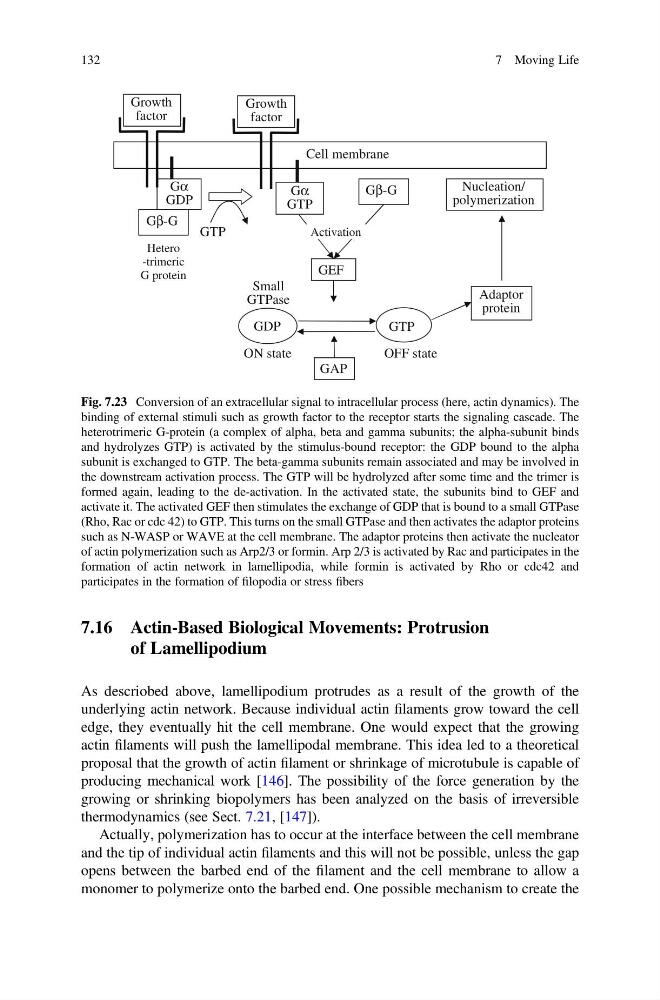
Fig. 7.23 Conversion of an extracellular signal to intracellular process (here, actin dynamics). The
binding of external stimuli such as growth factor to the receptor starts the signaling cascade. The
heterotrimeric G-protein (a complex of alpha, beta and gamma subunits; the alpha-subunit binds
and hydrolyzes GTP) is activated by the stimulus-bound receptor: the GDP bound to the alpha
subunit is exchanged to GTP. The beta-gamma subunits remain associated and may be involved in
the downstream activation process. The GTP will be hydrolyzed after some time and the trimer is
formed again, leading to the de-activation. In the activated state, the subunits bind to GEF and
activate it. The activated GEF then stimulates the exchange of GDP that is bound to a small GTPase
(Rho, Rac or cdc 42) to GTP. This turns on the small GTPase and then activates the adaptor proteins
such as N-WASP or WAVE at the cell membrane. The adaptor proteins then activate the nucleator
of actin polymerization such as Arp2/3 or formin. Arp 2/3 is activated by Rac and participates in the
formation of actin network in lamellipodia, while formin is activated by Rho or cdc42 and
participates in the formation of filopodia or stress fibers
132
7 Moving Life
of Lamellipodium
As descriobed above, lamellipodium protrudes as a result of the growth of the
underlying actin network. Because individual actin filaments grow toward the cell
edge, they eventually hit the cell membrane. One would expect that the growing
actin filaments will push the lamellipodal membrane. This idea led to a theoretical
proposal that the growth of actin filament or shrinkage of microtubule is capable of
producing mechanical work [146]. The possibility of the force generation by the
growing or shrinking biopolymers has been analyzed on the basis of irreversible
thermodynamics (see Sect. 7.21, [147]).
Actually, polymerization has to occur at the interface between the cell membrane
and the tip of individual actin filaments and this will not be possible, unless the gap
opens between the barbed end of the filament and the cell membrane to allow a
monomer to polymerize onto the barbed end. One possible mechanism to create the
Growth
factor
Growth
factor
Cell membrane
Activation
Hetero
-trimeric
G protein
Nucleation/
polymerization
Gα
GDP
Gα
GTP
GTP
GTP
Adaptor
protein
ON state
OFF state
GEF
Small
GTPase
GAP
GDP
Gβ-G
Gβ-G
Fig. 7.23 Conversion of an extracellular signal to intracellular process (here, actin dynamics). The
binding of external stimuli such as growth factor to the receptor starts the signaling cascade. The
heterotrimeric G-protein (a complex of alpha, beta and gamma subunits; the alpha-subunit binds
and hydrolyzes GTP) is activated by the stimulus-bound receptor: the GDP bound to the alpha
subunit is exchanged to GTP. The beta-gamma subunits remain associated and may be involved in
the downstream activation process. The GTP will be hydrolyzed after some time and the trimer is
formed again, leading to the de-activation. In the activated state, the subunits bind to GEF and
activate it. The activated GEF then stimulates the exchange of GDP that is bound to a small GTPase
(Rho, Rac or cdc 42) to GTP. This turns on the small GTPase and then activates the adaptor proteins
such as N-WASP or WAVE at the cell membrane. The adaptor proteins then activate the nucleator
of actin polymerization such as Arp2/3 or formin. Arp 2/3 is activated by Rac and participates in the
formation of actin network in lamellipodia, while formin is activated by Rho or cdc42 and
participates in the formation of filopodia or stress fibers
132
7 Moving Life